
05 | 2026 PROJECT
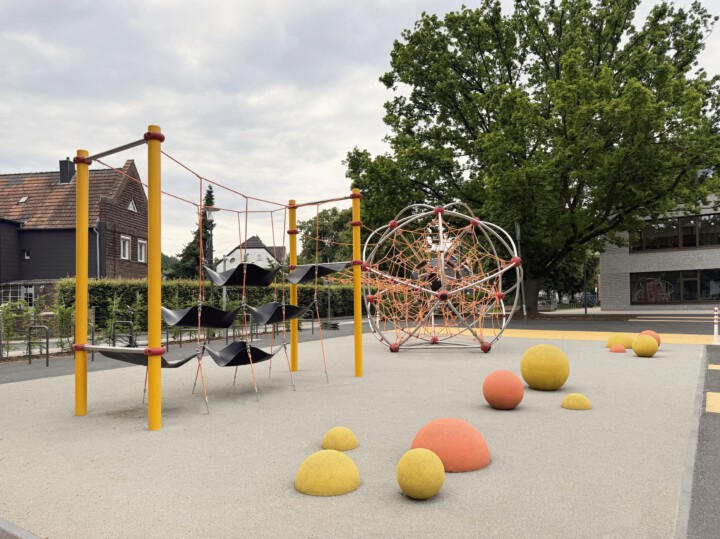
Anne Frank Comprehensive School | Düren
Completion
With the completion of the outdoor facilities, a school campus has been created that naturally combines socialising, physical activity and outdoor learning. Existing trees worthy of preservation have been incorporated and complemented by new plantings. To the south, green, small-scale recreational areas characterise the landscape, deliberately creating a contrast to the open, refurbished existing school playground.
In front of the building, paved paths and square-like extensions create versatile ‘courtyards’ for outdoor lessons, performances and school events. The northern school playground has been comprehensively refurbished and visually linked to the new building areas through a graphic striped motif. This creates an open space that fosters a sense of identity, aids orientation and, at the same time, encourages informal play.
A new, spacious play area complements the existing facilities and creates further attractive spaces for pupils to be active.

09 | 2026 Award
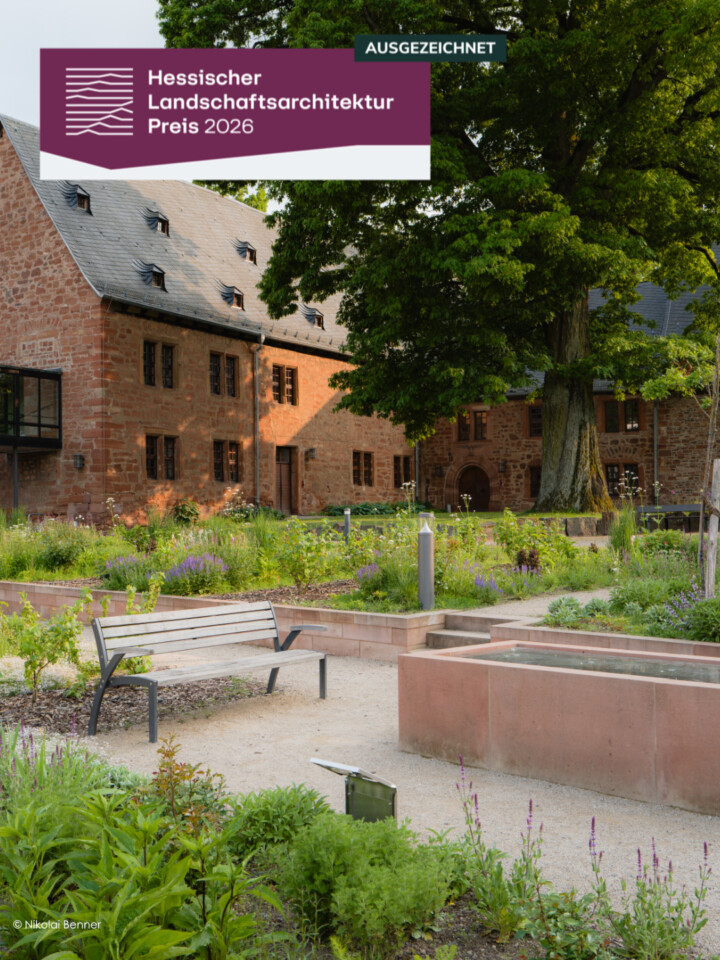
Winner of the 2026 Hessian Landscape Architecture Prize in the category ‘Cultural Landscape and Experiencing Nature’!
We are delighted that our project for the monastery grounds in Frankenberg has received this award. The project has transformed an area previously dominated by traffic into a vibrant open space that uniquely combines history, nature and urban life!
Through the opening up and renaturation of the Nemphe, the restoration of historical spatial relationships and the creation of a diverse wellness garden, the monastery grounds have been given a new identity. The project demonstrates how, through bold decisions, sustainable planning and close collaboration between many stakeholders, valuable spaces for both people and nature can be created. We are particularly proud that this transformation has now been recognised with this award!
09 | 2026 Expansion of the management team
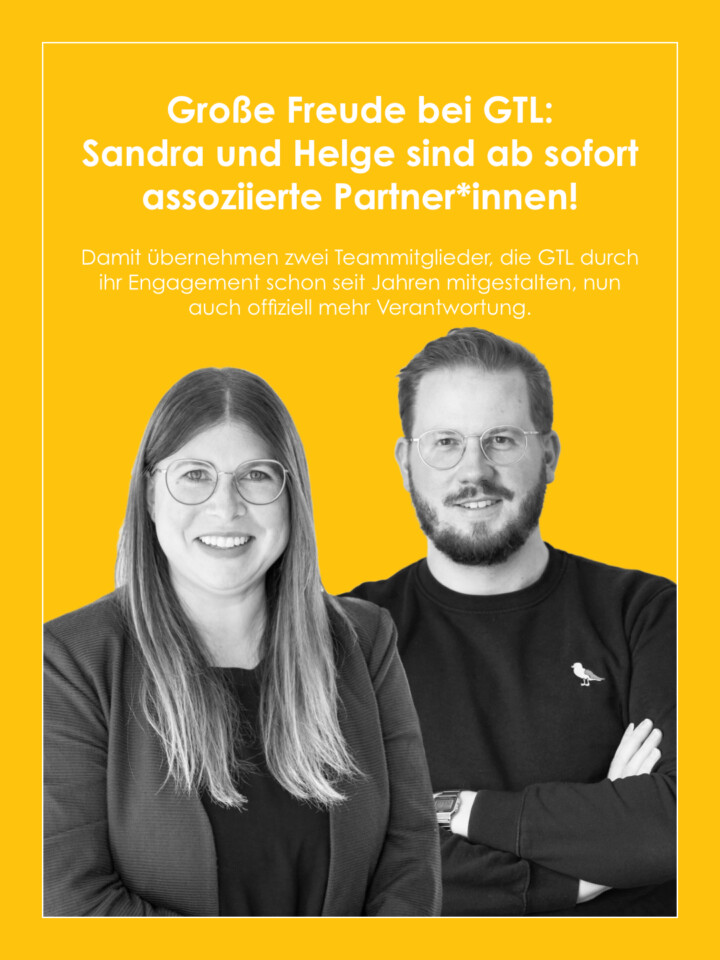
Our leadership team grows!
For us, 35 years of GTL mean one thing above all else: taking responsibility together and making development possible. That is why we are delighted to welcome Sandra from Kassel and Helge from Hamburg as associate partners at GTL.
Both have been shaping our office for years with great dedication, professional expertise and a keen sense of how to create the right kind of space. They take on responsibility, drive forward internal office matters and shape the culture of our working relationships anew every day.
For us, their appointment is a sign of trust, appreciation and a shared future. We look forward to writing the next chapters of GTL’s story as a five-member leadership team.
09 | 2026 Anniversary
35 years of designing open spaces!
We’re celebrating our anniversary!
For 35 years, we have been developing places that bring people together, foster a sense of identity and bring the landscape to life.
What began in 1991 has grown into an interdisciplinary landscape architecture practice with offices in Kassel and Hamburg, a dedicated team and numerous projects throughout Germany and beyond. Over the past decades, we have had the privilege of planning and overseeing town squares, parks, school playgrounds, residential neighbourhoods, corporate sites and landscape spaces – always with the aim of creating places that are functional, sustainable and inspiring.
35 years of GTL stand for continuity and change, for shared ideas, trusting collaboration and the conviction that good open spaces make an important contribution to our society.
We would like to thank all our clients, partners, colleagues and staff who have helped shape this journey with us, and we look forward to the coming years full of exciting projects, new challenges and shared successes.
10 | 2026 Award
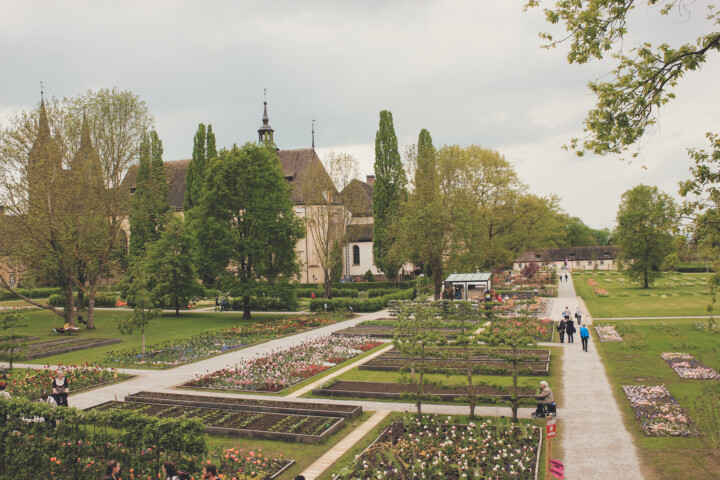
Winner of the 2026 OWL Architecture Award!
The 2026 Ostwestfalen-Lippe Architecture Award recognises an outstanding public space project that uniquely combines history, landscape and urban space. Our warmest congratulations go in particular to the practice @frl_landschaftsarchitektur, which designed this project with its distinctive conceptual and design approach and played a key role in shaping it!
The result is identity-forming open spaces along the historic ramparts, the Weser promenade and in the vicinity of Corvey, which sensitively build on existing features and create new qualities for leisure, relaxation and social interaction.
We were privileged to support the implementation of the project during service phases 6 to 8 and to help turn the planning vision into reality. We are delighted to receive this award and look forward to the newly created open spaces enriching the town of Höxter for years to come.
10 | 2026 COMPETITION
Living in the town centre | Hannover-Davenstedt
1st Prize in collaboration with Office03
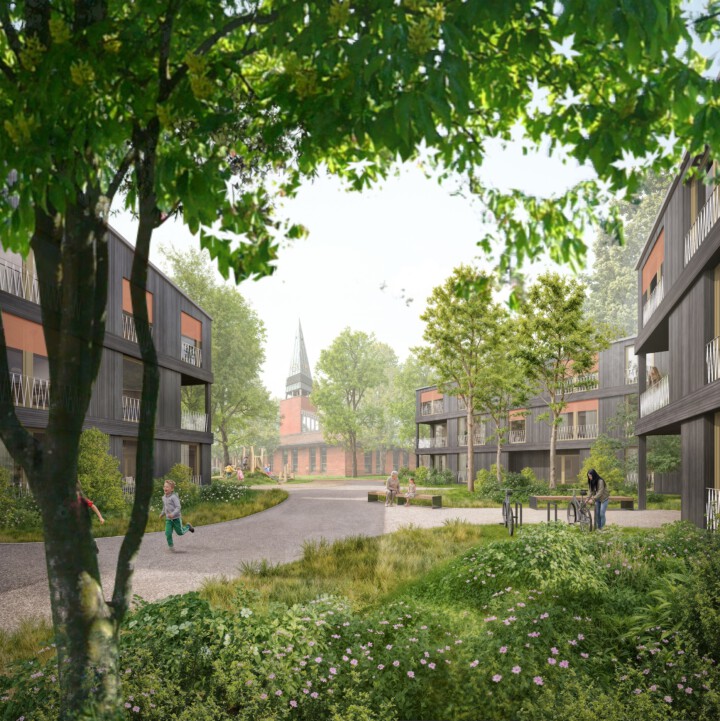
The design’s starting point was the distinctive tree population, which defines the character of the area and has a significant influence on the urban layout. Three residential buildings blend into the existing parkland and form a communal courtyard as the neighbourhood’s central open space. The architecture acts as a bridge between the buildings and the landscape, reinterpreting the brick style typical of the area and creating a spatial interplay between housing and open space.
In addition to 19 residential units, space is being created for a paediatrician’s practice as well as places for socialising and fostering a sense of community. Rainwater is retained on site and allowed to infiltrate the ground. Furthermore, the concept involves assessing existing building components and materials for their suitability for reuse, thereby incorporating circular economy principles into the planning.
Visualisierung: © Adrian Calitz/A.Calitz Visual
07 | 2026 COMPETITION
Pankstraße Comprehensive School | Berlin
1st Prize in collaboration with Atelier30 Architekten
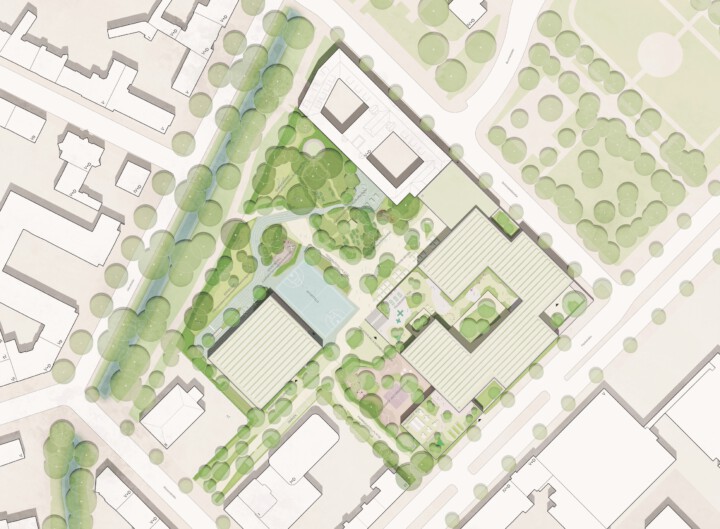
The new Pankstraße Community School is conceived as an open, clearly structured educational space within the urban landscape of Berlin-Gesundbrunnen. Running along the street frontage, it forms a precise urban figure with a forecourt that defines the address and a green plinth serving as a transition between the city and the school. Inside, a central, transparent core comprising a break hall, canteen and communal areas organises school life, whilst clearly structured compartments create flexible learning environments. Particular focus is placed on the outdoor spaces: a versatile, green landscape for learning and activity, featuring trees, meadows, play and sports facilities, quiet retreats and terraces, connects architecture and nature. Rainwater management, biodiversity and climate-adapted design make the outdoor space a sustainable, identity-forming component of the overall concept.
07 | 2026 COMPETITION
Construction of a new fire station and community centre | Wehrheim
Recognition in collaboration with Atelier30 Architekten
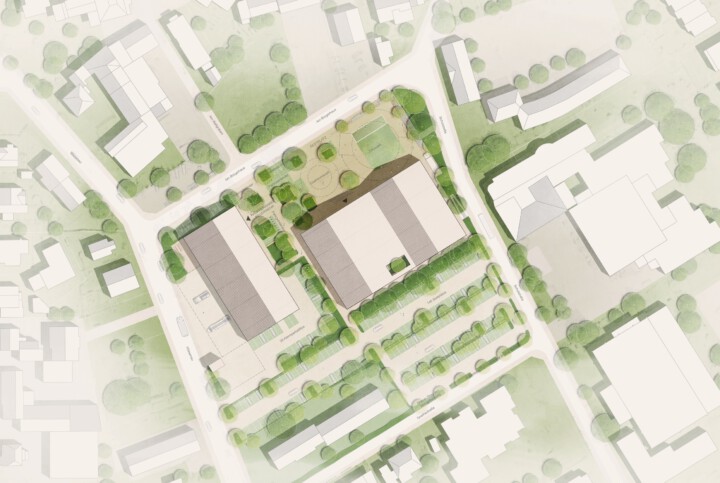
How do you create a place that works in everyday life whilst also providing space for community, events and a sense of identity?
Our answer was not to plan the fire station, community centre and festival grounds as separate elements, but as a cohesive ensemble. Two striking buildings and the integration of the historic existing structures frame a new central square and establish a clear focal point for Wehrheim.
The multifunctional open space becomes the town’s meeting place: as a festival ground, a communal space with trees and seating steps, and as a flexible area for events. The community centre and fire station are deliberately oriented towards this shared focal point, thereby fostering interaction and cohesion.
Robust materials, a contemporary interpretation of regional building culture and a resource-efficient, low-tech approach combine durability, functionality and atmosphere.
06 | 2026 COMPETITION
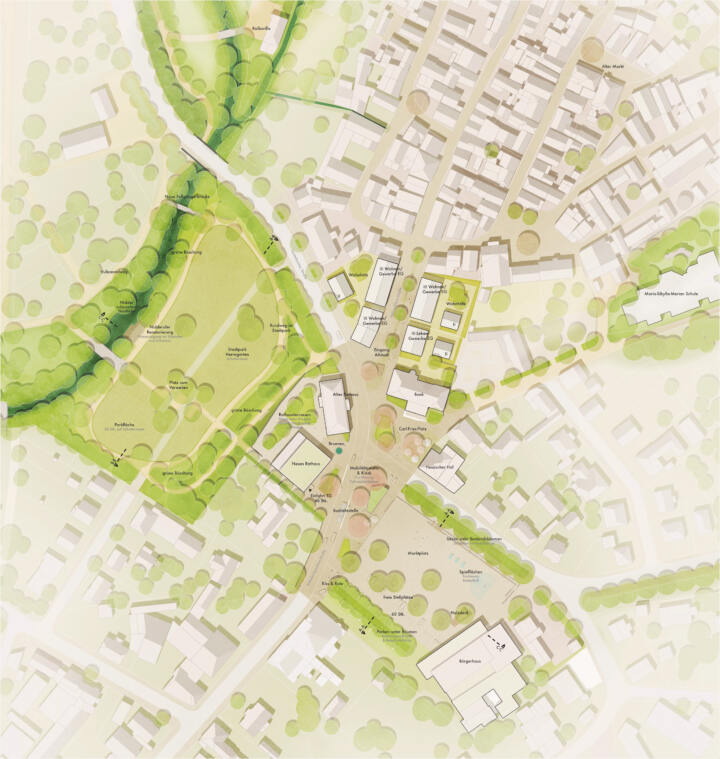
New urban spaces for Ortenberg | Ortenberg (Hesse)
2nd Prize in collaboration with Thomas Schüler Architekten und Stadtplaner
At the heart of the design lies a clear urban planning decision: rather than individual measures, we are developing a cohesive, new public space to serve as a connecting element. This central location acts as a hub, linking Wilhelm-Leuschner-Straße, the town hall, the market square and the historic old town both spatially and functionally.
Particularly striking is the way the square opens up to the landscape. By extending right to the edge of the slope, a publicly accessible space is created with views of the Nidder and the surrounding area – a kind of ‘landscape window’ that allows the town to be experienced in a new way and fosters a sense of identity. At the same time, existing structures are integrated and strengthened rather than replaced.
The result is a new centre that not only organises but also enhances the quality of life: a flexible space for everyday life and events that naturally brings together administration, housing, mobility and open space, and functions as a communal meeting place for the urban community.
06 | 2026 COMPETITION
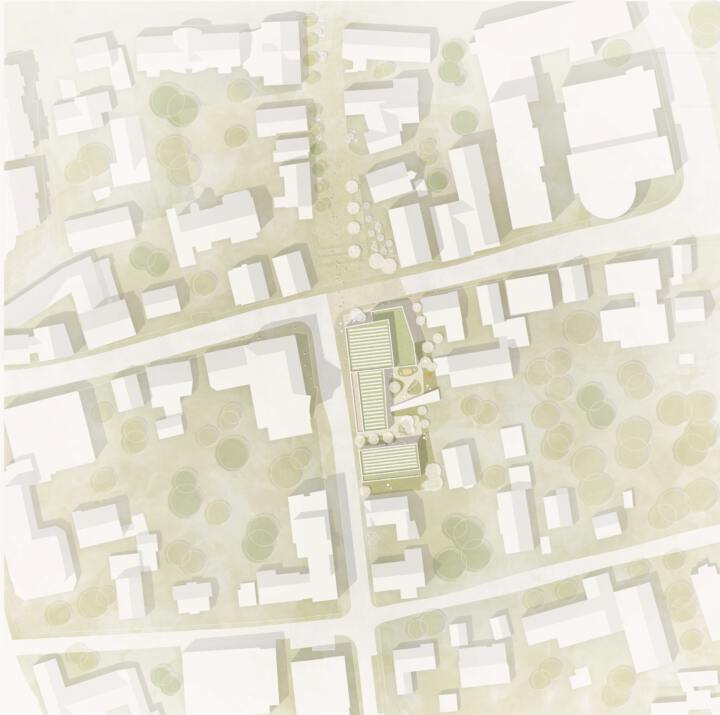
Construction of a new multi-purpose residential building | Filderstadt-Bernhausen
2nd Prize in collaboration with ATELIER30 Architekten GmbH
As a striking urban landmark at the junction of Bernhäuser Hauptstraße and Volmarstraße, the new building marks the start of the pedestrian zone and brings together public space, residential and commercial functions to form a vibrant ensemble. An inviting forecourt enhances the location and brings the neighbourhood to life with restaurants and events, whilst a clearly structured building with flexible living arrangements and sustainable hybrid timber construction enables future-proof uses. The focus is on the open space: the green inner courtyard, as a communal hub, offers space for socialising, play and retreat. Tree planting, green islands and shaded seating areas create a pleasant microclimate, complemented by lawns and a communal barbecue deck. This creates a high-quality, permeable living space that connects the neighbourhood and the city.