
Officebuilding GIZ Campus | Eschborn
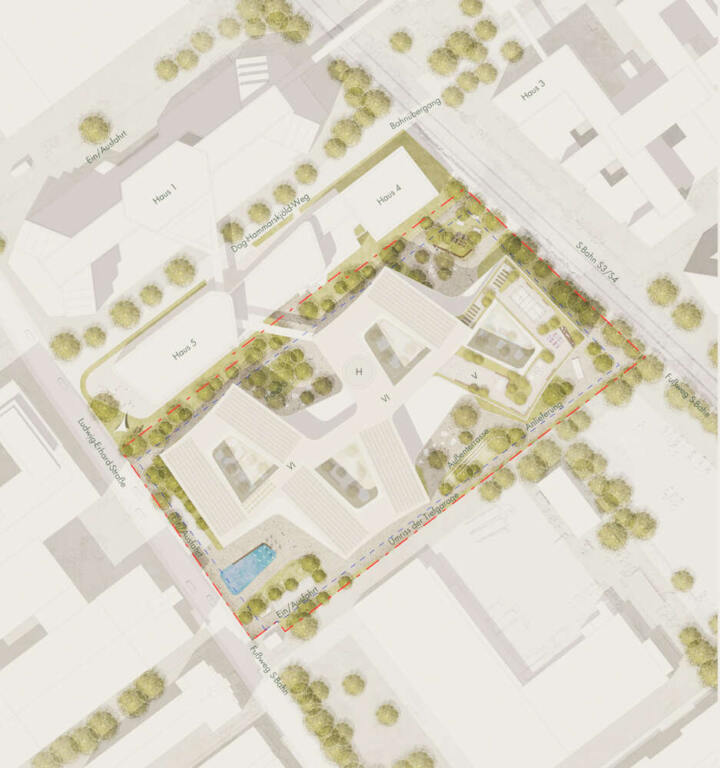
2. Prize I Officebuilding GIZ Campus
Eschborn
In collaboration with schneider + schumacher
The open spaces flow around the new GIZ building in soft lines. Clinker terraces and gravelled areas interact with green spaces overgrown with trees to form a spatially attractive sequence of open spaces that can be used for a break in the open air as well as for concentrated work at individual places or a meeting in the shade of the trees.
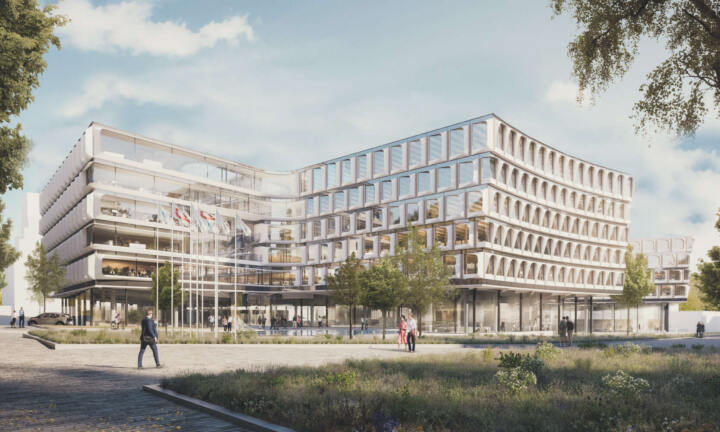
The basic shape of the building creates clearly defined outdoor areas, each of which sets different focal points for their uses:
- The forecourt as a prelude and welcoming place is paved to the necessary extent, and offers enough space for arriving groups, waiting people and cars driving up. In the center, a decorative bed with moisture-tolerant plants such as brightly flowering irises and tall sedges collects and cleans the rainwater from the adjacent areas.
- The courtyard in front of the staff restaurant is screened from the street by a gently rising embankment with seating steps and a planting at its back. The size of the courtyard is designed in such a way that individual tables can be placed slightly apart from each other so that they can also be used as desks or for meetings.
- The delivery courtyard is screened off at the south-eastern corner.
- The two northern courtyards are limited by the wooded islands and are also less sunny overall due to the building shade, which is beneficial during breaks as well as when working during the warm months.
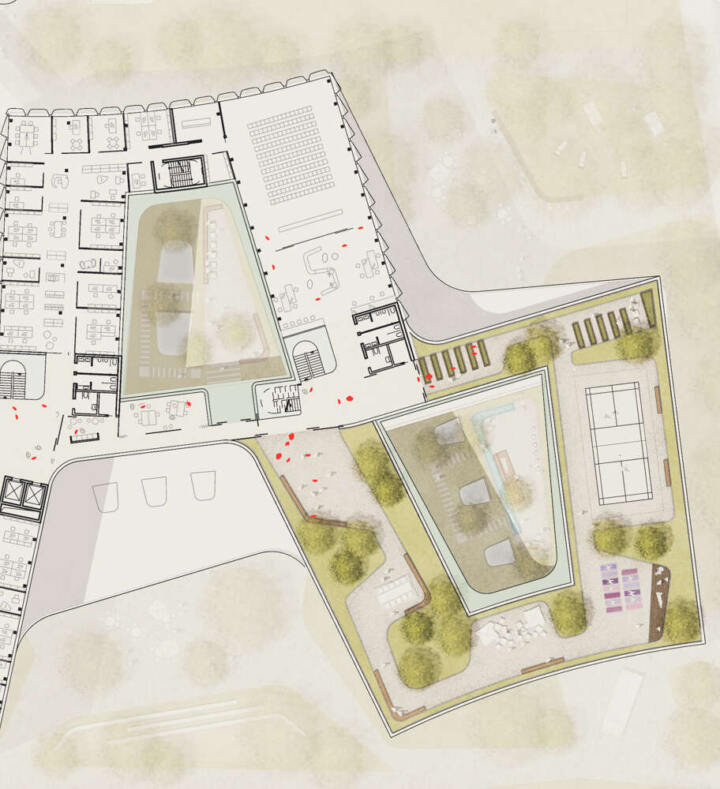
- The courtyards are also designed to move the small informal meetings in the tea kitchen outside in a very short distance. The terraces are embedded in a shade planting at least waist-high and screened by individual large shrubs for privacy.
- The large roof area in direct spatial connection with the co-working and event area combines ball sports and gymnastics, breaks and urban farming as well as the possibility of working outdoors to enable informal gatherings with different groups. The individual areas are arranged in such a way that they interfere with each other as little as possible. Directly adjoining the corridor area is a large event terrace, which could also be enlarged if necessary.
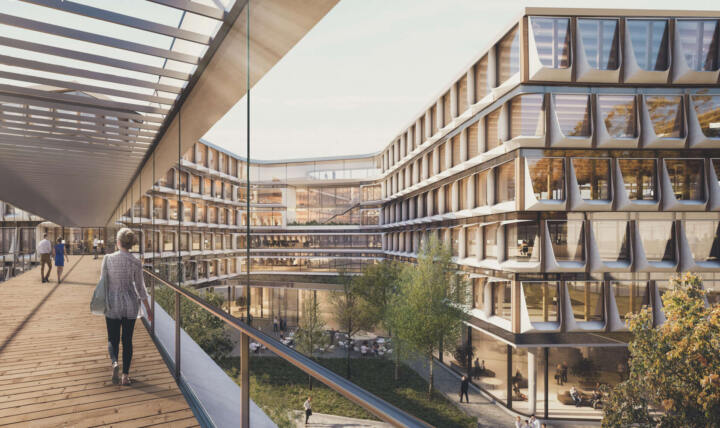
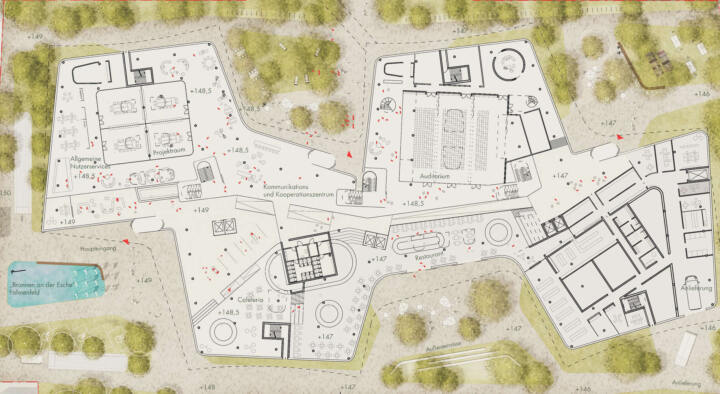
The planting concept relies on a low-maintenance and robust strategy that can best be described as “controlled wilderness with increased biodiversity”. This broad ecological amplitude begins with the roofs, which develop into dry grasslands with a high diversity of species and a large number of Red List species through special substrates and hay seeds (also on the solar roofs!), and ends with the flowering wet meadow of the forecourt.
All green spaces are designed as species-rich meadows or site-appropriate woodland islands with a flowering undersow of native wild shrubs and become an important stepping stone of urban biodiversity. Where possible, surface water is channelled openly and infiltrated into hollows.

Wolffskeelhalle | Markt Reichenberg
1.Prize | Wolffskeelhalle
Markt Reichenberg
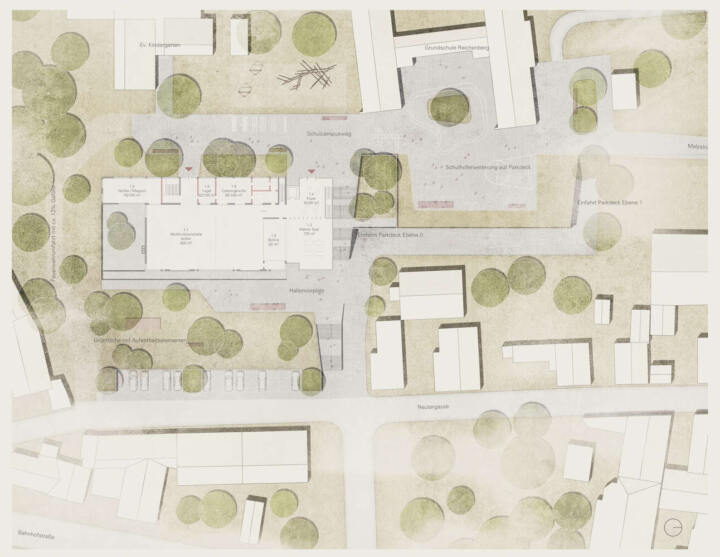
The surrounding open space of the Wolffskeelhalle is structurally divided into two levels, a “lower” level on the 2nd basement of the hall and an “upper” level on the ground floor. A spacious staircase in the context of the new building connects these levels with one another.
Lageplan © GTL

The “lower” level creates a strong connection to Bahnhofstrasse and consequently to the village center and thus brings the refurbished, converted Wolffskeelhalle more into focus, making it more present and transforming it into a clear landmark. The foyer, in front of the hall that serves as a residential stay, gives way to a public, sloping green space. A forecourt leads the visitors to the main entrance and offers space for different uses. In addition, it provides a qualitative free space for the premises of the youth center, the clubs and the foyer. A spacious wooden deck as a living element offers a view of the surrounding landscape.
Pedestrian and car access from the direction of Bahnhofstrasse and Reutergasse are clearly separated from each other. With the car you are clearly guided to the new, two-story parking deck.
The new parking deck slides into the existing embankment, creating a schoolyard extension on the “upper” level. Through this measure, the long, narrow open space of the school is selectively expanded, which creates different uses and qualities. The “upper” level is understood as an axis of open space which connects the school, kindergarten and Wolffskeelhalle to each other and serves different usage requirements. The result is a space that can be used in a variety of ways, a connection axis that also takes up the surrounding path network and joins them with one another to create different spaces that invite you to linger.
Due to the new parking deck, the existing trees on the embankment are no longer required. However, this measure is compensated by a large supply of new green spaces with numerous new plantings.

Landmark Turbine factory | Mannheim
3. Prize I Landmark Turbine factory
Mannheim
In collaboration with netzwerkarchitekten GmbH
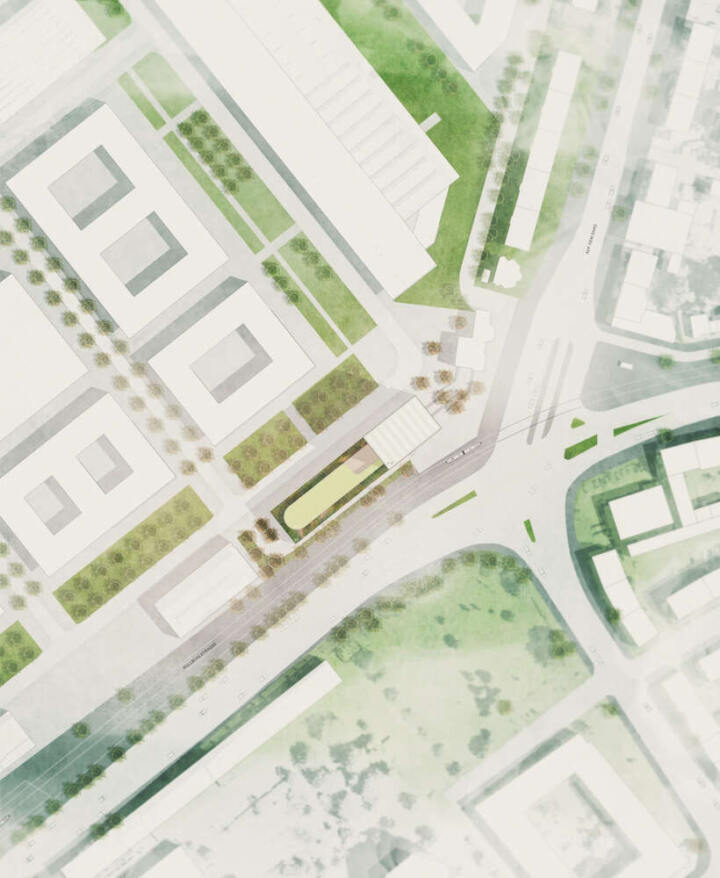
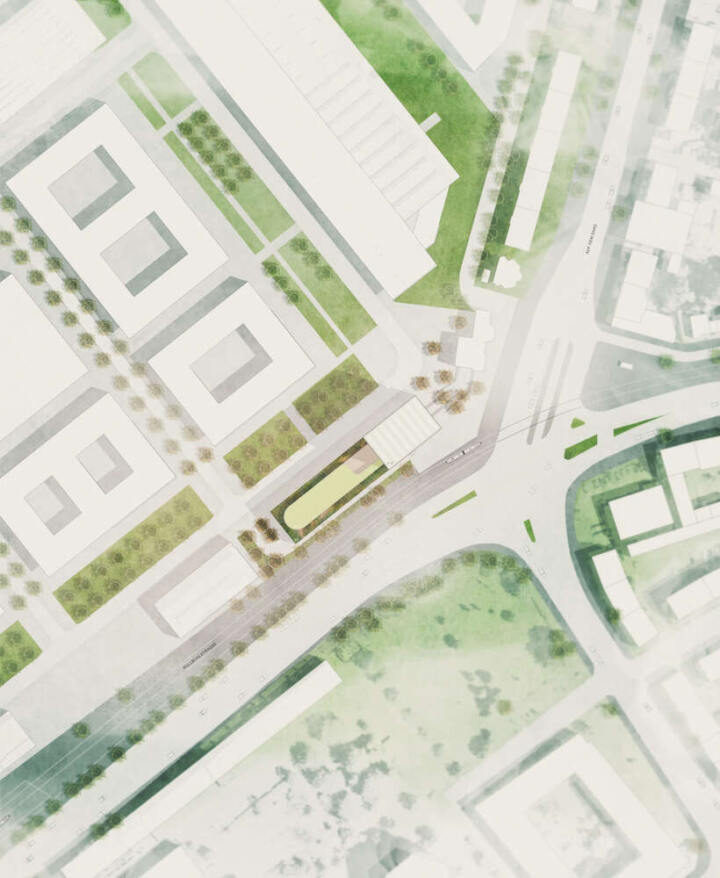
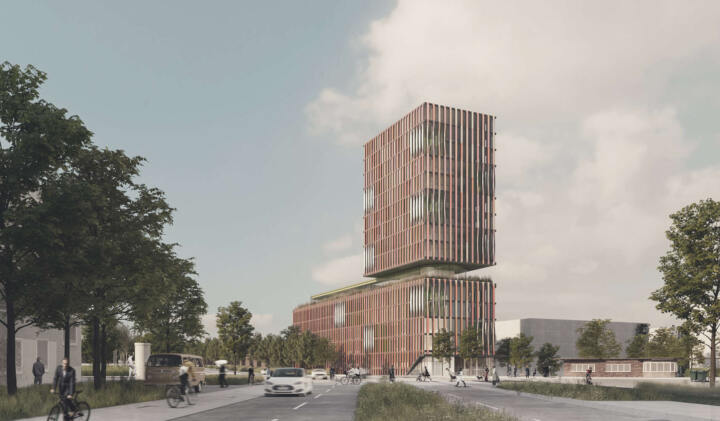
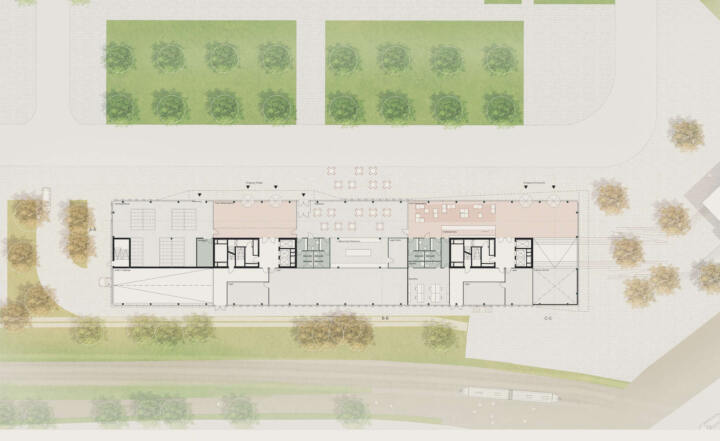
The ‘landmark building’ is designed as a floating volume above an elongated 6-storey plinth building. The base provides the boulevard extension of Rollbühlstrasse with an urban setting and enables the clear contouring of the turbine plant area. An inviting and flexibly usable ground floor zone enables the landmark formation and public activation of the quarter with restaurant and outdoor catering.
The entrance foyer of the high point opens up in a glass corner. Here, a generous staircase spans the historic gatehouse and marks the urban opening into the turbine factory. A special floor with a lush green roof garden for the conference area is inserted via the ‘horizontal cut’ in the building cubature. Ceramic pilaster strip in the color canon of the bricks are an identity-forming link to the Turbinenwerk area.
Lageplan © GTL, netzwerkarchitekten
Train Station | Soest
2nd Prize | Train Station Soest
Soest
In Collaboration with Jankowski Bürgener Architekten Stadtplaner PartmbB
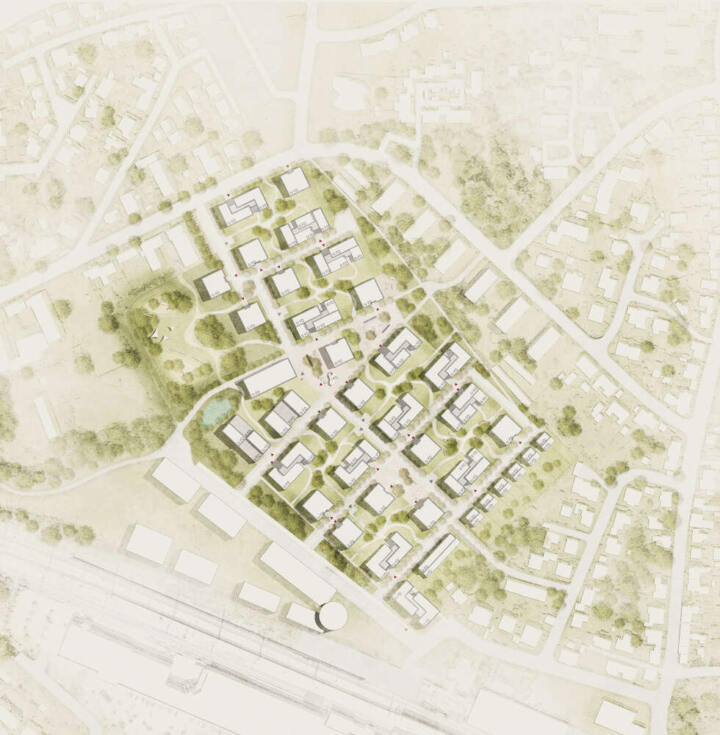
The modern urban expansion of the old city of Soest has so far been carried out by primarily building single-family houses. Consequently, no independent urban identity could develop alongside the historic city center. However, for the new station district in Soest, the design aim is to develop its own character despite a difficult location.
Lageplan © GTL
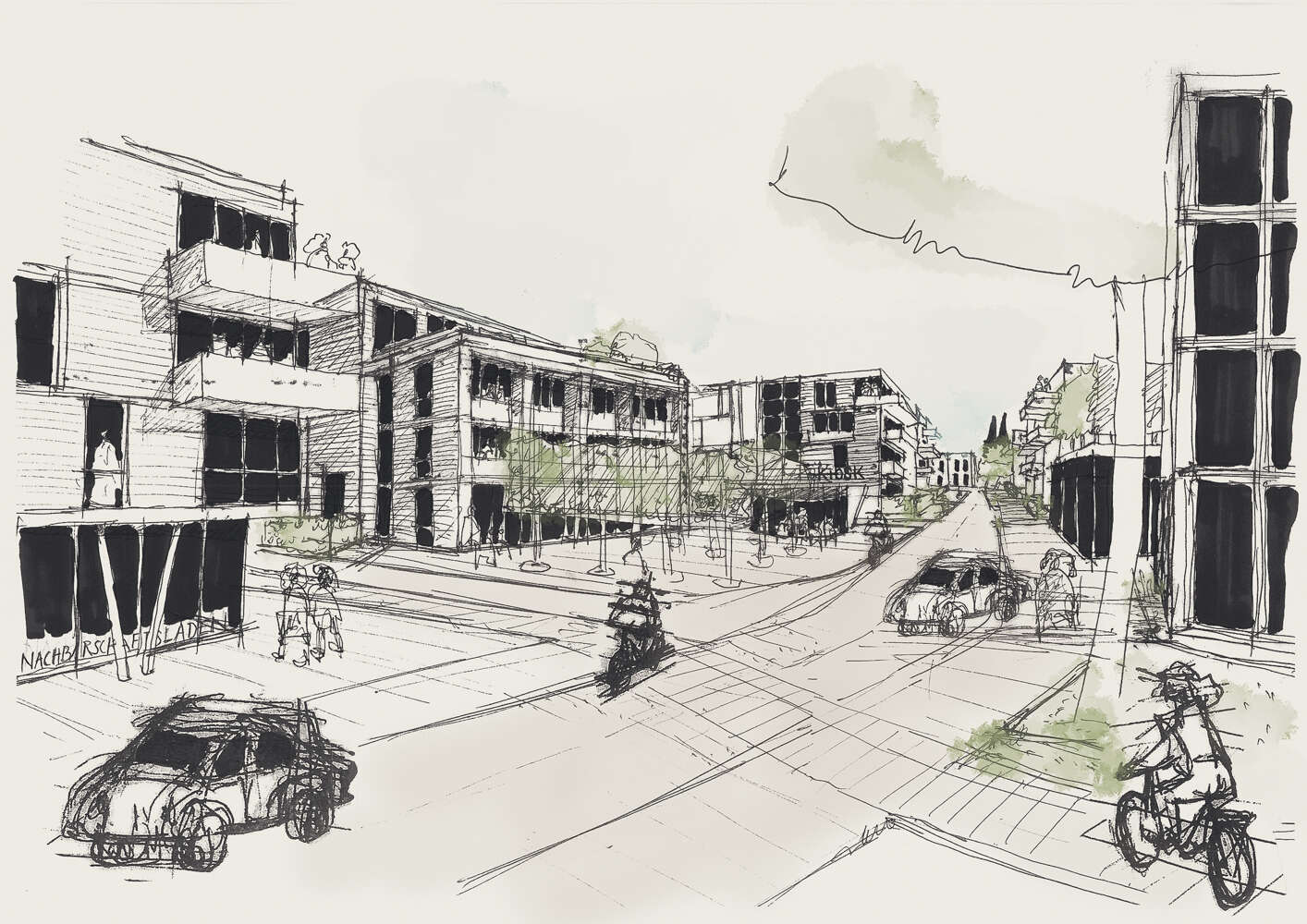
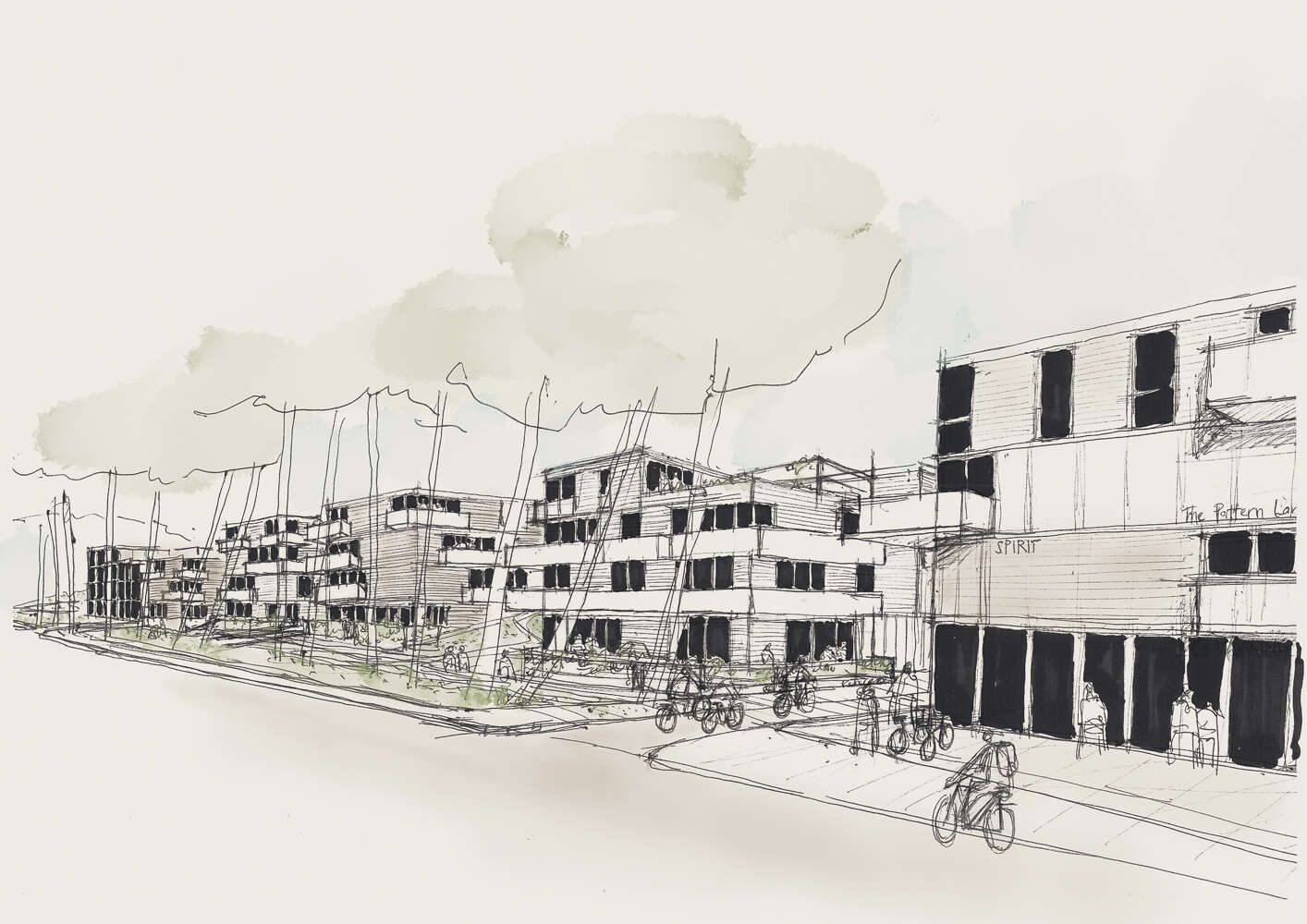
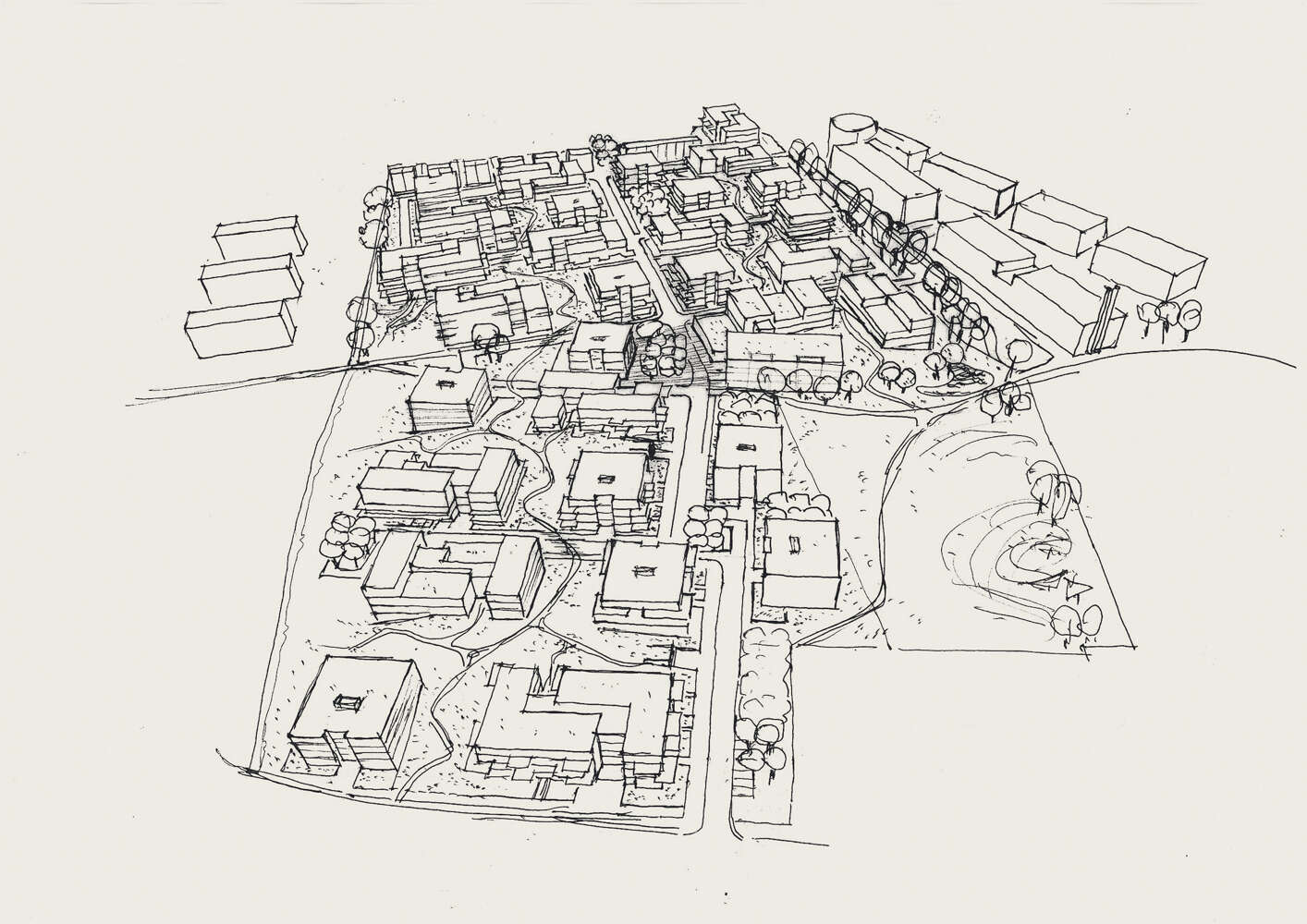
The new station district is populated by various clusters. The open block structures create diverse, varied and engaging (optical) relationships between the urban and landscape areas, which are considerably reinforced by the diverse levels and qualities of use. The clear network system creates lines of sight to the core city with the St. Patrokli Cathedral and the surrounding urban spaces. A central square forms the heart of the quarter.
The landscape concept relies on the formation of differentiated green structures corresponding to the distinct living areas, and reconnecting them to the network of open spaces. In contrast to the development, the open space is planned with an organic design language.
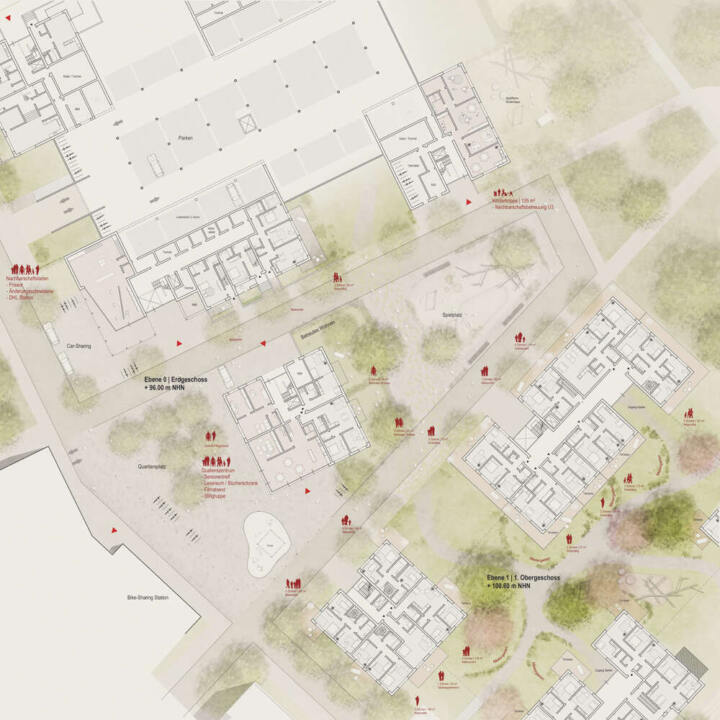
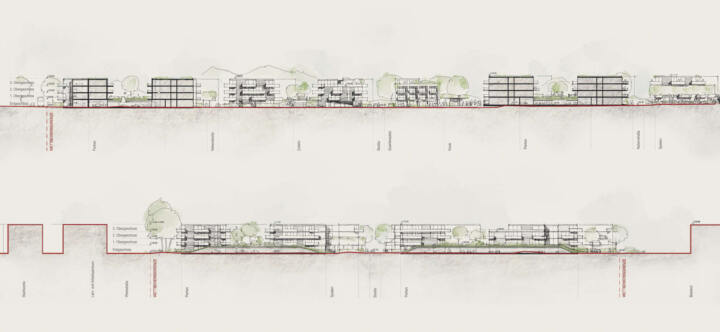
The quarter illustration is painted by its landscaping: an up to 8 m high plateau embankment which is structured with plant groups and playgrounds, opening up new perspectives and visual connections to the surrounding area and the cathedral in the city center. This fixed point of reference is always visible from the access road.
The heart of the quarter as a central open space acts as a bracket between the neighborhoods to the north and south. The traffic areas are planned as “shared space” for all road users.
With the communal inner courtyards and the individually designed private open spaces in the form of tenants’ gardens, terraces, loggias and roof gardens, in addition to the public green connections, the design offers various quality open spaces that caters for the different population groups in the neighborhoods and in the quarter distict.
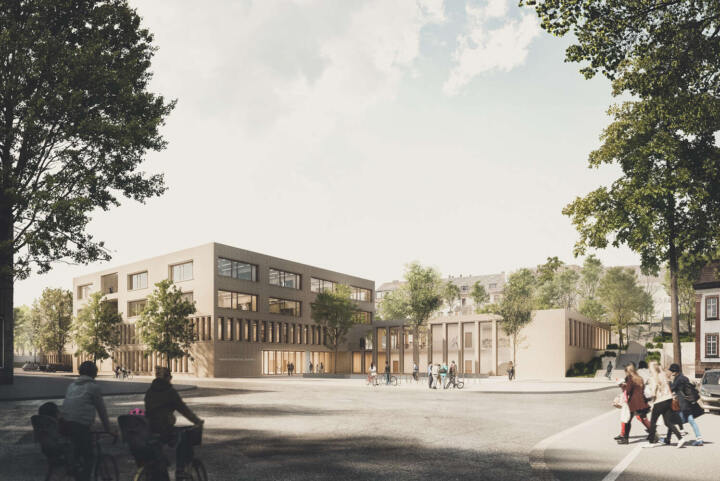
Community School | Neunkirchen
2. Prize I Community School
Neunkirchen
In Collaboration with troi Architekten, Aachen
The town center community school is being redefined in terms of structure and content. The new design emphasizes this notion with an assertive, and striking architecture. Urban spatial edges are included and partially expanded. The building blends harmoniously into the intended construction window.
The forecourt created by the new school building along Lutherstrasse forms a clear landmark as public space, and functions as a meeting point and lounge for the students. A high-quality, public and urban space will also be created for the entire quarter.
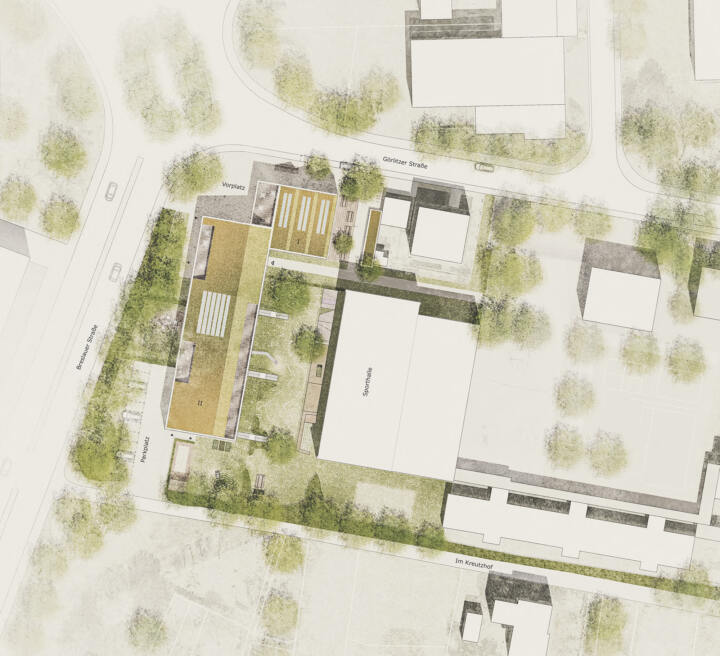
Lageplan © GTL
The playground is distinctly framed by the existing terrain and is accessed from the 1st floor. A generous, topographically modeled lawn divides the playground into different areas of use (including sports, school garden, and recreation area) and additionally serves as a lounge and activity area for the students.
An important existing tree in this area is being preserved and supplemented by further tree plantings to create a loose tree grove.
Along the existing wall, tribune-like places to stay are created, from which one can oversee what is happening in the playground. A climbing wall is also added on it to encourage movement. Alternatively, this area can also be used as an outdoor classroom.
A school garden is located in front of the dining room, which teaches the pupils the subjects of nutrition, health and understanding flora through practical use.
Family Center, Learning Workshop and Daycare Center, Waldau Campus | Kassel
1st Prize I Family Center, Learning Workshop and Daycare Center, Waldau Campus
Kassel
In collaboration with pape + pape architekten
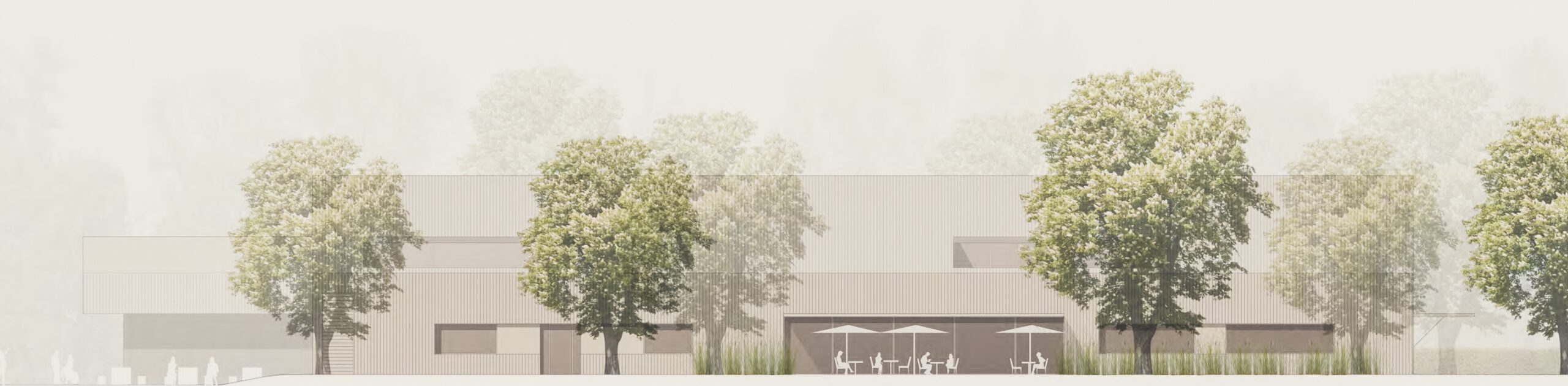
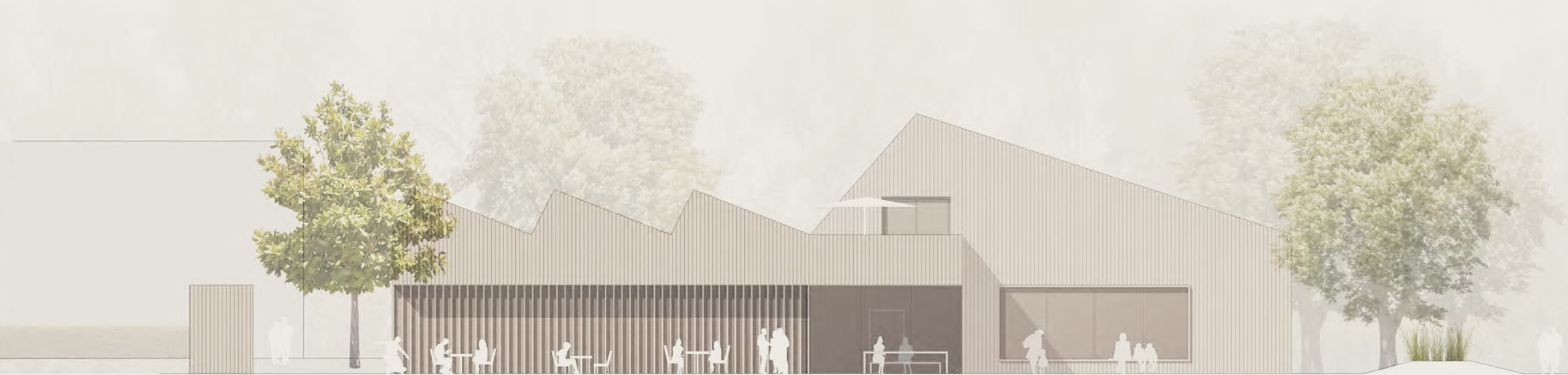
The L-shaped building forms two structural angles parallel to the northern and western boundaries of the site, creating an inviting forecourt encompassing an entrance area under a canopy. This attractive outdoor space can be used for big events. Large glazed openings in the learning workshop, in the multifunctional room, and facing the campus grounds generate transparency, allowing the building to enter into direct dialogue with its surroundings.
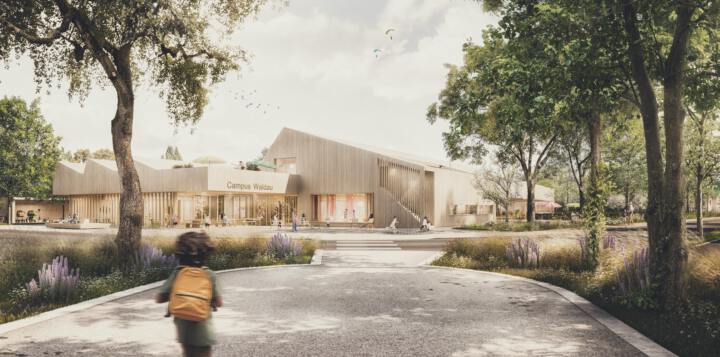
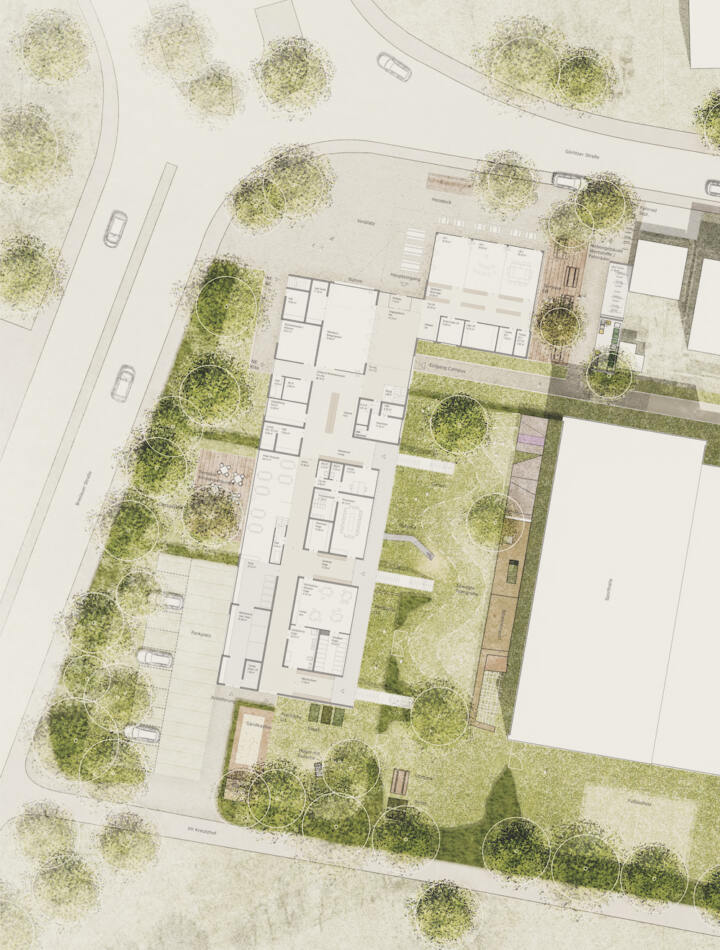
The building volume and interior layout of the new family centre lay down clear categories and zones within the open space. A spacious forecourt has plenty of room for parents’ daily chat and, when the occasional performance takes place, offer somewhere to meet and talk during the interval. A lounging deck, slightly off to the side, is destined to become a popular meeting place for the kids.
On the quieter east side child-friendly bench-table combinations offer space for doing homework or craft activities outside. Between the new building and the gymnasium there is an outdoor playground and romp area for the daycare children. A linear playground sculpture offers opportunities for all age groups to stimulate all their senses through play, via various climbing and balancing options over the covered sandpit, to cosy boxes to which children can retreat.
A contiguous area of undulating lawn provides space where kids can whizz around and leap about. If necessary, the area for the under-3s can be separated off from the rest of the playground by low wooden gates. This area has its own sandpit with a deck, a playhouse and a small grassy slope with a slide for toddlers. The terrace in the eating area is set in a vegetable patch or ‘snack garden’ that provides a rich supply of delicious fruit and herbs, screened from the rest of the grounds by low fruit hedges. Fruiting shrubs and trees also grow on other parts of the site.

"Blasius-Blick" residential district, Kaufbeuren
1. Price | “Blasius-Blick” residential district
Kaufbeuren
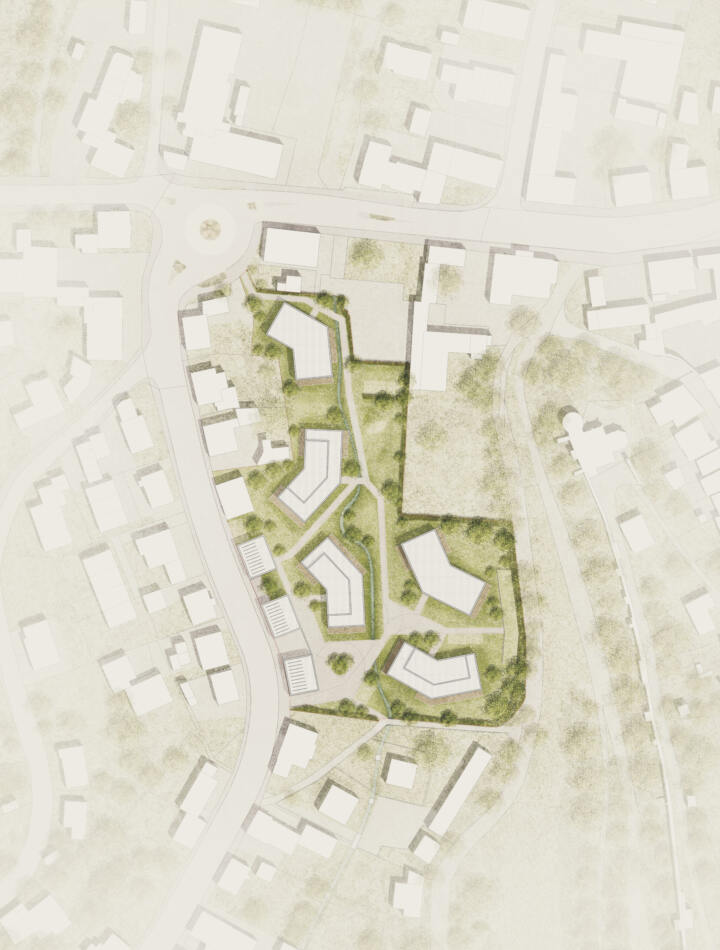
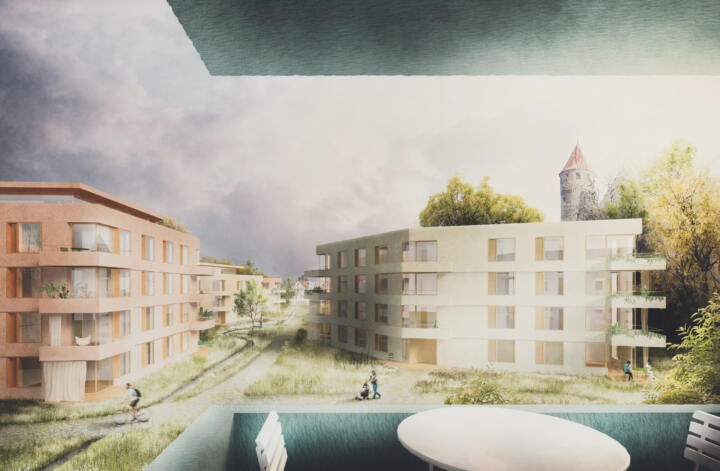
This new residential district in Kaufbeuren, located near the old town centre, is designed to offer future residents an attractive, locally rooted, and climate-friendly area in which to live. In all aspects of the project, attention has been focused on providing accessibility for all and contemporary design.
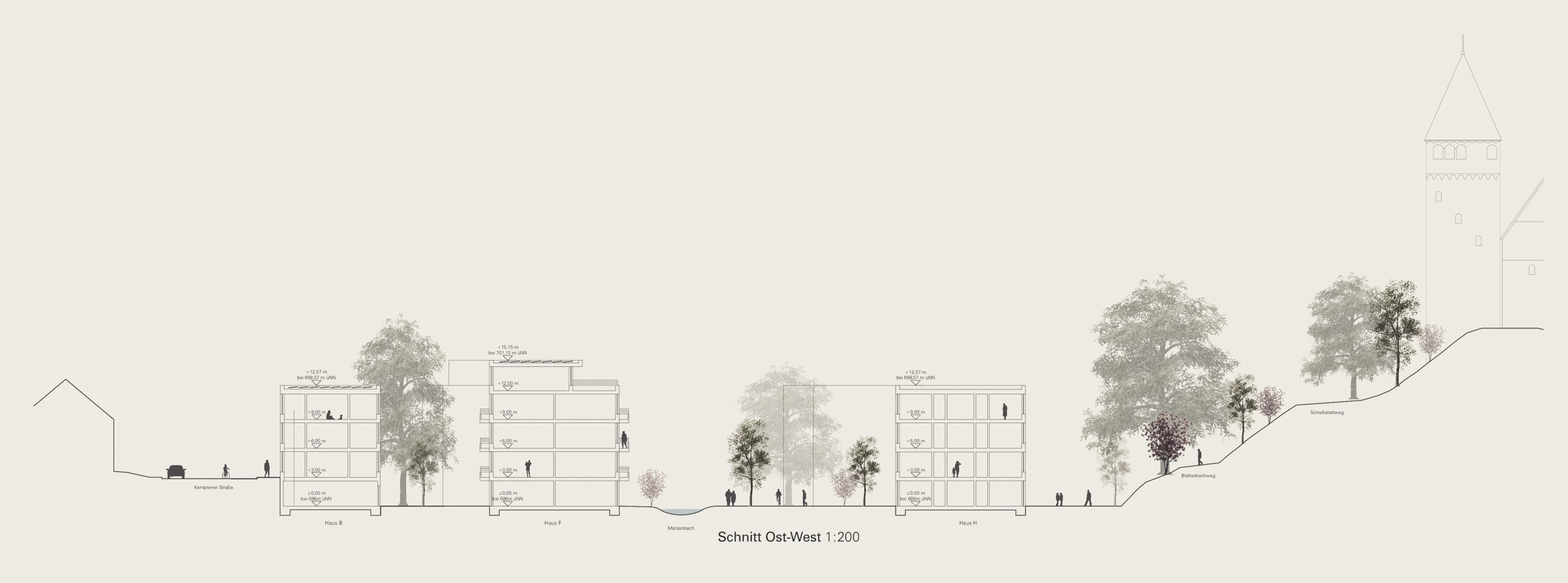
The Märzenbach stream has been used as a structuring element in the landscape design, and proposed re-wilding will turn it into a natural and attractive asset. The spaces between the residential buildings visually flow into each other through a sequence of trees, flowering meadows, paths and other green spaces, all designed to echo the stream’s character. Alongside play equipment for children, there is also potential for games and recreational facilities for people of all ages in the public space located at the core of the neighbourhood’s landscape. The inclusion of picnic tables, among other things, encourages social interaction. In contrast, there are generous private gardens too, located at a discrete distance from the residents’ green space.
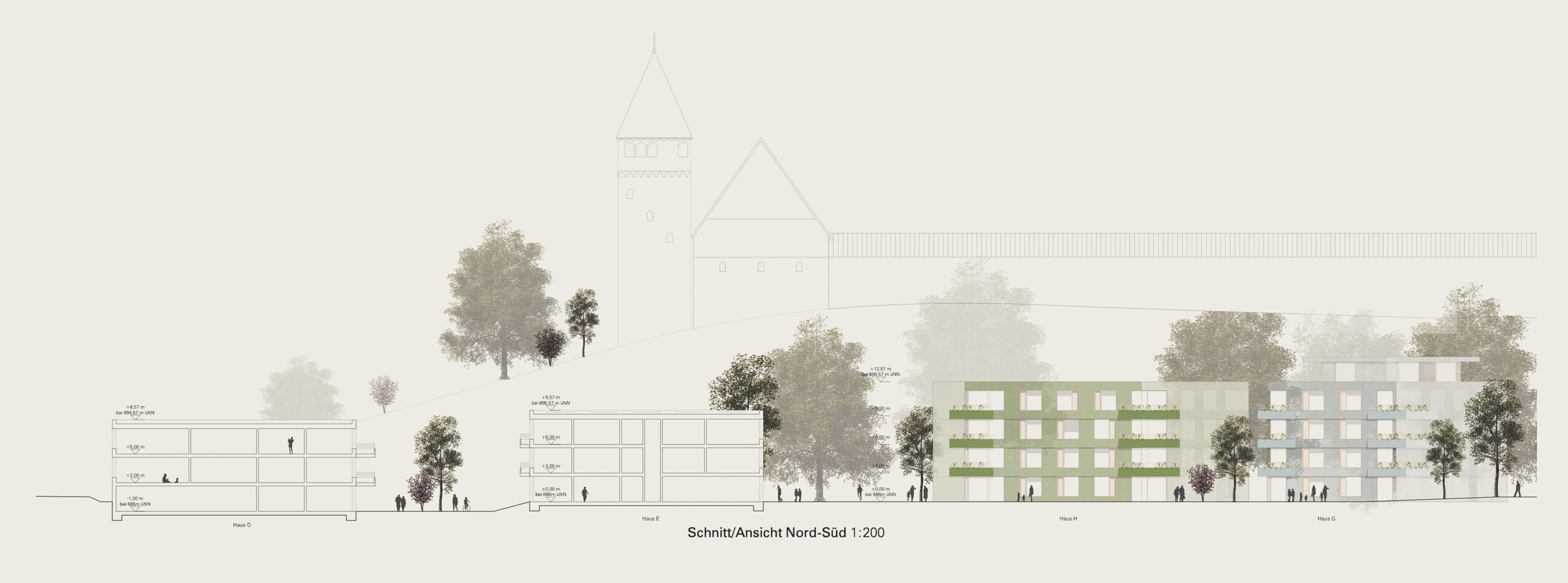
Private cars have been kept out of the neighbourhood and links established to major existing networks of footpaths and cycle paths. In addition, bicycle-parking facilities are available at various locations. Nevertheless, access for emergency vehicles, delivery traffic and other traffic for all newly proposed areas and buildings is achieved via safe and reliable routes with appropriate surfacing used for access and in the vicinity of buildings. These hard-landscaped areas are kept to a minimum since they serve only this purpose as well as providing accessible approach routes, with alternating cellular paving and greenery blending harmoniously together.
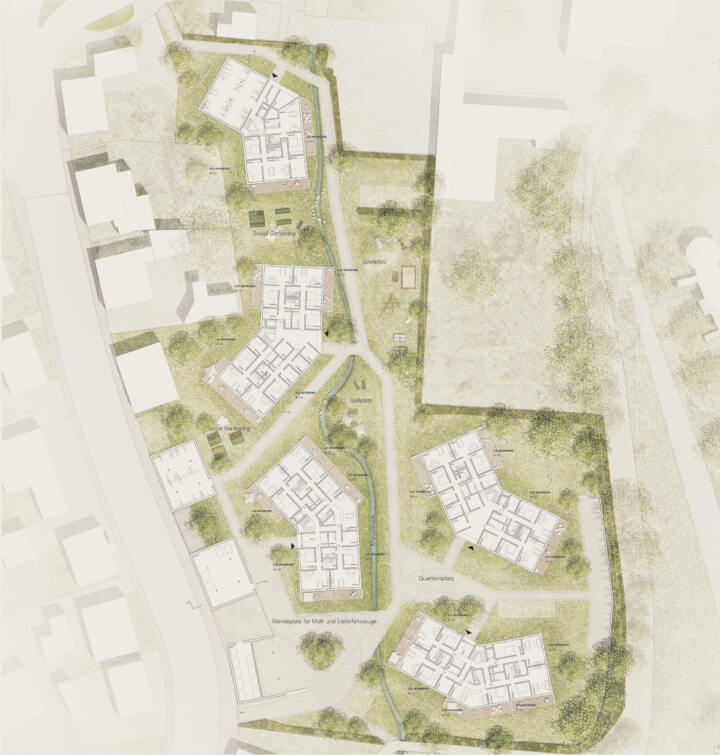
The theme of landscape runs throughout the entire residential quarter, and assembling the residential buildings in a meandering arrangement helps to give contour to the overall urban structure. The screening buildings located along Kemptener Strasse serve to buffer the area, creating a quieter and more sheltered environment within. It is imperative that the proposed apartments should not only be climate friendly, but affordable and attractive too. Responding to the outdoor spaces, apartments are oriented two ways, offering a range of views of the Blasiusberg and historical buildings beyond the immediate neighbourhood. Individual blocks are ideally suited to this, with their compact structure, monolithic construction method and energy efficiency, as well as step-free access.
The current tendency to work from home is taken into account in this forward-looking design concept by providing ‘joker’ rooms that offer people the option to work from home, or to use their space more flexibly. Through a mix of various-sized apartments, a social blend can be created, which helps to underscore the goal of creating stable, communal living.
Through the combination of compact buildings, a simple and thermally robust monolithic construction method, regenerative energy sources, and an energy-efficient BlueGreen building and landscaping concept, this project guarantees a forward-looking climate-friendly development.
High-Rise Marienplatz| Darmstadt
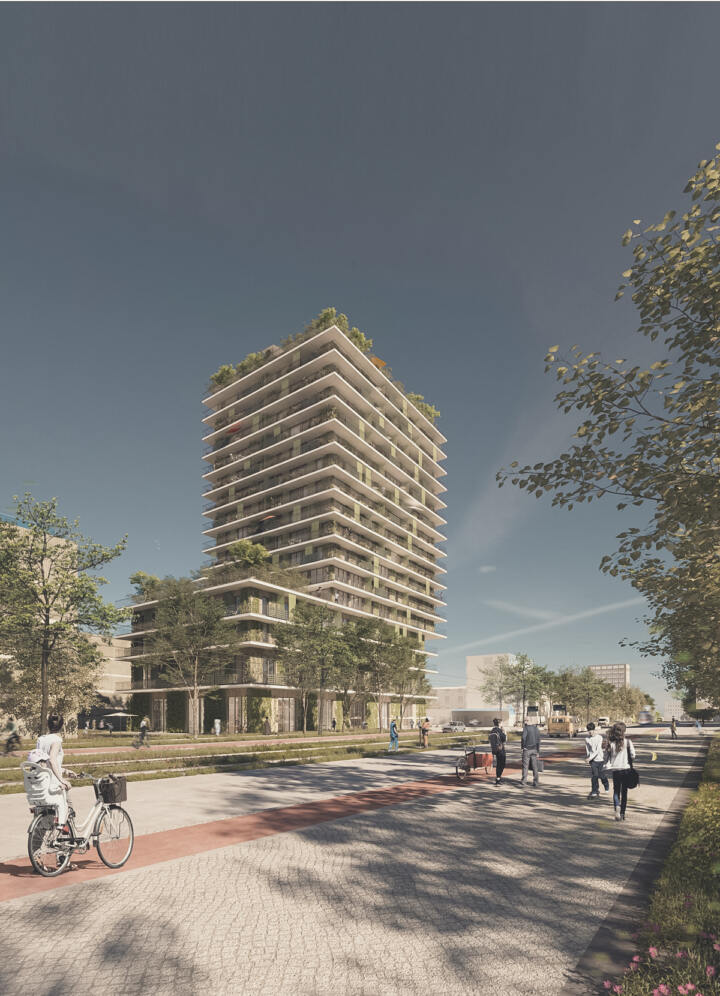
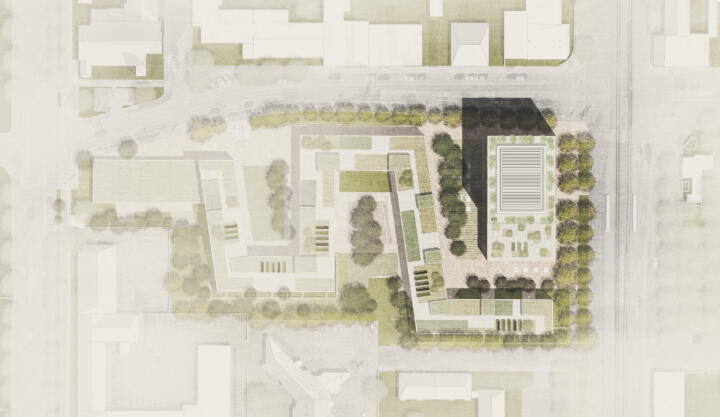
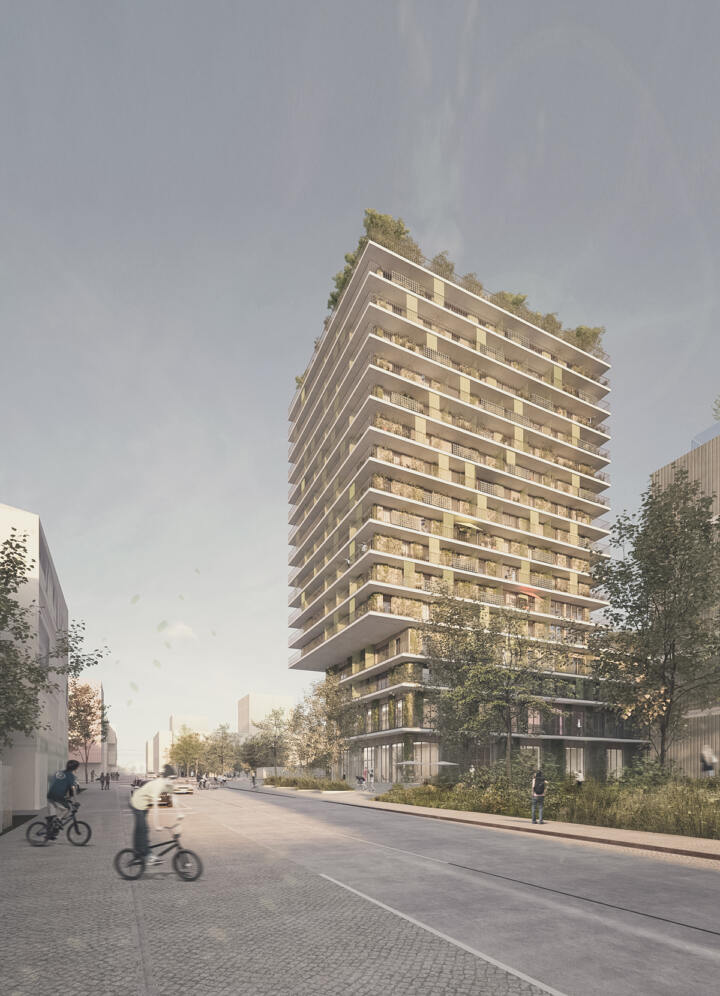
1.Prize I High-Rise Marienplatz
Darmstadt
This new high-rise building creates a link between Darmstadt’s publishing district and the city centre, while anchoring the project in the existing urban context.
The characteristic profile of the high-rise, with the lower four storeys set back, will make it a prestigious address for both residences and offices. The high-rise consists of a 4-storey plinth base, plus a 12-storey block rising from it. The plinth mirrors the eaves height of the neighbouring building thus establishing a relationship with its urban context. The top of plinth is planted with a roof garden that corresponds with its neighbour too. Another feature of the high-rise block are the 1.7m deep balconies that run round the building. Permanently installed planters here are intensively planted, engendering a garden-like atmosphere, shading the façade and creating a microclimate. This greenery is further enhanced by a generous roof area, the distinctive design of the terraces, and a row of trees along the outer edge of the penthouse terrace. The aim is to use all resources judiciously in order to create a sustainable building.
The space surrounding the building is typified by a square with some areas covered in grass pavers, and informal groups of trees. Benches beneath them are designed to encourage people to linger a while. Bicycle parking is arranged along the façade and the traffic routes. The green façade at ground floor level helps to tie the external landscaping into the building.
Cuno-Raabe School | Fulda
1.Prize + Surcharge I Cuno-Raabe School
Fulda
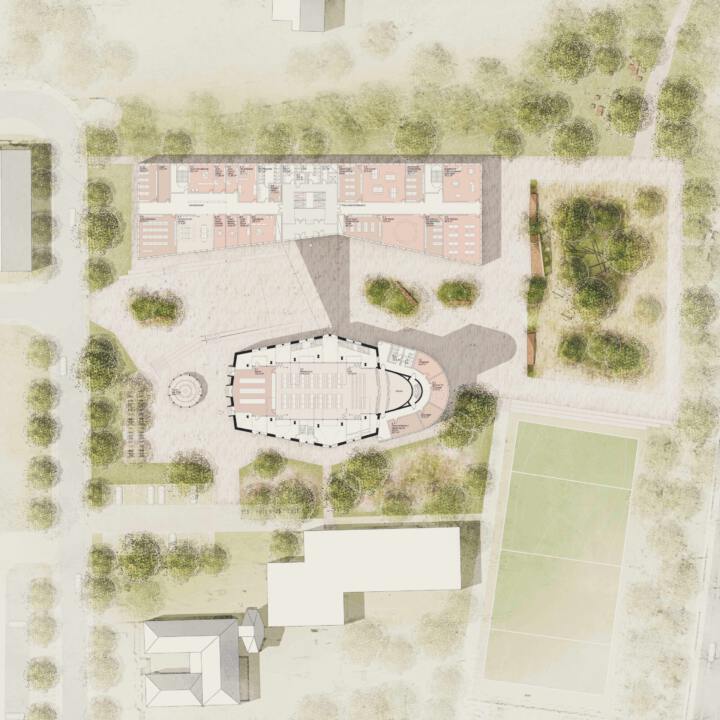
The redesign of the Cuno-Raabe School in Fulda encompasses a wide range of issues. Alongside erecting buildings, establishing fire compartments and escape routes, and generating an energy concept for the buildings, the external spaces offer high-quality, efficient and sustainable design. All this presents an opportunity to put the former church – a heritage listed building with a strong identity – to a new use.
The new building, which forms the northwest extremity of the site, is being developed in conjunction with the existing church building. To bring together various internal uses – such as classrooms, admin rooms, staffrooms, a school canteen, plus a teaching kitchen and other spaces – the church’s volume is to be retained, and inside it a “house-in-house” principle will be applied. While the substance of the church will continue to provide protection from the elements, a separate building that meets the requirements for new sustainable buildings will be built inside. This will later house a school canteen, an auditorium and on the upper floor, a kitchen, areas used throughout the day, and the library. This eliminates the need for a costly energy retrofit. The bridge connecting these two buildings also creates an important external element. A fascinating interplay of façade materials and landscaping is achieved through juxtaposing the materiality of the brick church façade with that of the external areas with alternating wood, textile sunshades, and light concrete block paving.
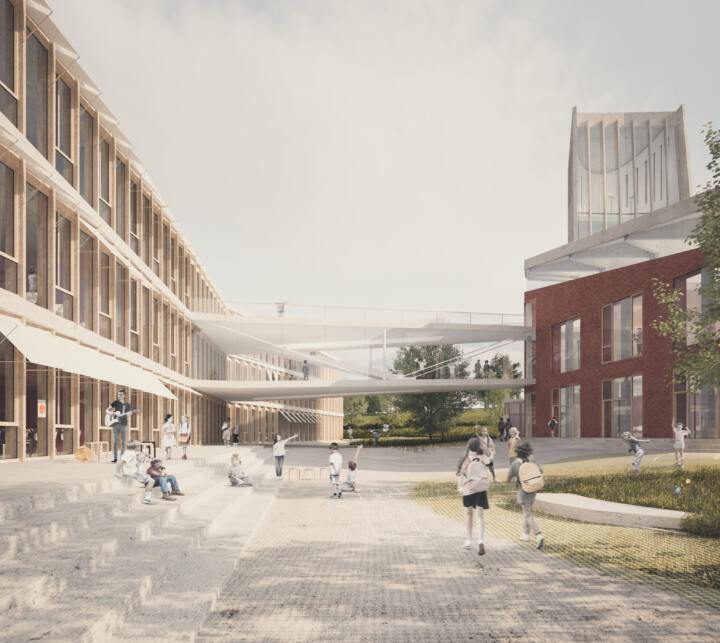
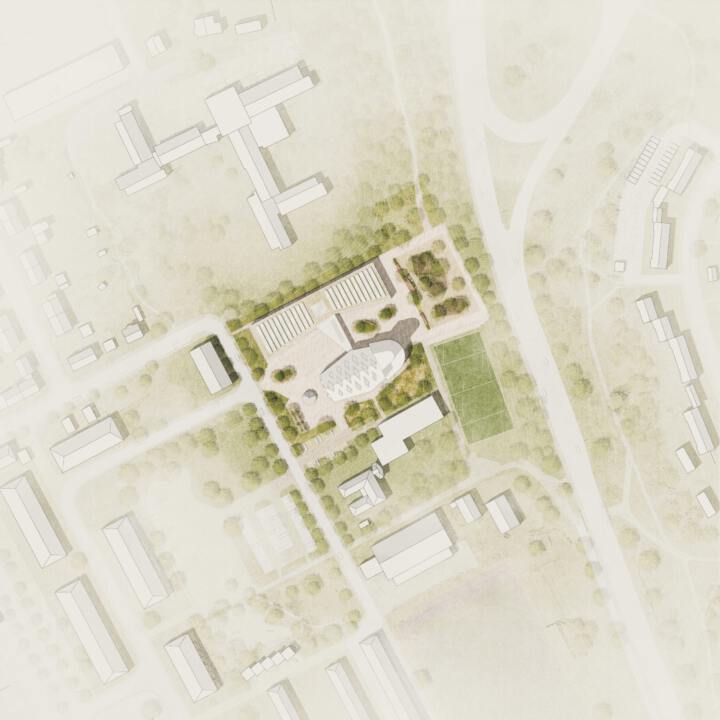
A core element in the external landscaping concept is the playground between the former church and the new building. Bounded on both sides by stepped seating, it opens up in the centre with space-defining single trees and leads to a dense ‘play forest’ where children can romp around. Another special feature is the climbing and balancing frame that uses gravel incorporated in the subsoil to mitigate the impact of falls. Away from all the hustle and bustle is a quiet area that can also be used as a green classroom or school garden. The planting concept calls for the use of robust native shrubs in the perimeter areas that can withstand all the various demands.
Parking is being restructured in conjunction with the new building. Parking spaces will be supplemented by centrally located bicycle parking close to the entrance. The roofs of the new building, in addition to supporting a modern photovoltaic system for generating power, will be planted as extensive green roofs, plus a landscaped roof garden and a play area.
Millennium Areal | Frankfurt
Recognition I Millennium Areal
Frankfurt
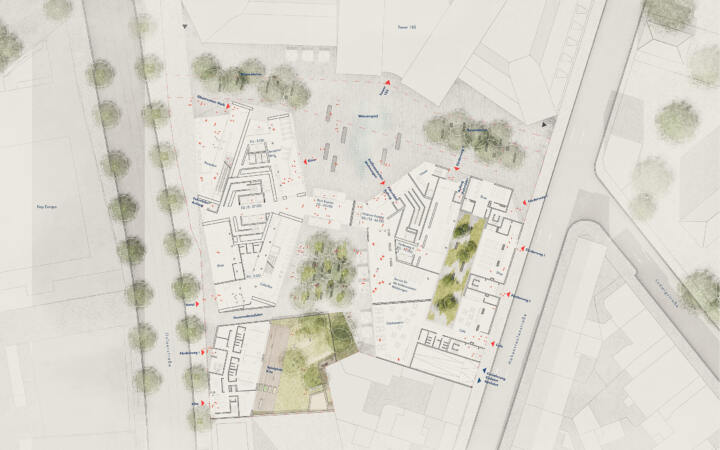
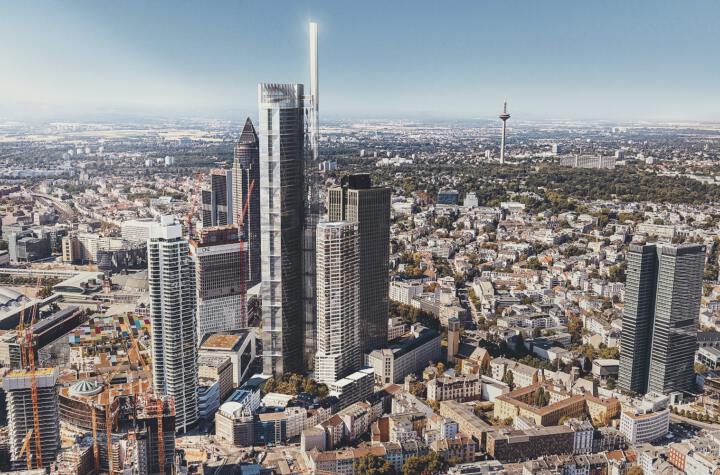
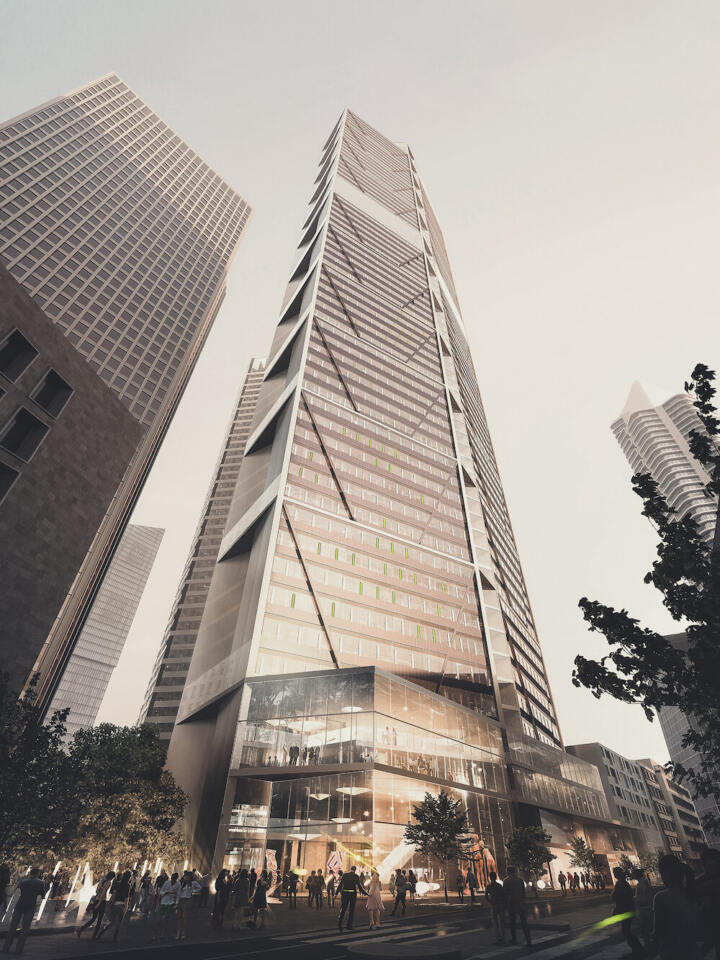
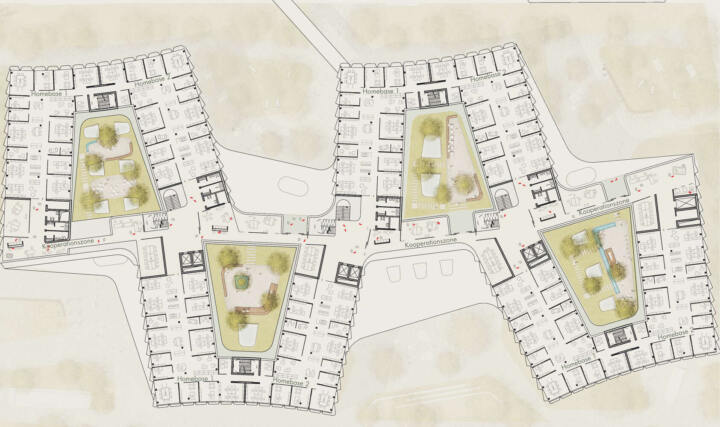
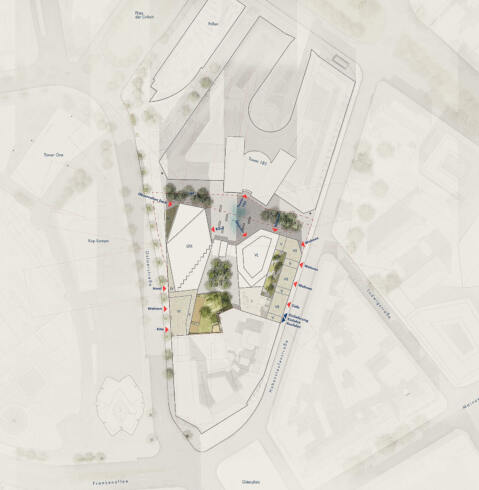
The interplay between green courtyards and stone urban space creates attractive and spatially differentiated outdoor lounges. Loosely set, the multi-stemmed field maples in the courtyard and to the left and right of the entrance plaza form a light-filled canopy that frames and sets the scene for the fountain plaza in front of the main entrance.
A cleverly controlled, flush-to-the-ground fountain and spray field, which can be turned off when needed, together with the bench elements, make the forecourt a popular gathering place. The tree canopies continue into the central courtyard, where loosely placed tree locations are generously underplanted with shade shrubs and ferns. This creates small-scale, green spaces. To make the play area in the kindergarten as contiguous as possible, a linear play and climbing element that accommodates all of the expansive play equipment uses the windowless firewall facing the courtyard.
In the courtyard, the paved amenity areas are reduced and broken up in favor of an even larger greening component.