
2nd Prize | Construction of a new multi-purpose residential building
Filderstadt-Bernhausen
In collaboration with ATELIER30 Architekten GmbH
Urban Planning and Internal Organisation
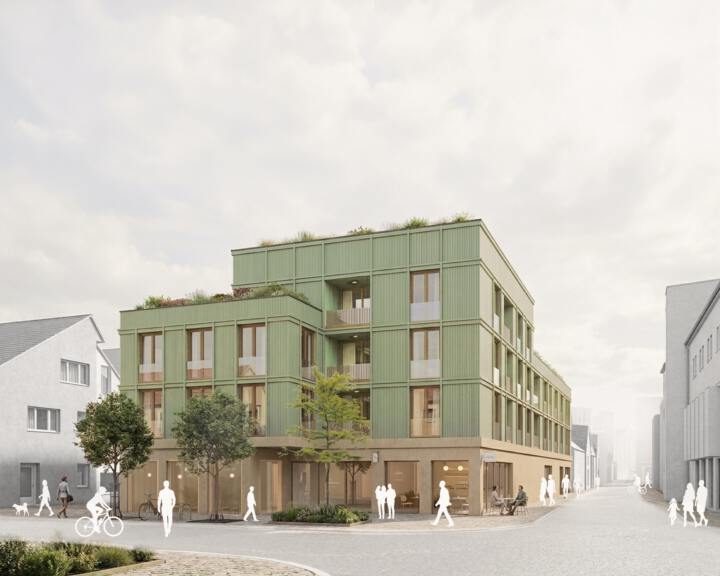
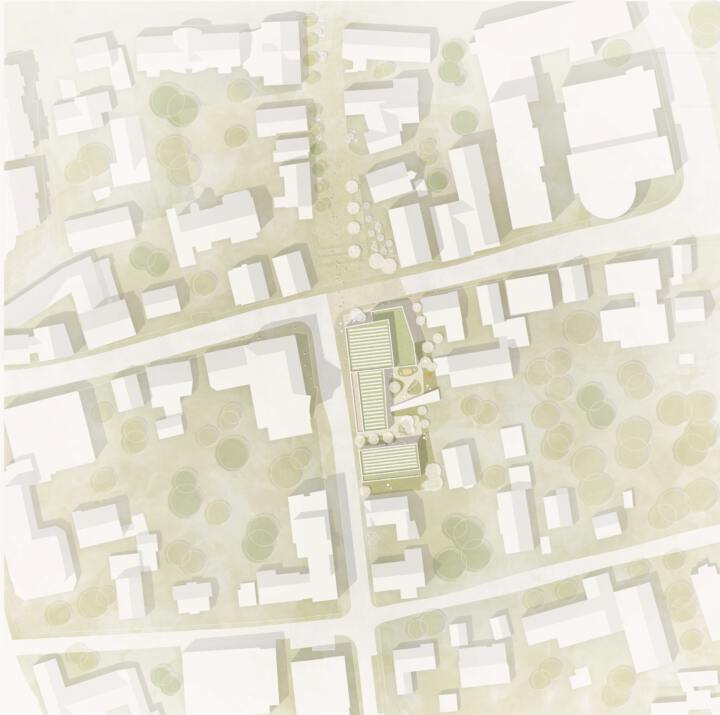
The new building stands as a confident urban element on the corner of Bernhäuser Hauptstraße and Volmarstraße, on the site of the former car park. It marks both the start and the spatial conclusion of the pedestrian zone on Bernhäuser Hauptstraße, thereby reinforcing the urban presence of this important local area.
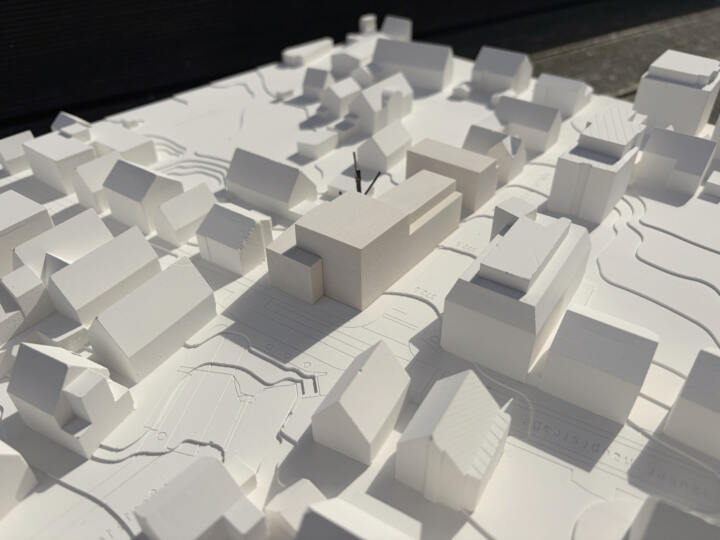
The carefully designed, L-shaped structure responds sensitively to the existing context. It incorporates both the height profile and the building lines of the adjacent development, translating the small-scale, granular character of the surrounding area into a contemporary architectural structure.
The conceptual section complements the ensemble naturally and, with its transverse orientation towards Volmarstraße, provides an urban conclusion to it. The striking four-storey structure in the implementation section creates an inviting forecourt through a deliberate setback, thereby clearly marking the public uses on the ground floor.
Both the event space and the restaurant are accessed via a spacious foyer. Both areas are deliberately oriented towards Bernhäuser Hauptstraße, thereby helping to bring life to the public space. In addition, both the event space and the restaurant have their own entrance from the forecourt. This allows both areas to be operated independently of one another, whilst at the same time facilitating synergies between them. The event area is further complemented by a terrace opening onto the tranquil inner courtyard.
The foyer area also houses the central staircase, which provides access to the apartments on the upper floors. The staircase is accessible from both Bernhäuser Hauptstraße and the green inner courtyard. This provides future residents with direct and easy access to the communal open space. The courtyard serves as the communicative heart of the neighbourhood and offers space for relaxation, socialising and neighbourly interaction.
The ground floor also houses all the ancillary rooms for the catering kitchen as well as the central toilet facilities. A passageway from Volmarstraße connects the courtyard directly to the public street space, thereby enhancing the neighbourhood’s accessibility.
The longitudinal section of the building is designed to accommodate additional commercial space, which can be easily subdivided as required thanks to its flexible layout. The ground floor is complemented by an electric bicycle storage room, separate waste disposal rooms and the building services room.
The floors above are based on a clearly structured floor plan with a grid of approximately 3.00 m. This structure allows for a high degree of flexibility in the design of different apartment types. Two-, three- and four-room apartments can be created on each floor. Around 50% of the flats are designed to be fully accessible, whilst the remaining flats are designed to be barrier-free. All flats also feature a loggia, which serves as a sheltered private outdoor space and significantly enhances the quality of living.
The entrance to the underground car park is located in the desired area in the north-east of the site. The underground car park provides a total of 24 parking spaces as well as additional storage areas for residents. On the third floor, the stepped storeys respond sensitively to the height of the neighbouring buildings, thus creating a harmonious transition to the urban context. The conceptual section follows the same structural logic as the implementation section, thereby ensuring a clear overall architectural form.