
Open space planning for the Jeetzel riverbank, Amtsgarten park and old cemetery | Lüchow
Recognition | Open space planning for the Jeetzel riverbank, Amtsgarten park and old cemetery
Lüchow
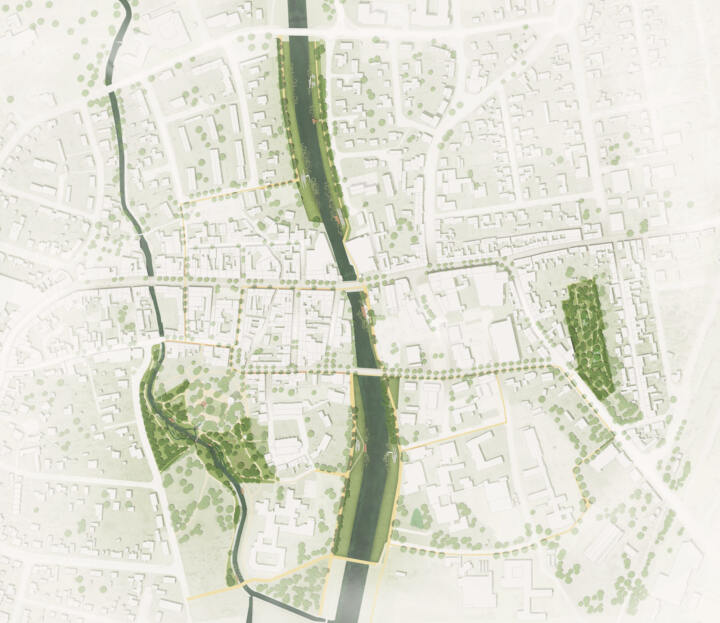
The three inner-city green spaces – Amtsgarten, Alter Friedhof and Jeetzelufer – form a continuous sequence of open spaces along Lange Straße, allowing visitors to experience nature, water and tranquillity in the heart of Lüchow. They are connected by a continuous, barrier-free path system, enabling visitors to easily explore the different qualities of each area. Uniform furnishings, lounge and relaxation areas provide orientation and enhance the quality of the experience, while the different landscape characteristics of the three spaces convey different atmospheres. The design combines historical, social and ecological aspects, strengthens the identity of the city centre and offers places for people of all generations to meet, relax and enjoy local recreation.
The deliberate sequence of green spaces creates clear connections between the individual areas as well as an overarching urban experience. The integration of natural design elements, planting and water-related structures supports the ecological function, strengthens biodiversity and contributes to a sustainable, resilient city centre. The result is a coherent overall concept that enhances the quality of life, appeals to different user groups and positions the city centre as a vibrant urban space with a strong identity in the long term.
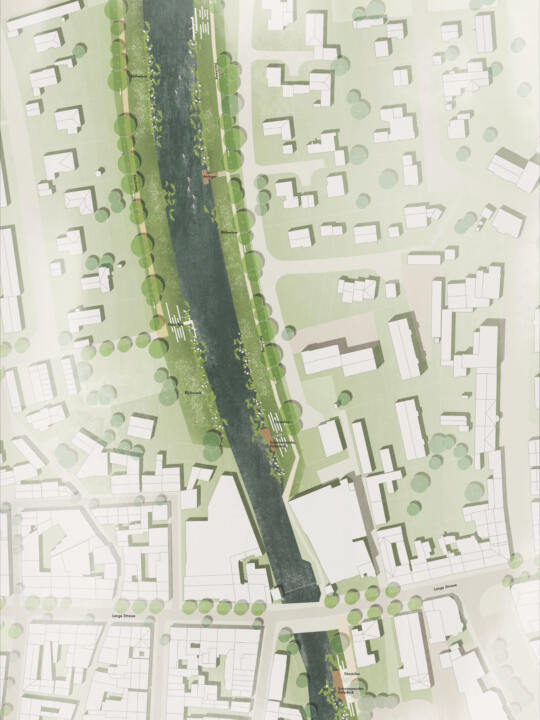
Jeetzel riverbank
The Jeetzel river flows through the centre of Lüchow from north to south and shapes the cityscape as an inner-city river. Historically used as a transport route, today the Jeetzel primarily serves functions in flood protection, urban structure and ecological concerns. The inner-city banks are currently heavily regulated, with only a few natural recreation areas available, and the river remains largely inaccessible to citizens.
The aim of the redesign is to integrate the Jeetzel more closely into city life, strengthen its ecological potential and create new opportunities for recreation and experiences. Taking into account the urban conditions and flood protection, a concept was developed that combines natural design with recreational opportunities.
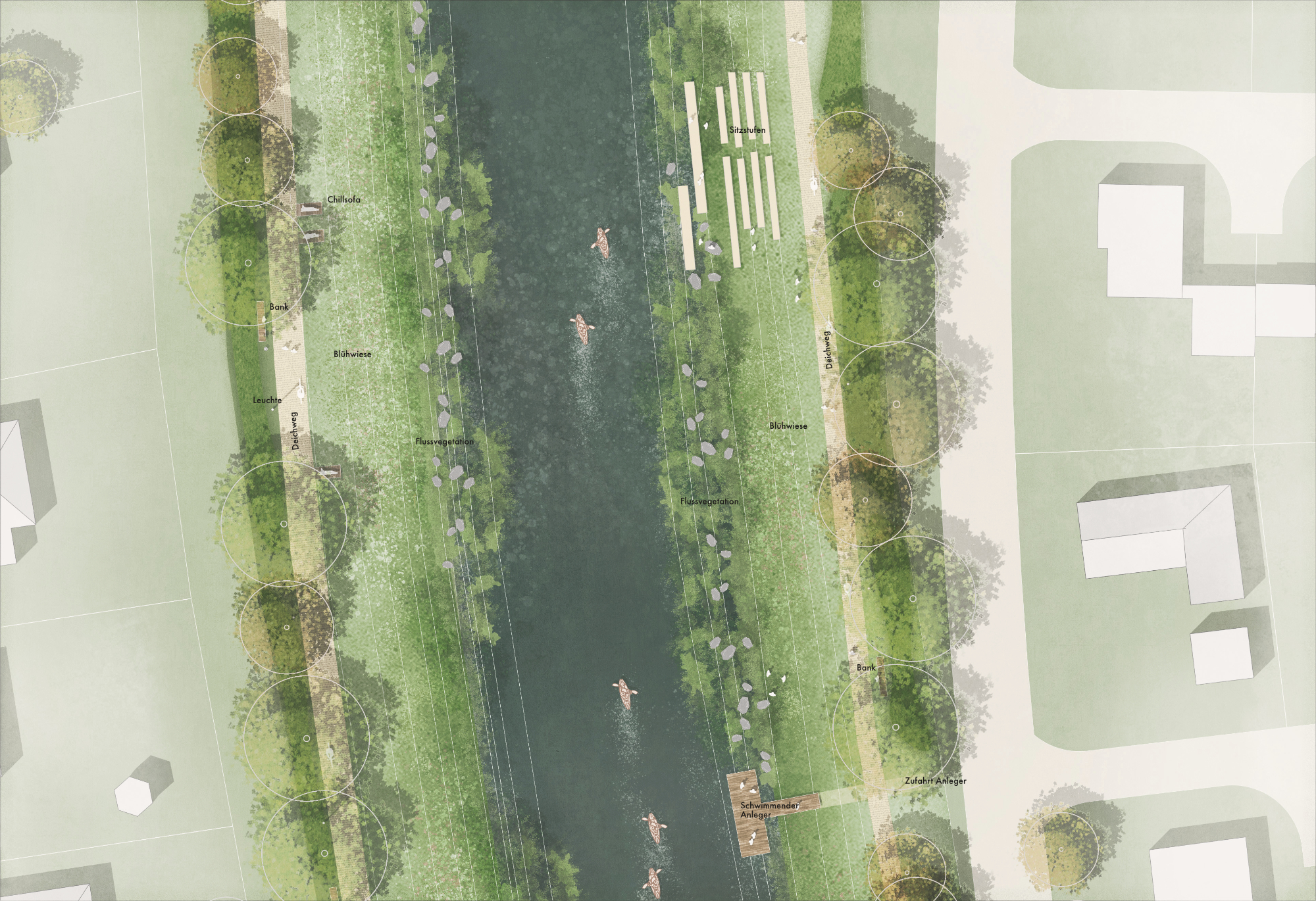
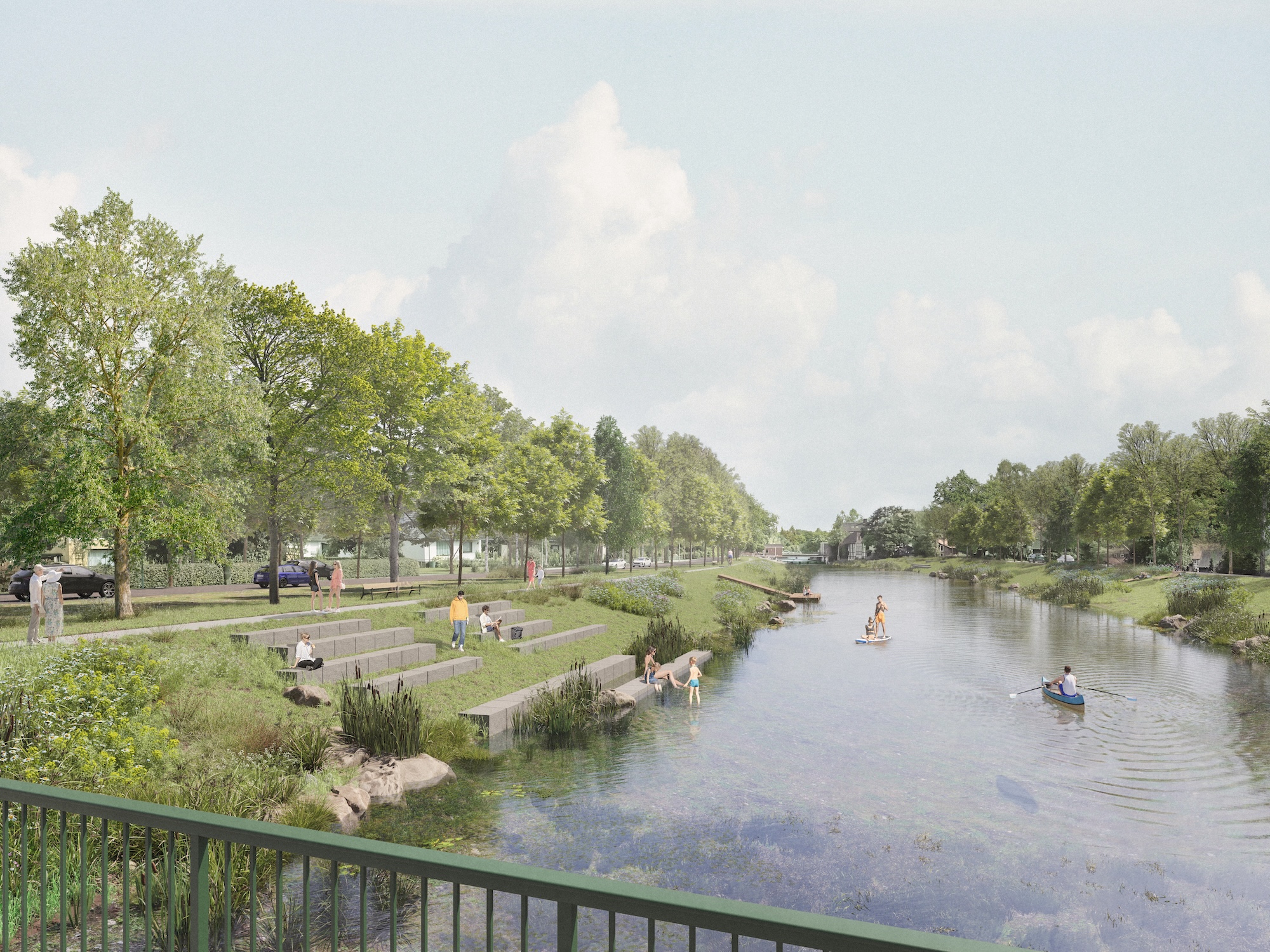
Seating steps have been integrated into the embankment at several points along the riverbank, and floating wooden decks have been installed on the water in some places, allowing visitors to experience the river up close. In the northern area, a landing stage for canoes and similar uses is also being built, supplemented by safe access from the road ‘Am Deich’. The southern recreation area, on the side of the retirement home, has been designed to be barrier-free, so that people of all ages can reach and enjoy the water via a ramp integrated into the embankment.
The sequence of recreational areas blends harmoniously into the urban structure: sometimes urban, sometimes close to nature, creating a varied experience. In addition, new benches and so-called ‘chill sofas’ have been installed along the existing paths, inviting visitors to take short breaks and linger on the banks. In order not to compromise flood protection on the dyke, it was kept free of trees and permanently installed fixtures. Instead, new trees were planted along the paths on the side facing away from the water, providing shade on the paths and seating areas and thus further enhancing the recreational facilities.
The embankments were planted with vegetation typical of the location in many places. Plant communities typical of rivers in the water and on the banks contribute to ecological diversity, promote biodiversity and support the natural purification of the water. Flowering meadows along the shore zones provide additional habitat for insects and other small animals. The meadows are mowed twice a year to ensure that the embankments are flood-proof.
The result is a Jeetzel riverbank that enhances the town, offers residents new recreational opportunities and spaces for exercise, and at the same time strengthens ecological functions. The redesign combines urban life, nature and water experiences, thus contributing significantly to the enhancement of Lüchow’s town centre.
Amtsgarten park
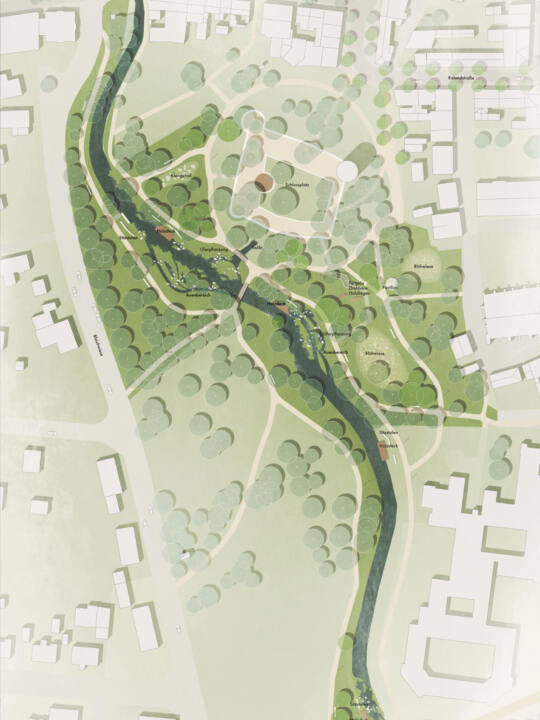
The listed Amtsgarten forms an important green space in the south-west of Lüchow. As a historic park with a rural character, it is shaped by the course of the Drawehner Jeetzel, which flows through the grounds in gentle curves and remains a defining feature of the area.
The aim of the redesign is to enhance the existing qualities of the Amtsgarten, improve its amenity value and make the connection to the water more tangible. Taking into account the requirements of monument preservation, a careful, nature-oriented upgrade was carried out that respects existing structures while creating new offerings for different user groups.
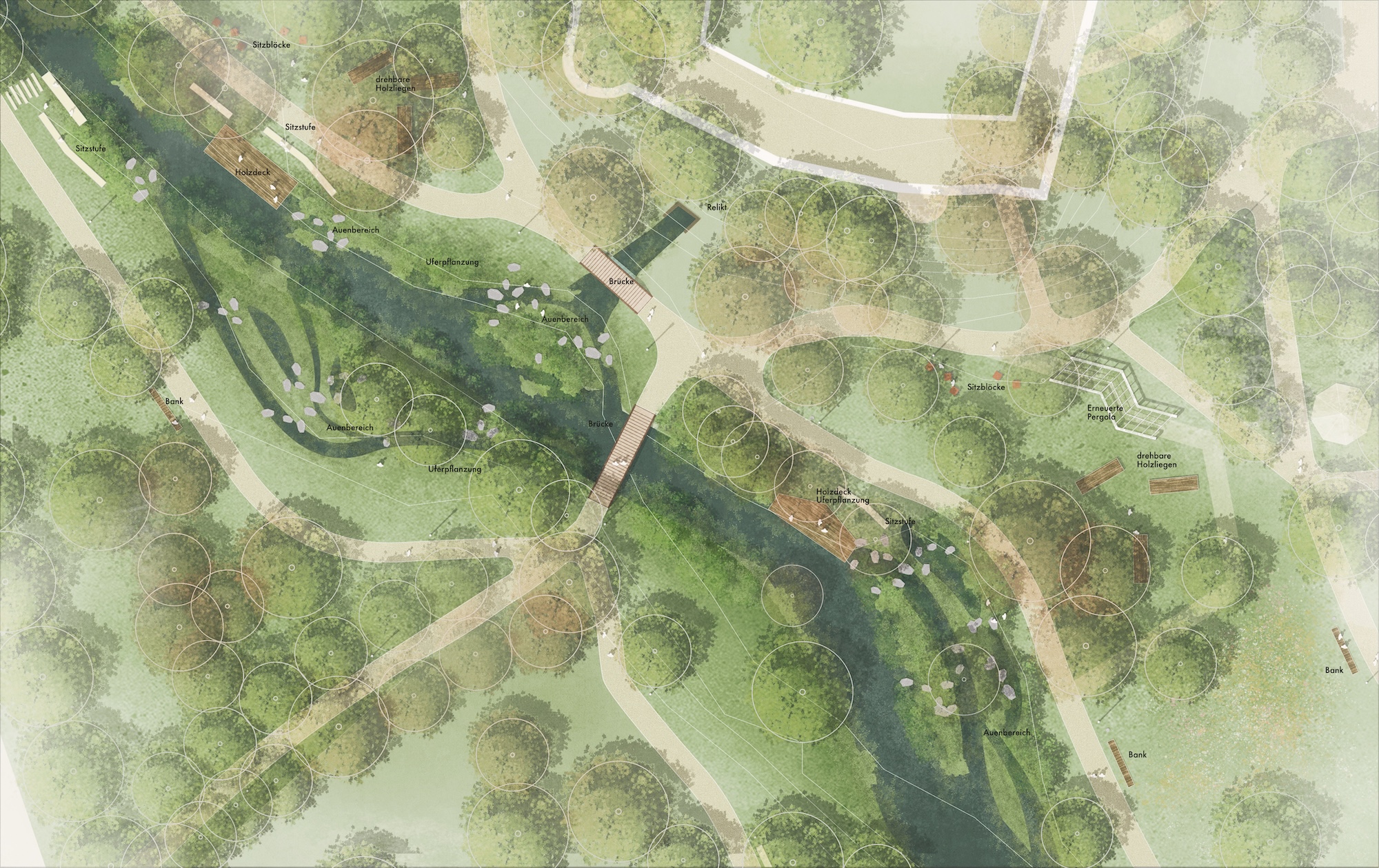
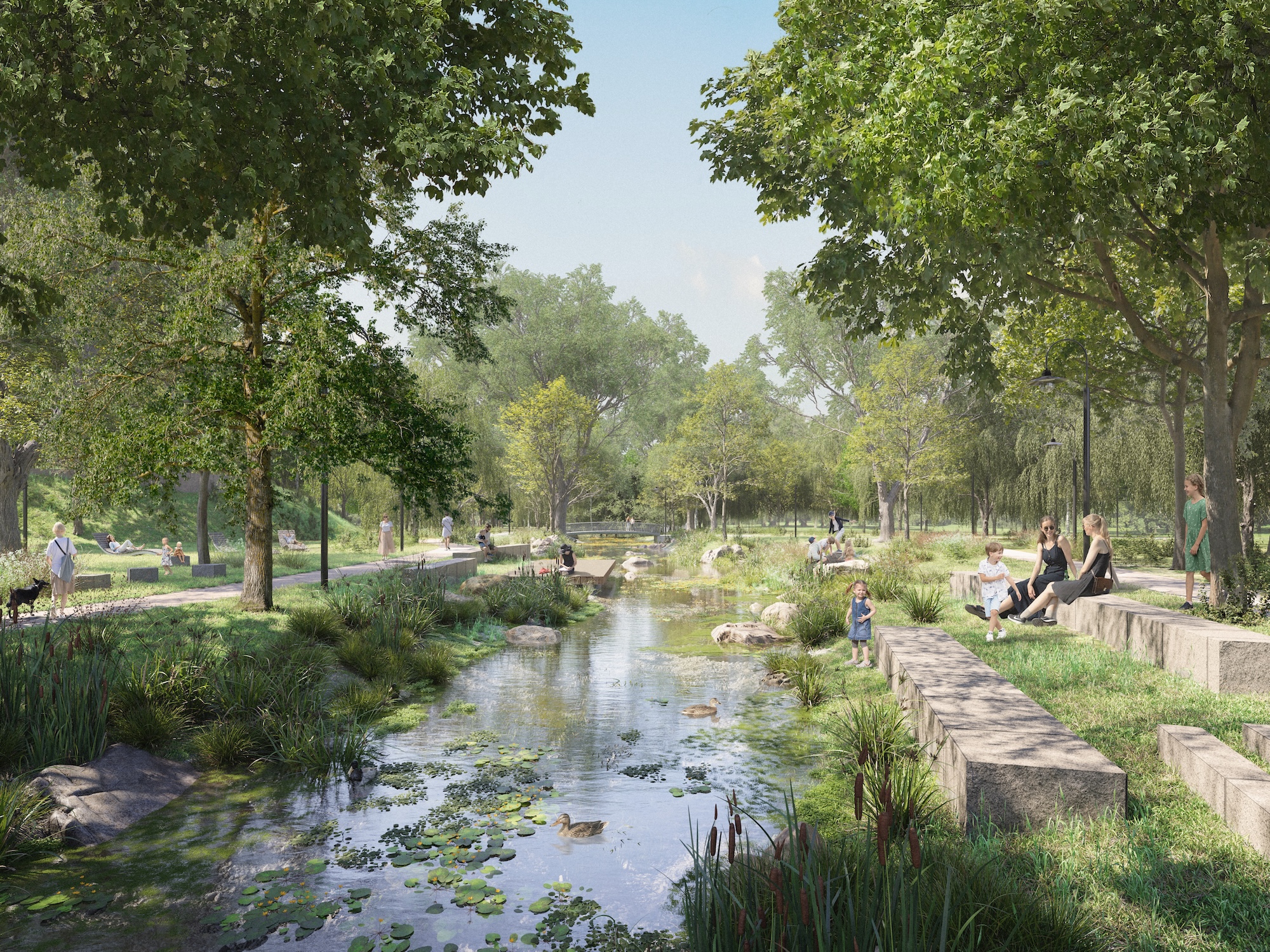
The path layout has been supplemented and improved to provide clear orientation and better access without detracting from the landscape character. Along the Drawehner Jeetzel, sections of the riverbank have been opened up to create an accessible floodplain area. Typical river vegetation and water-purifying plants strengthen the ecological function and promote biodiversity. Seating steps and wooden platforms invite visitors to linger by the water and create places where the water can be experienced with all the senses.
The pergola was renovated and the historic relic preserved as an identity-defining element. A newly added, weather-protected pavilion complements the offering and provides a sheltered place to relax. A sound trail and newly created wildflower areas add further layers of experience, making the Amtsgarten a place of discovery.
The subtle, natural design and the uniform, understated use of materials and forms create a harmonious overall picture that preserves the historic character. The Amtsgarten thus becomes a local recreation park that combines nature, history and green spaces – a green experience in the middle of the city that sustainably enhances the ecological and atmospheric quality of the location.

Hamburg-Nord district office building development | Hamburg-Eppendorf
3rd prize | Hamburg-Nord district office building development
Hamburg-Eppendorf
In collaboration with gmp Architekten
Urban development and monument preservation
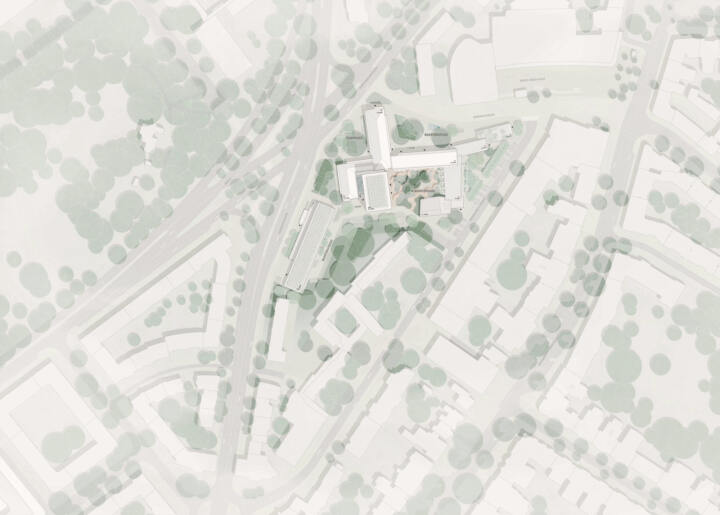
The aim of this competition entry is to highlight and strengthen the potential of the listed building complex ‘Bezirksamt Hamburg-Nord’ (Hamburg-Nord District Office). The administrative building will be transformed into a liveable and sustainable neighbourhood: the Seitz Quarter will be created.
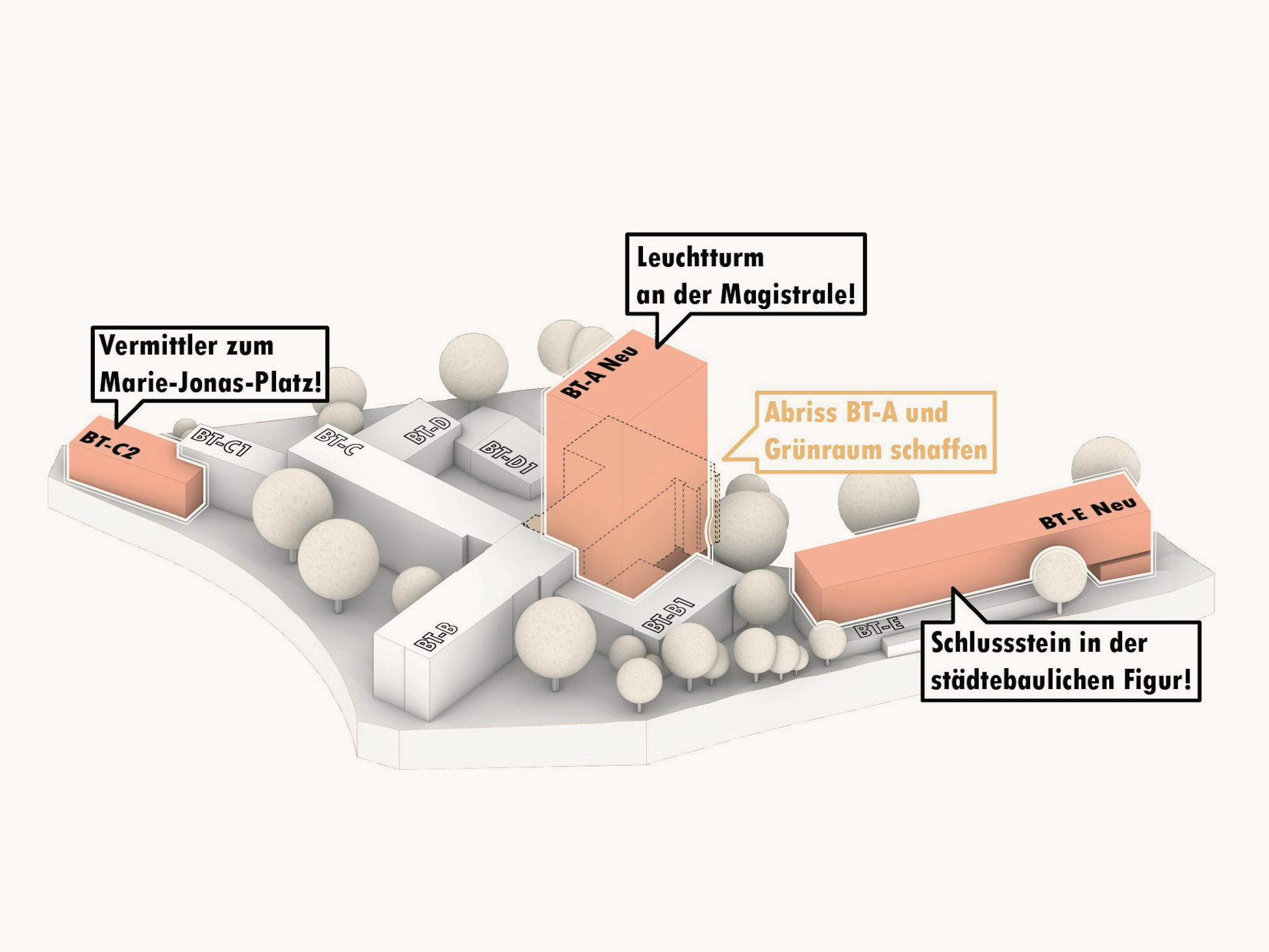
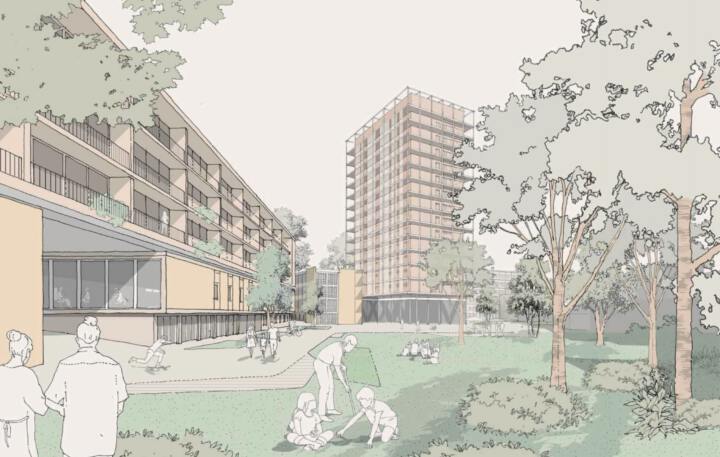
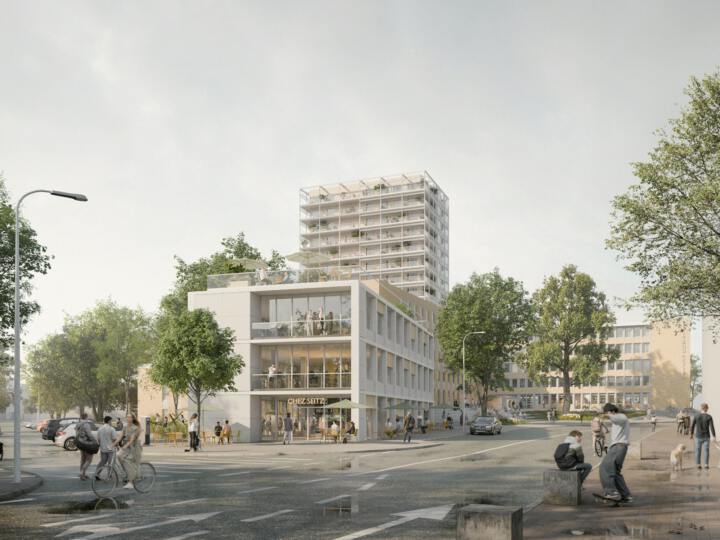
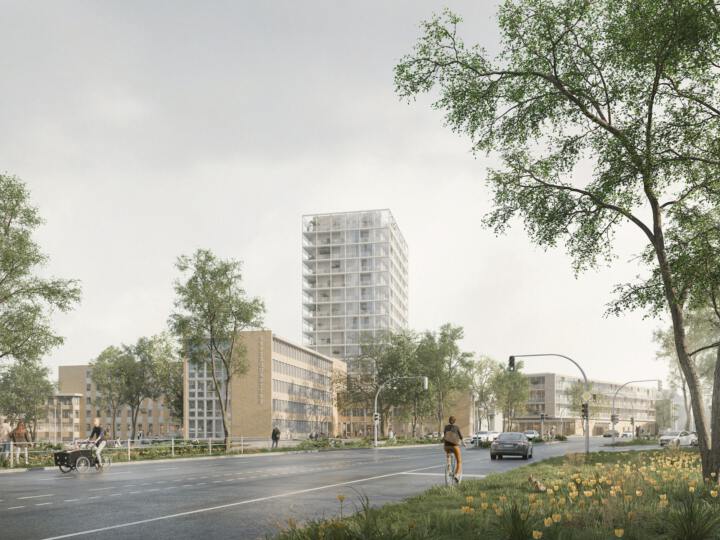
The listed buildings B-E, designed by architect Paul Seitz, will be preserved in their structural substance and carefully supplemented by three new buildings: a new tower as the highest point on the main road emphasises the start of Eppendorf with its long-distance effect. It will be located directly behind building section B1, replacing building section A, and will be connected to it by a covered hall, creating a large, contiguous inner courtyard to the east.
An extension to the former library rounds off the building block along the busy Lenhartzstraße. The street edge of the new building is set back slightly so that building E retains its presence. An extension to building C1 connects the quarter with the adjacent Marie-Jonas-Platz as a mediating building block. The original design idea is continued here, with the new building stepping down in height compared to the existing structure and creating a new frontage. In this way, all the new buildings blend harmoniously into the existing structure and the adjacent development, developing it further in a contemporary manner.
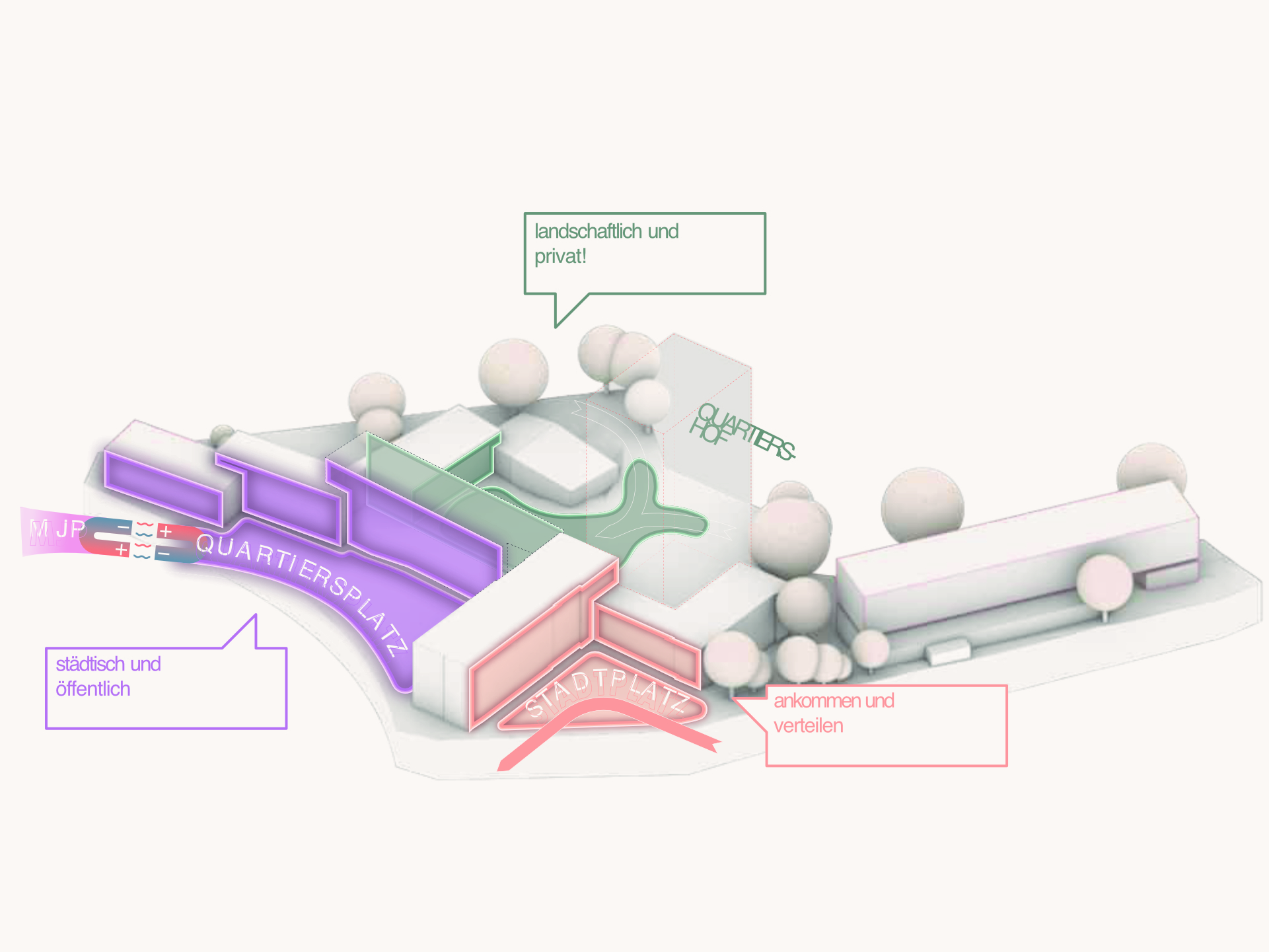
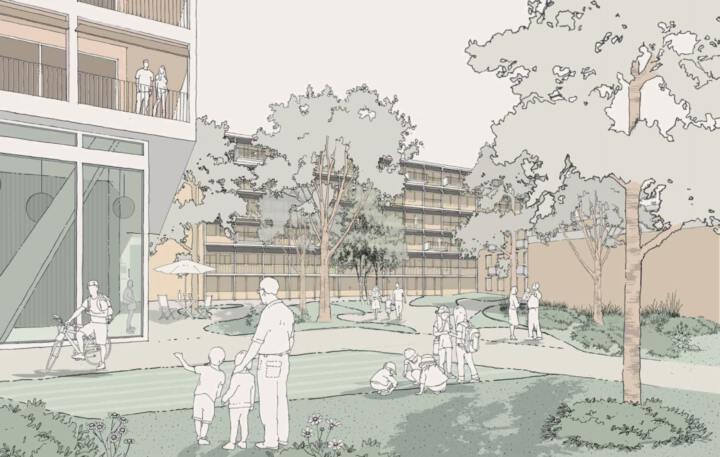
The existing buildings will be renovated in consultation with the monument protection authority and converted for new use in the interior. The façades will retain their protected appearance and will only be supplemented with balconies in the courtyard areas (buildings C and D). This will create an inner, private and landscaped courtyard as an oasis and identity-forming space for the residents of the Seitz Quarter, in contrast to the more public neighbourhood square on Marie-Jonas-Platz and the more urban square on Magistrale.
Development and use
The new buildings will enable an appropriate density of use and, as a result, greater economic efficiency for the project. Retail space is primarily located on the ground floor on the north side. Office space is located on the lower floors on the east side and at the highest point. The upper floors will contain apartments of various sizes, ranging from compact one-room apartments in the existing building to spacious townhouses in section D and maisonette apartments in section C.
Open space design
The transformation of the administrative building into a neighbourhood with commercial, office and residential units also changes the requirements for open space. Unused and inaccessible green spaces, purely functional entrance areas and parking spaces are making way for neighbourhood life and play areas. The inner courtyard is open to the public, but is primarily reserved for residents. New plantings in free, curved shapes complement the existing tree population, which is worthy of protection. The courtyard is accessed directly from the surrounding buildings. A private passageway connects the open spaces to each other.
Mobility concept
The demand for car parking spaces is determined based on empirical values, taking into account location-specific reduction factors. Residents and guests have access to two large bicycle garages, supplemented by decentralised parking areas in the outdoor areas. A mobility hub and two bicycle repair shops complete the mobility concept.
Westerwischstrom neighbourhood | Cuxhaven
3rd Prize | Westerwischstrom neighbourhood
Cuxhaven
In collaboration with Thomas Schüler Architekten und Stadtplaner
Urban development concept
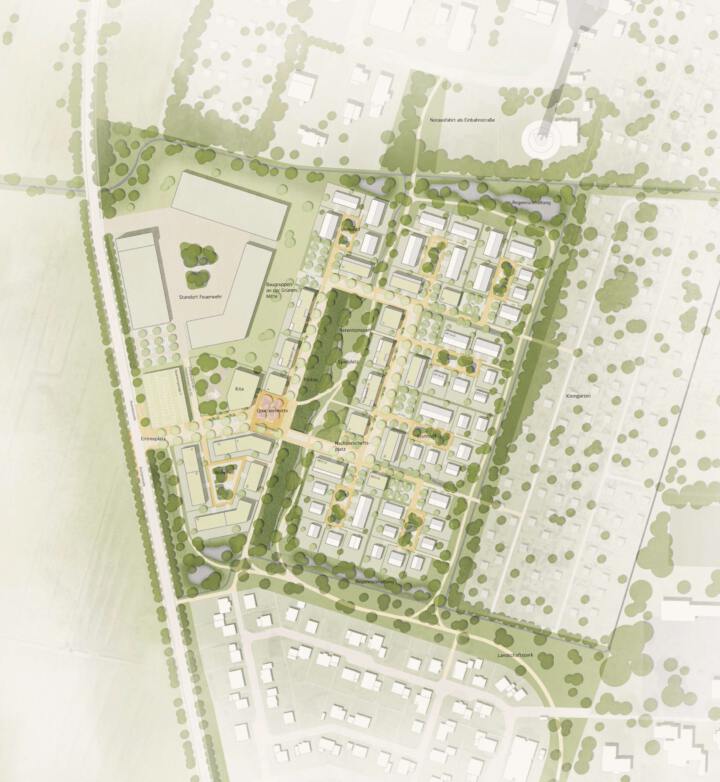
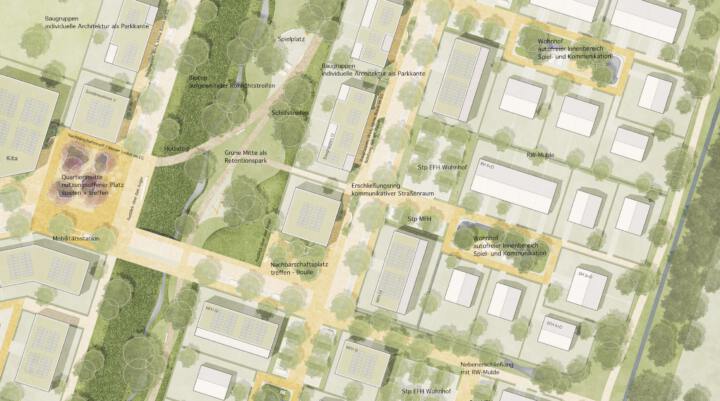
Due to its existing island location, the new neighbourhood needs a neighbourly structure in order to create an identity here in the future. A village green will be created as a central open space element, forming a communal interior area as a ‘green heart’ to which all building plots are adjacent and from which they derive their addresses.
The village green connects with the landscape areas, in particular the southern green corridor and the Süderwischschule school, thus creating a coherent open space framework. The individual building plots, which give the green centre its spatial edges, arise naturally from these path axes.
The biotope area of the reed strip is preserved and given a sufficient buffer strip. It becomes the new open space theme of the green centre and strengthens the function of a retention meadow.
Quarter centre
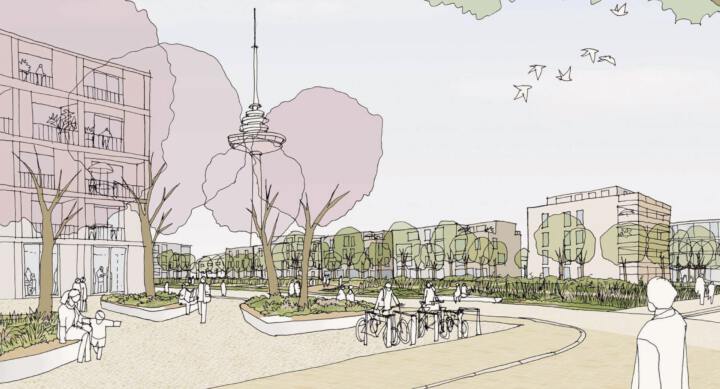
Directly opposite Theodor-Heuss-Allee, a centrally located neighbourhood square is being created as a representative gateway to the new quarter. It opens up like a window onto the retention meadow and forms a central hub here. As an urban square, it allows for a wide range of uses and integrates central play and activity areas. Large benches and seating steps invite visitors to linger and create a pleasant atmosphere with a view across the Retentionsanger.
The structural centrepiece is the daycare centre, which, together with a bakery or a small village shop in the adjacent neighbourhood house, will enliven the square. The upper floors could be used for special types of housing, such as multi-generational housing or senior living.
The forecourt along the district road is integrated into the new sequence of squares as an open space and forms the entrance to the new neighbourhood. This is where the public transport stop and the neighbourhood car park are located, which also serves as a structural noise barrier.
Garden courtyards at the Green Centre
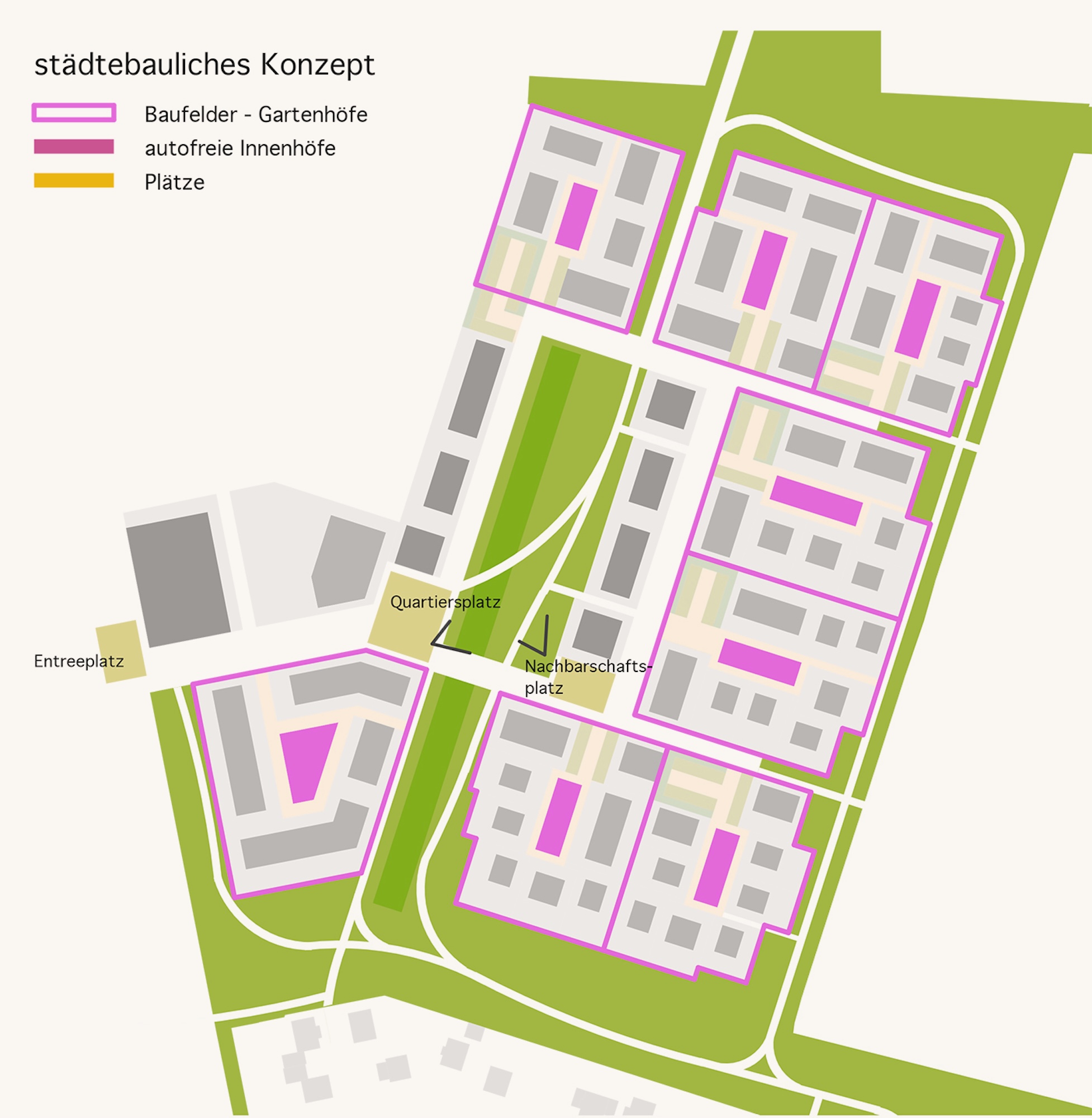
The modular concept of garden courtyards forms small neighbourhoods that can be developed with different types of buildings for single-family homes and multi-family homes with a focus on family-friendly and communal living. They are grouped around a garden courtyard with play and communication areas, which strengthens neighbourly coexistence. The building density is highest at the green centre and becomes less dense towards the edges.
The buildings along the green centre are intended for building groups that form a striking park edge with varied architecture through individual development. The ground-floor communal uses and small offices for W+A have easily findable addresses and enliven the public space.
Traffic-free residential environment
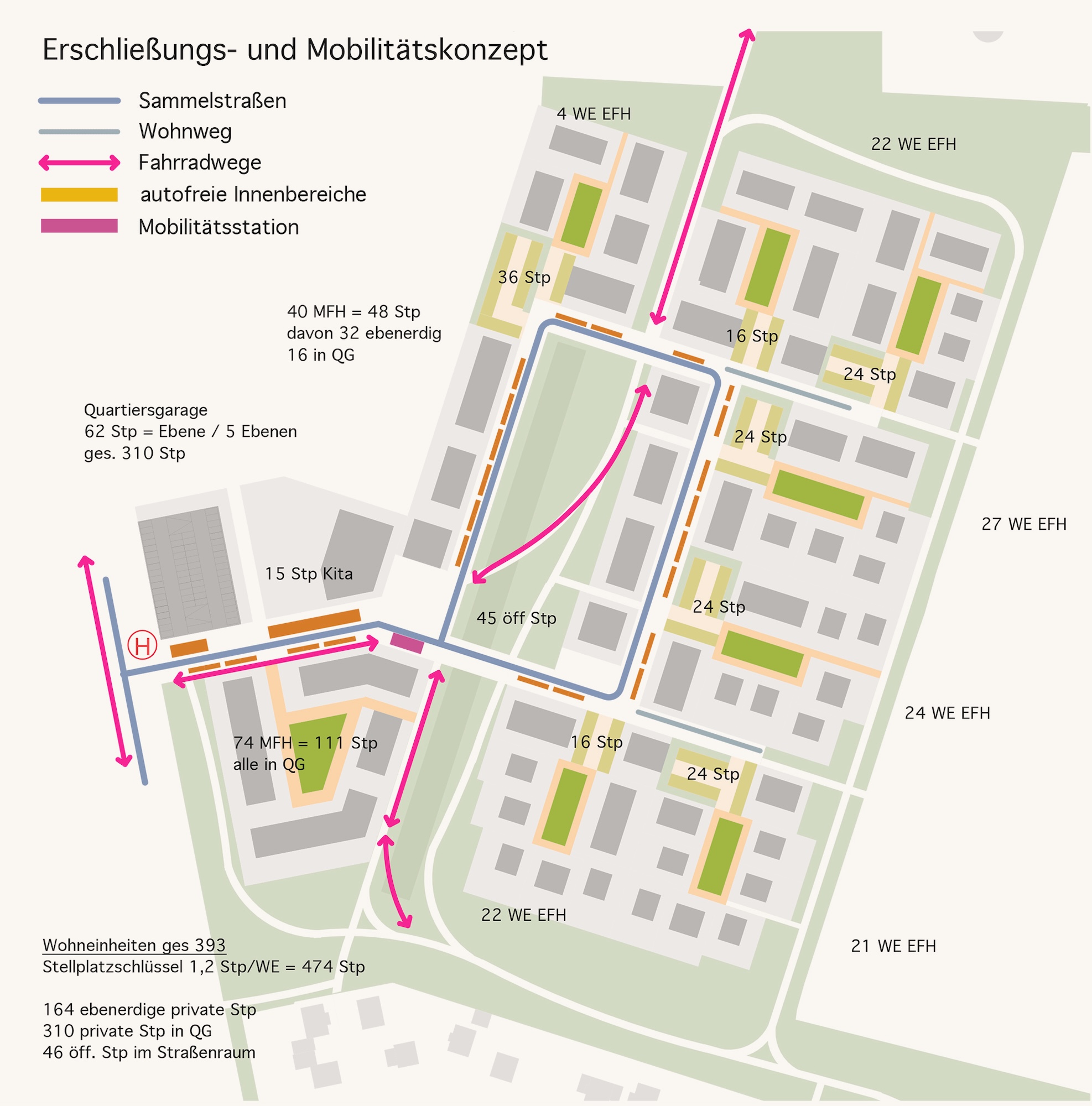
The neighbourhood car park is located directly in the access area, providing parking spaces for the western apartment building. The base houses a bicycle parking facility and an energy centre, which supplies the neighbourhood with energy independently as a combined heat and power plant or large heat pump.
The parking spaces for the garden courtyards are located directly at the access areas, keeping the interior areas car-free and creating neighbourhoods with a high quality of life. Understated and well-placed furniture creates a pleasant atmosphere in the public spaces as places for meeting and communication.
Directly on the neighbourhood square is a mobility station that accommodates all functions of ‘soft mobility’ such as car sharing and e-mobility. The footpaths and cycle paths through the green spaces reinforce the permeable internal access concept and promote individual walking and cycling.
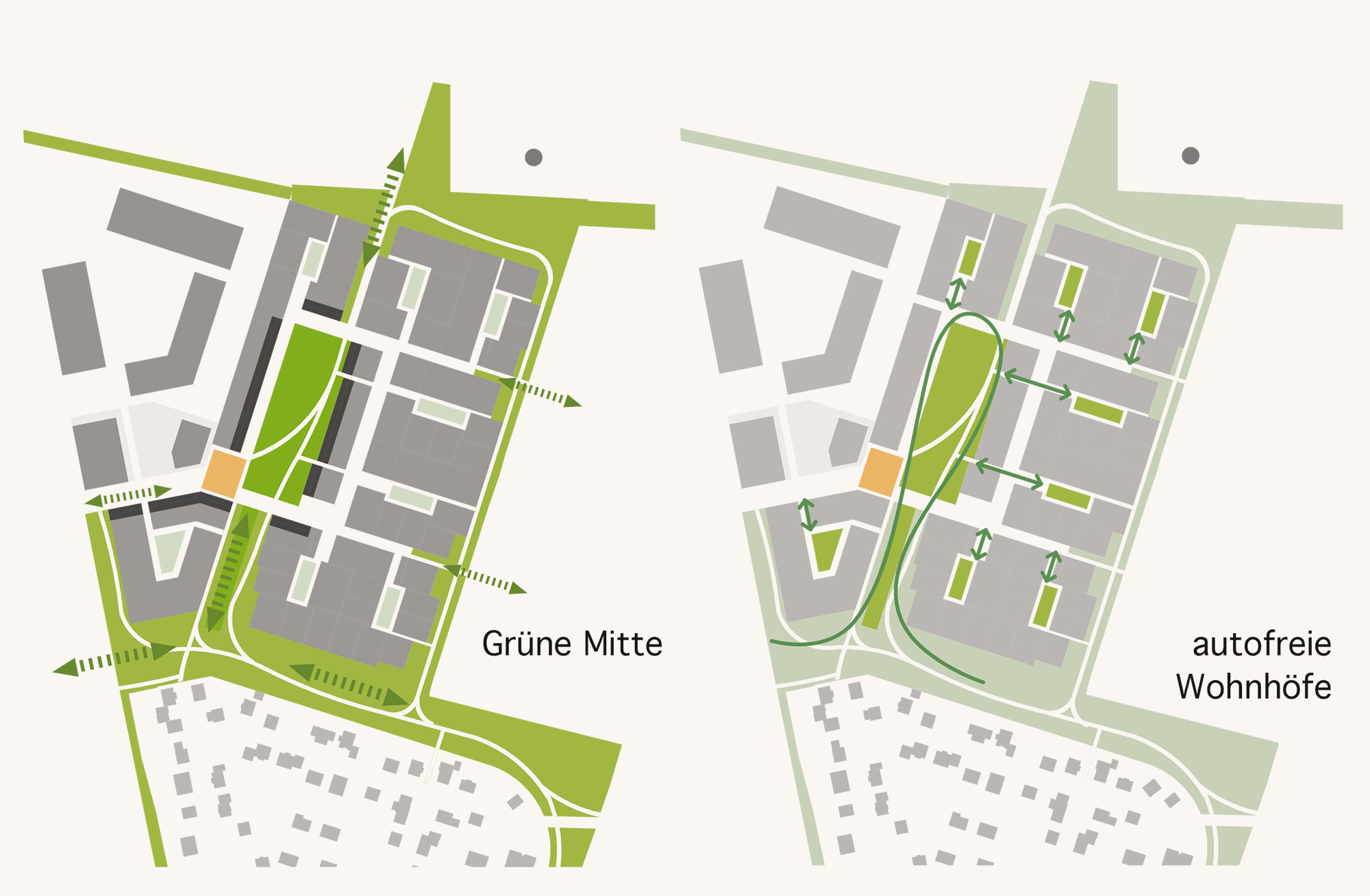
Green centre as a retention area
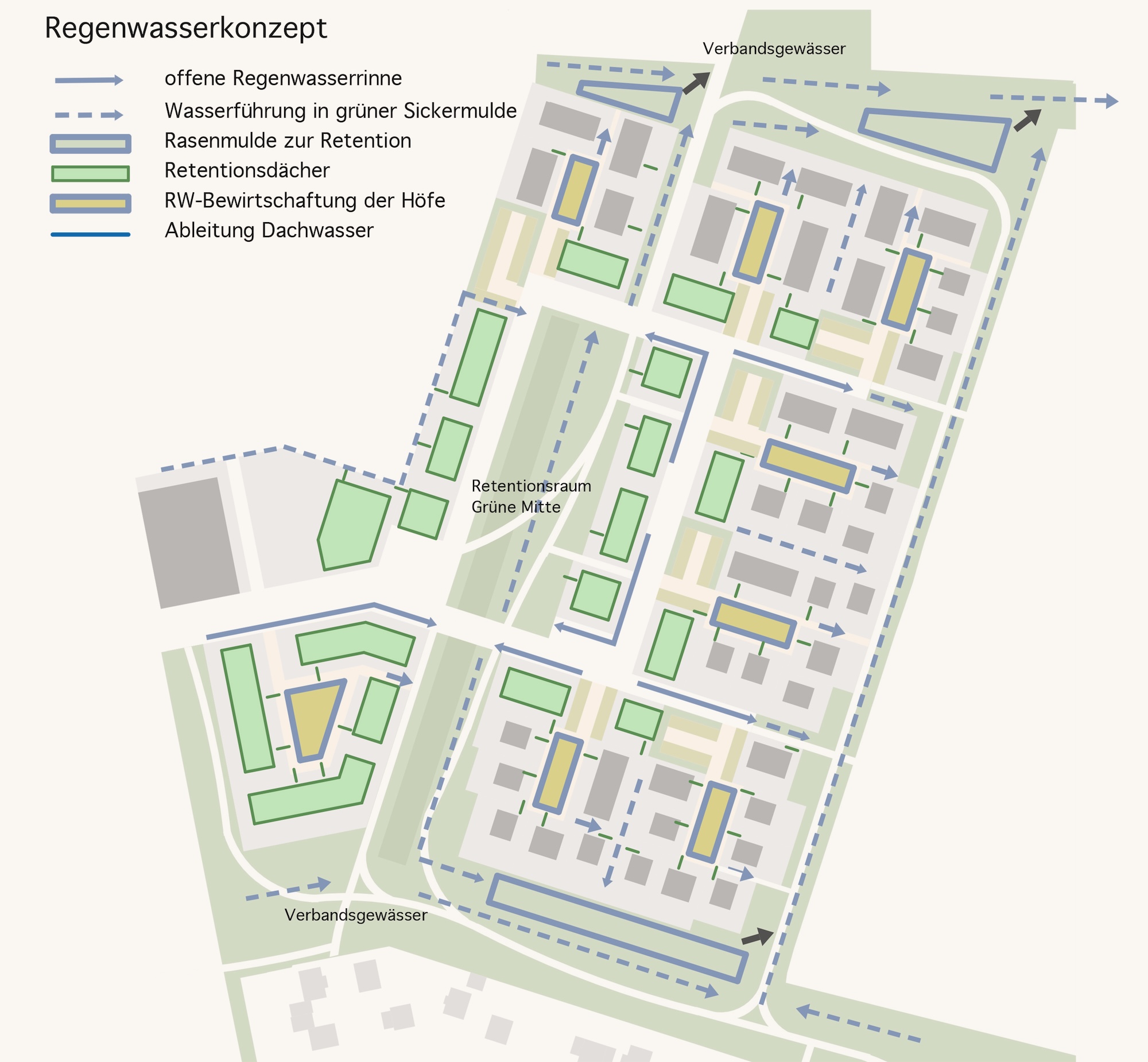
The green centre serves as a large retention area. It is designed to be close to nature and acts as a retention space for rainwater. With its recreational qualities, play facilities and ecological function as a rainwater retention area, it contributes to improving the quality of the neighbourhood and enhancing its identity.
A flat lawn depression parallel to the reed bed strip acts as a central retention area, collecting rainwater from the neighbouring residential courtyards and draining it into the rainwater retention areas to the north and south. The interaction between the reed bed and the extension with intermittently wet retention areas is carefully coordinated with nature conservation requirements in terms of modelling and rainwater supply.
Rainwater and climate impact adaptation concept
The rainwater management concept follows the principles of minimising surface sealing and retaining rainwater runoff at its source so that a large proportion of the water no longer needs to be drained away through evaporation. First, the rainwater from the flat roofs on the construction sites is retained in retention roofs with minimal runoff and an evaporation rate of up to 75%, The rainwater from the gabled roofs and courtyard areas is collected in retention cisterns or led via open seepage ditches and seepage channels close to the surface into the temporarily dammed, lowered areas of the residential courtyards and the lawns and wet meadow hollows along the paths.
The water from the cisterns can be used for grey water utilisation in the buildings and for watering the garden courtyards. Proportional roof greening can contribute to the purification of rainwater and reduce the amount of water accumulating on private areas. The water flows through the garden areas to the central neighbourhood square or directly into the adjacent hollows. Here, the water is retained and discharged in a controlled manner into the adjacent green joints with their associated waterways. The green joints also ensure emergency waterways during heavy rainfall, so that rainwater can be discharged without causing damage.
Particular emphasis is placed on extensive tree planting with climate-resilient species that provide shade and evaporative cooling. In street spaces and squares, they are supplied with water via lowered planting strips and, to a lesser extent, via tree trenches, thus supporting the sponge city concept of the entire neighbourhood. The sowing of species-rich meadows, in combination with bird protection hedges, creates valuable habitats for insects and other animals. In this way, rainwater and climate change adaptation are made visible and tangible as ecological qualities, contributing to the positive image of the neighbourhood.
Wasserkuppe Arrival & Information Centre | Gersfeld (Rhön)
3rd Prize | Wasserkuppe Arrival & Information Centre
Gersfeld (Rhön)
In collaboration with Sturm und Wartzeck
Basalt as a leitmotif
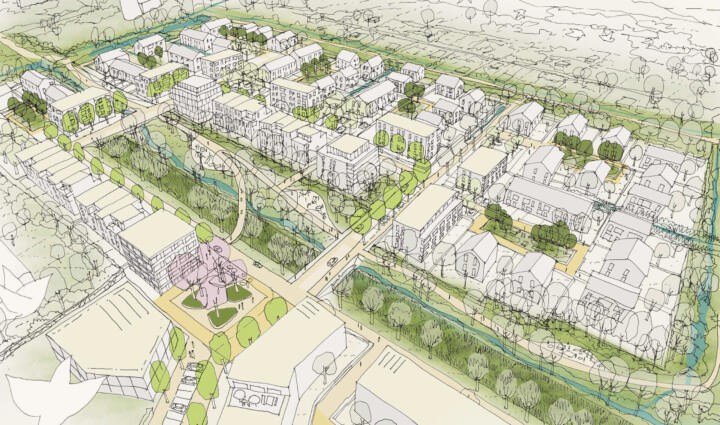
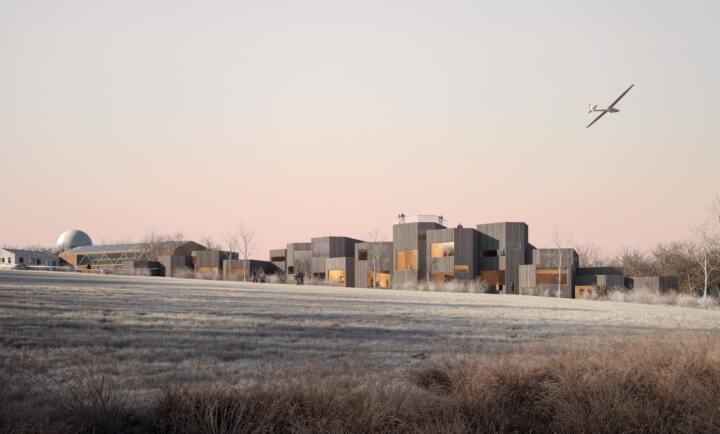
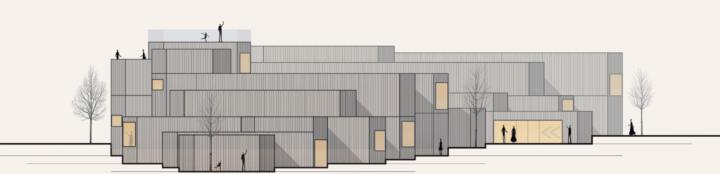
Basalt can be found everywhere in the Rhön in a wide variety of forms. Whether it stands on the rock face as spectacular vertical layers, like a stone forest among the trees, intertwines horizontally with the surrounding meadows at Pferdskopf, or illustrates the sculptural power of nature as filigree hexagonal columns (Gangolfsberg). Basalt always appears as a defining element of the landscape, entering into dialogue with its surroundings through its differentiated layers. This sculptural quality, which defines a place without dominating it, served as the leitmotif for our design.
Urban planning and open space design
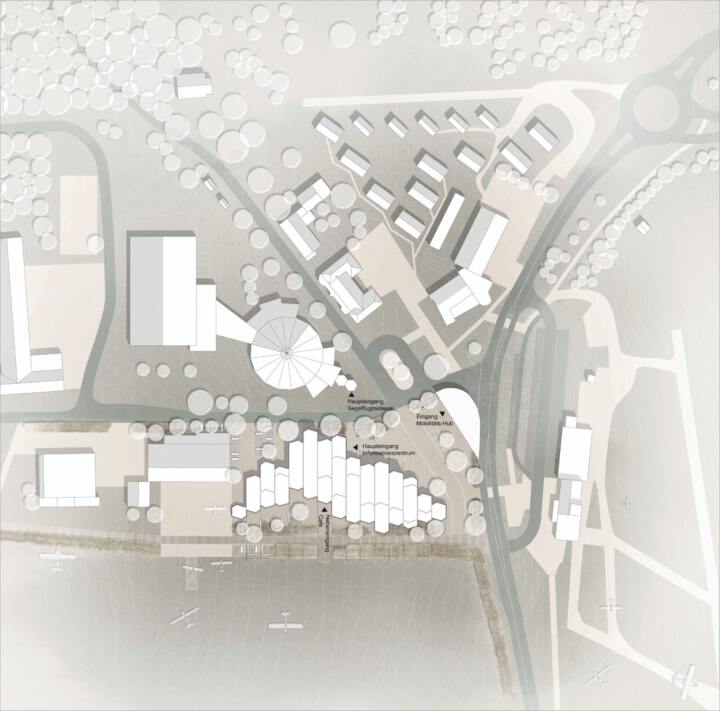
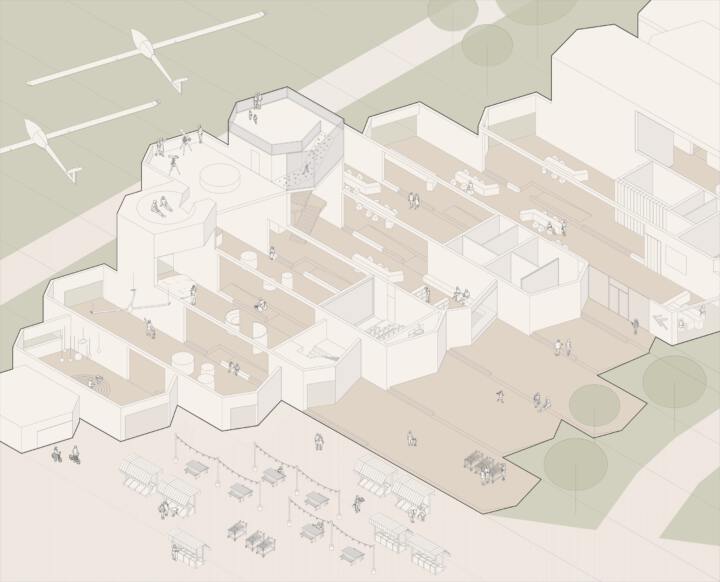
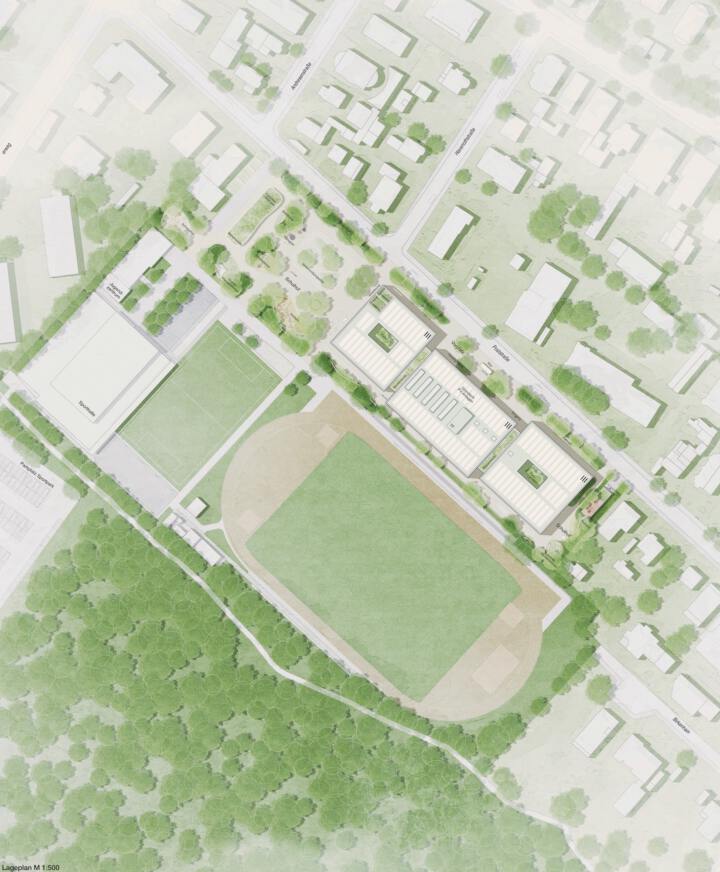
The building is a multi-layered, elongated structure situated between the heterogeneous existing buildings on the site and the open airfield. The shifting layers of the building allow it to respond organically to the different requirements of its surroundings. In the northeast, the differentiated edge of the building opposite the wing building defines a spacious, freely usable square that ties the entire area together as a new centre. Here, the beams are lower to give the square a scaled and inviting setting. The main entrance to the new information centre forms the end of the square, which is visible from afar. This is at the same level as the main entrance to the gliding museum, which makes it easier to find your way around the site and opens up spatial synergies between the institutions. In the north-west, the recess of the last building blocks creates an outdoor space that is clearly separated from public use, with parking spaces for employees and access for the mountain rescue service.
To the south, the building faces the airfield with its open vistas along its entire length. The tallest parts of the building, with viewing and star terraces, create a highly recognisable silhouette – the new gateway to the Wasserkuppe. In the restaurant and Regio Shop area, outdoor terraces on three sides offer a view of the airfield and the Rhön mountains, protected from wind and weather.
Open space
The nearby basalt formations are interpreted for the building construction, with the edges and projections of the façade giving the building a character that blends naturally into the landscape. The plot has a height difference of several metres, which is also reflected in the building construction with its varying ground floor heights. This principle is continued in the open space, with individual areas of the ground floor having access to terraced levels in front, which also follow the height differences and mediate between the building and the open terrain. The offsets of the terrace segments are staged with benches or steps, thus becoming usable elements. To the south, there is a green strip that also integrates the edge of the gliding field across the road. The road is designed with lawn liners, giving it the character of a private road that is only used by glider pilots. The planting here is dense, but does not obstruct the wide view. Trees are placed sparingly here. In the north, the planting is somewhat more lush and forms the framework for the open event area between the new building and the competence centre. The materials and colours in the open space are based on the building construction – basalt and wood, complemented by yellow-gold accents, create a unity between the building and the terrace base.


Replacement building for GGS - Strand Europaschule Timmendorfer Strand | Timmendorf
A 3rd Prize | Replacement building for GGS – Strand Europaschule Timmendorfer Strand
Timmendorf
In collaboration with Baufrösche Architekten und Stadtplaner
Guiding principle
The new GGS Strand Europaschule brings together three previously separate school and building sections in a shared architectural and educational concept. The result is a lively place of learning and encounter that combines educational diversity, architectural clarity, and spatial flexibility. The aim is to create a place that harmonizes learning, community, and sustainability and visibly embodies the European idea of diversity.
Architecture
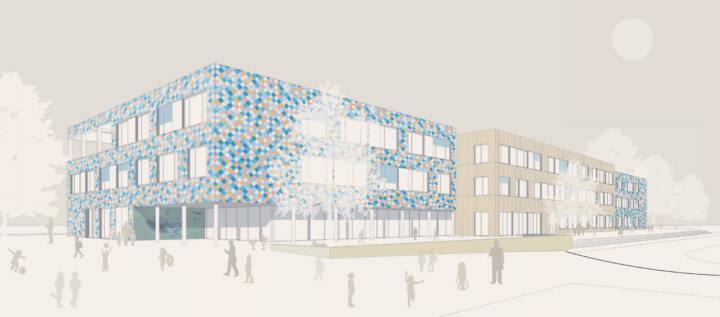
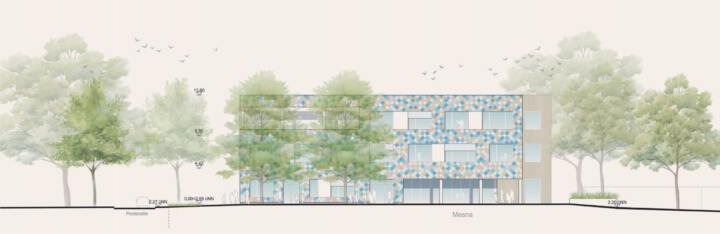
The new building is a compact, three-storey structure that blends harmoniously into its urban surroundings thanks to its clear layout. The three-part façade structure creates a sense of scale and fits naturally into its surroundings. The chosen positioning of the building creates a spacious, contiguous open area that can be used in a variety of ways as a school playground and event space.
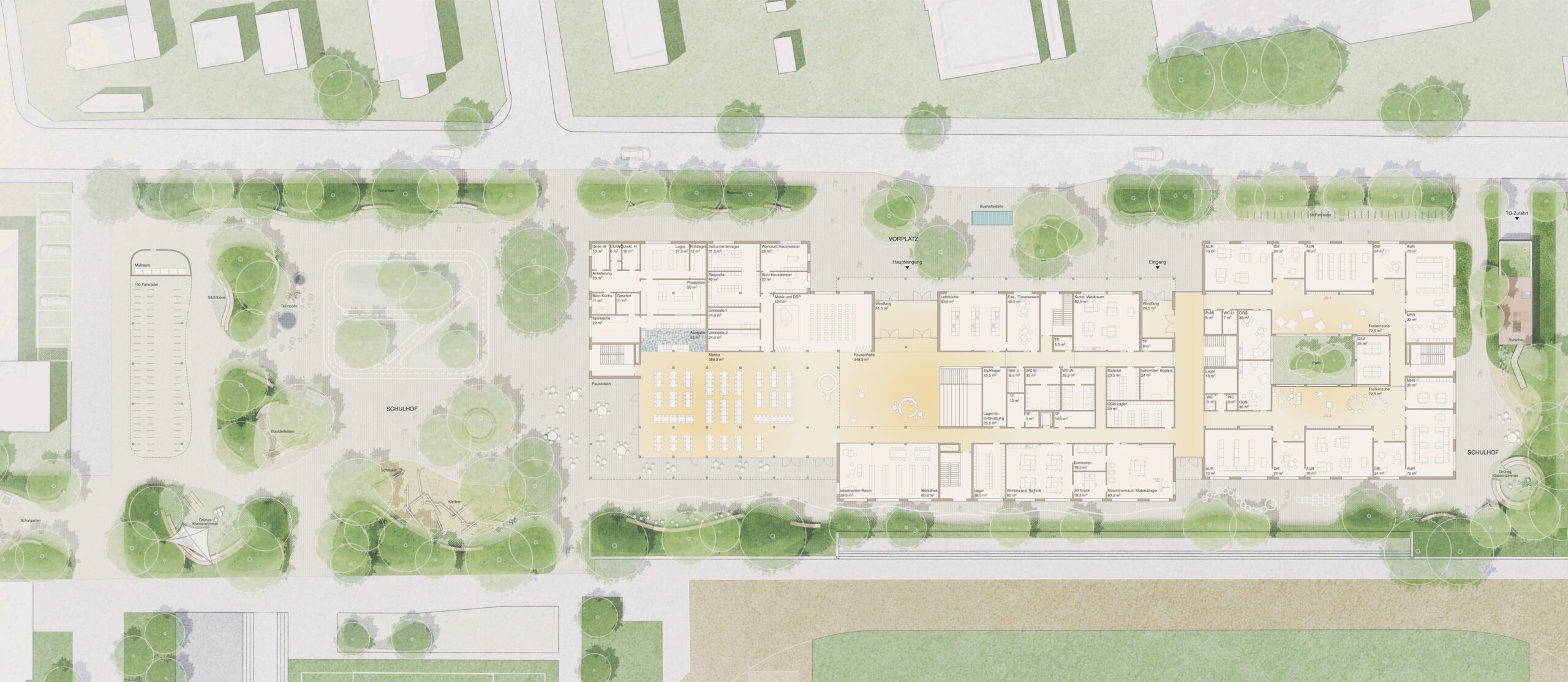
The centrally located main entrance is accessed via a spacious forecourt from the nearby public transport stop. In addition, the primary school has its own entrance, which makes everyday school life easier for younger children in particular and at the same time eases the flow of pupils at peak times.
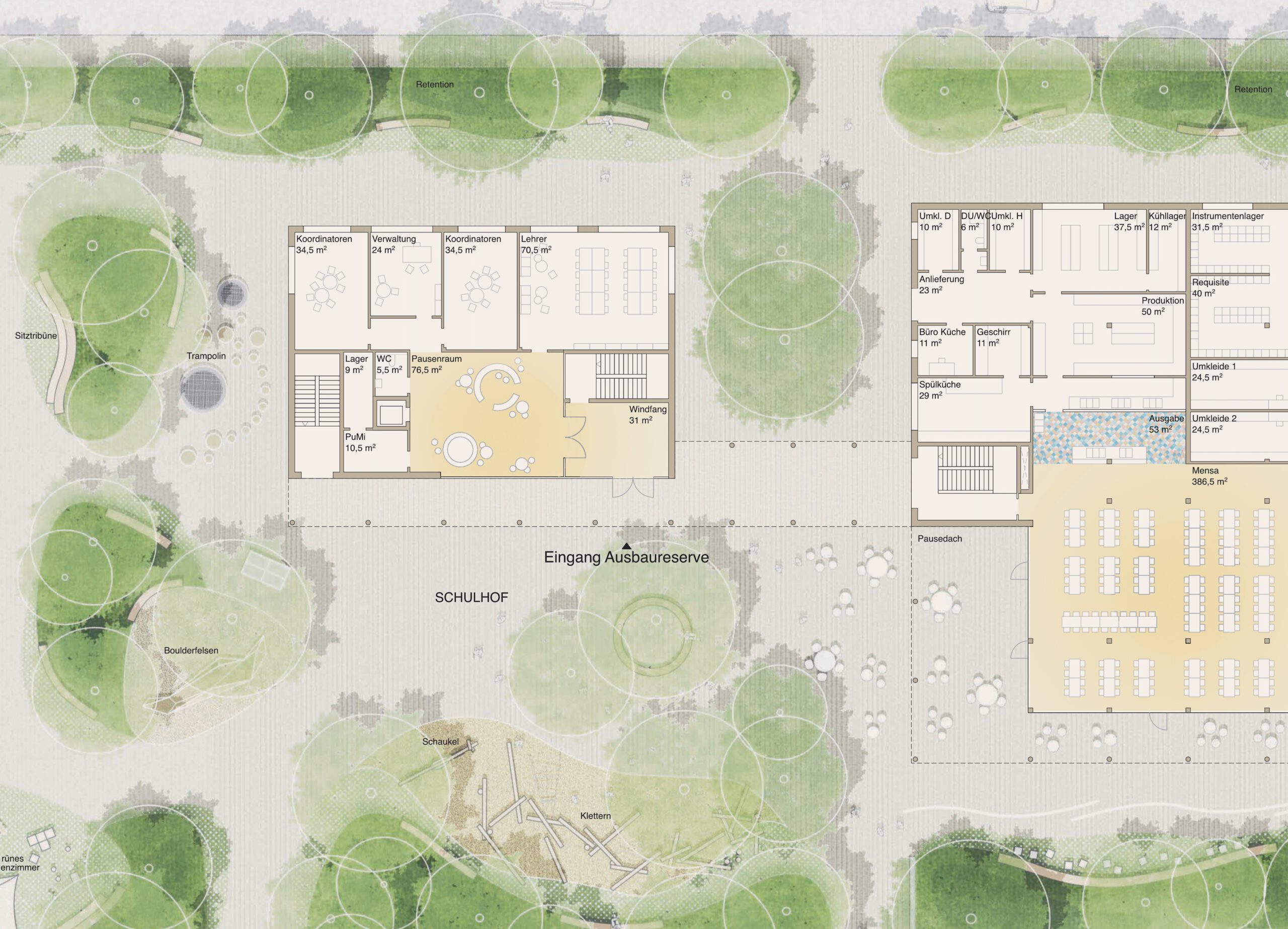
Inside, the building opens up to a central break hall with a canteen, which forms the communicative heart of the school. Large skylights with controllable dimming provide pleasant daylight, while flexible stage and room concepts allow for a wide variety of uses – from everyday encounters to school or cultural events. A surrounding gallery on the upper floors expands the possibilities for use and encourages interaction between the different year groups. The music room and library are directly connected to the break forum. The canteen opens generously onto the schoolyard and offers sheltered seating areas with its covered outdoor area.
The internal organisation follows modern educational approaches. Cluster structures with open learning zones promote communication, flexibility and independent learning. Classrooms and differentiation rooms are transparently connected to the open learning areas and naturally lit via additional inner courtyards. Short distances, clear floor plans and good orientation characterise the concept. The primary school has its own two-storey area with direct access to the upper floor. Two schoolyards of different sizes – a large one for everyone and a small one for the primary school – create age-appropriate spaces for physical activity. A central lift ensures barrier-free access to all levels.
Facade
The facade combines warm, natural materials with innovative, sustainable elements. Wooden cladding meets colourful, hexagonal façade tiles made from recycled plastic – so-called Pretty Plastic Tiles. These are made from 100% upcycled PVC, obtained from old window frames, rain gutters and downpipes. The colourful design symbolises the diversity of Europe and the openness of the school community. The material won the Green Product Award in 2021 and combines aesthetics, sustainability and durability.

Open space concept
The urban positioning of the new building creates a sequence of three independent but interconnected open spaces. These areas form a varied learning and exercise landscape.
The entrance plaza serves as a passageway and meeting point and is flanked by bicycle parking spaces. The primary school playground is a protected play area with age-appropriate climbing facilities and an integrated green classroom. A play path leads from there along the sports field to the large schoolyard, which is designed with groups of trees, curved shapes and different recreation areas. In front of the canteen, permanently installed furniture invites visitors to linger, while a large play structure in the south becomes a meeting place for exercise and community. Quieter areas are planned for the school apiary and another green classroom.
Water management and biodiversity
The open spaces follow an ecologically sustainable approach. Extensive green roofs, water-permeable surfaces and a rainwater recycling system contribute to the resilience of the area. Rainwater is retained on site, seeps away or is collected in cisterns for domestic use. The planting promotes biodiversity with species-rich, site-appropriate plant communities and creates valuable habitats.
Bicycle and car parking
The covered bicycle parking facility with a green roof is located to the west of the building. Car parking spaces are located in the underground car park, while above ground there are only parking spaces for people with disabilities.


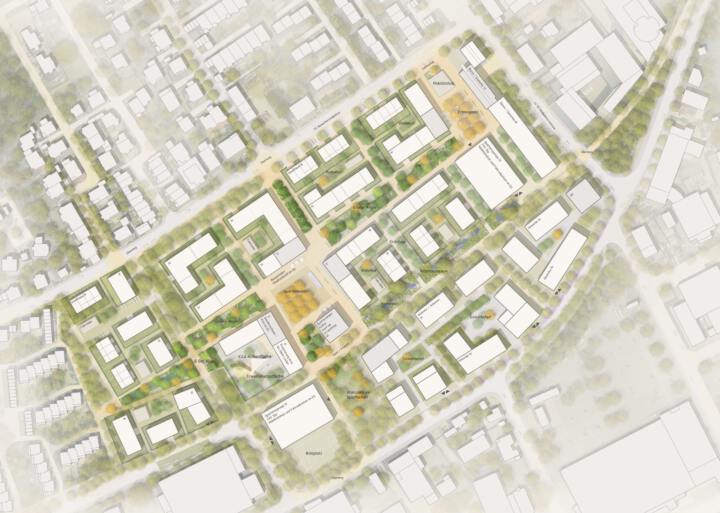
Former Telecommunications Office | Heusenstamm
1st Prize | Former Communications Office
Heusenstamm
In collaboration with Thomas Schüler Architekten und Stadtplaner
Urban development concept
The urban development concept builds on the adjacent urban fabric and forms an independent urban building block that mediates between the northern residential areas and the southern commercial area.
As an urban-style neighbourhood, new forms of living are emerging here that combine living and working and create a new type of sustainable urban neighbourhood for Heusenstamm on individual plots. The extensive greening of public spaces creates an all-round open-space interconnection and a green stepping stone to the adjacent landscape areas.
Open space backbone and neighbourhood structure
The new neighbourhood will be accessed via a central open space backbone, which the individual building plots will be based on and from which they will receive their addresses. This open space, as an ‘urban green space’, forms an attractive inner green corridor and connects all areas of the neighbourhood, promoting identification and community within the new urban neighbourhood.
This creates a high quality of living throughout the entire interior area with communal spaces for playing, meeting and spending time. Recesses and widenings create different spatial situations and give rise to an exciting internal structure.
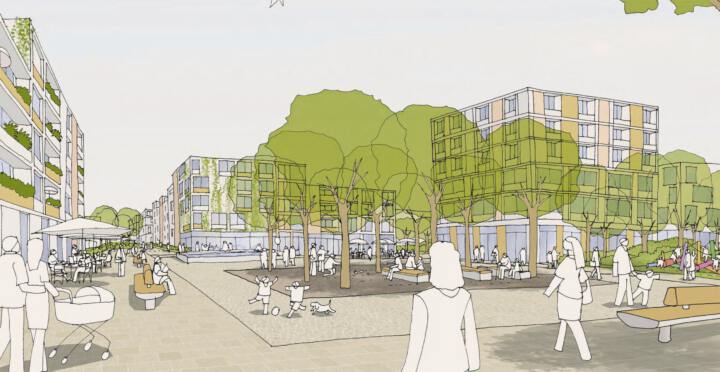
The ‘green common’ functions as a communicative communal open space with play and recreation areas for all generations.
Partially shaded by a mixed canopy of climate-resilient tree species, the green space integrates meeting places, outdoor fitness facilities and play areas. A subtle relief with hollows absorbs some of the surface and roof water and, in addition to the changing image of dry and temporarily wet areas, creates a mosaic of different location factors that promise a highly diverse species composition.
Green joints divide the new residential quarter into clearly legible individual building plots and provide clear orientation and address formation. At the same time, they make the quarter permeable, enable a variety of crossings and ensure connection to the existing cycle and footpath networks.
Development concept
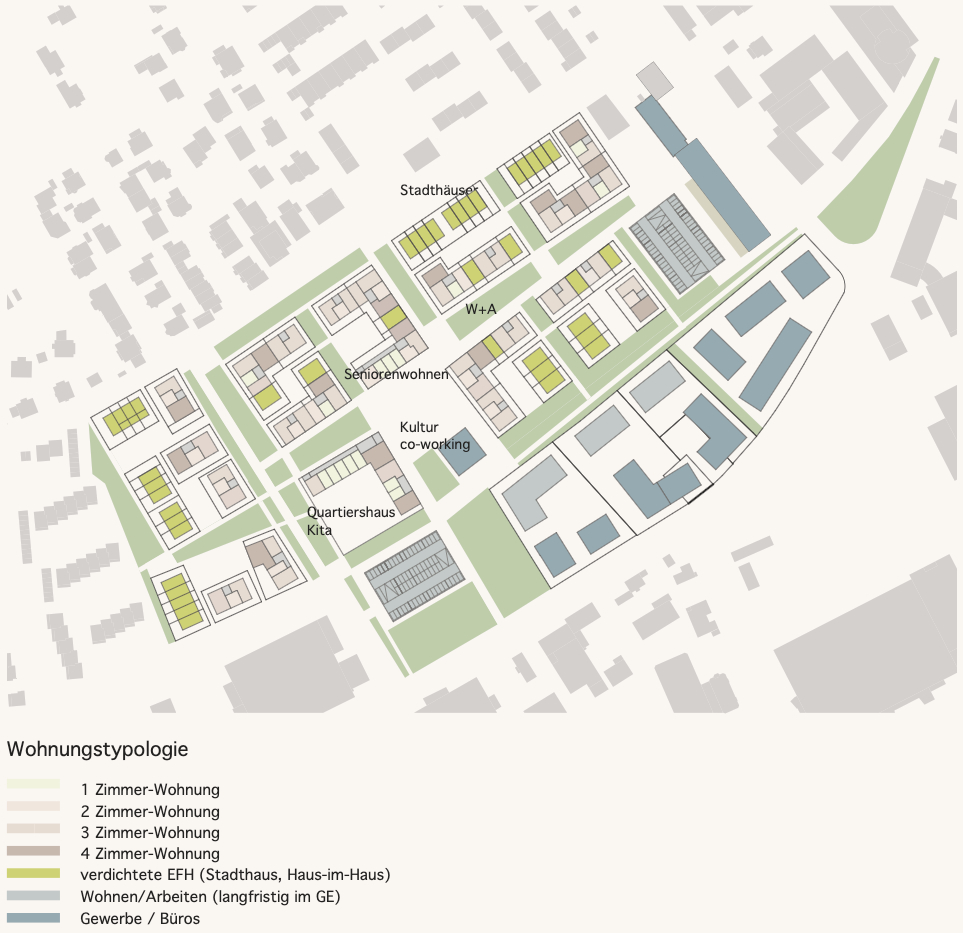
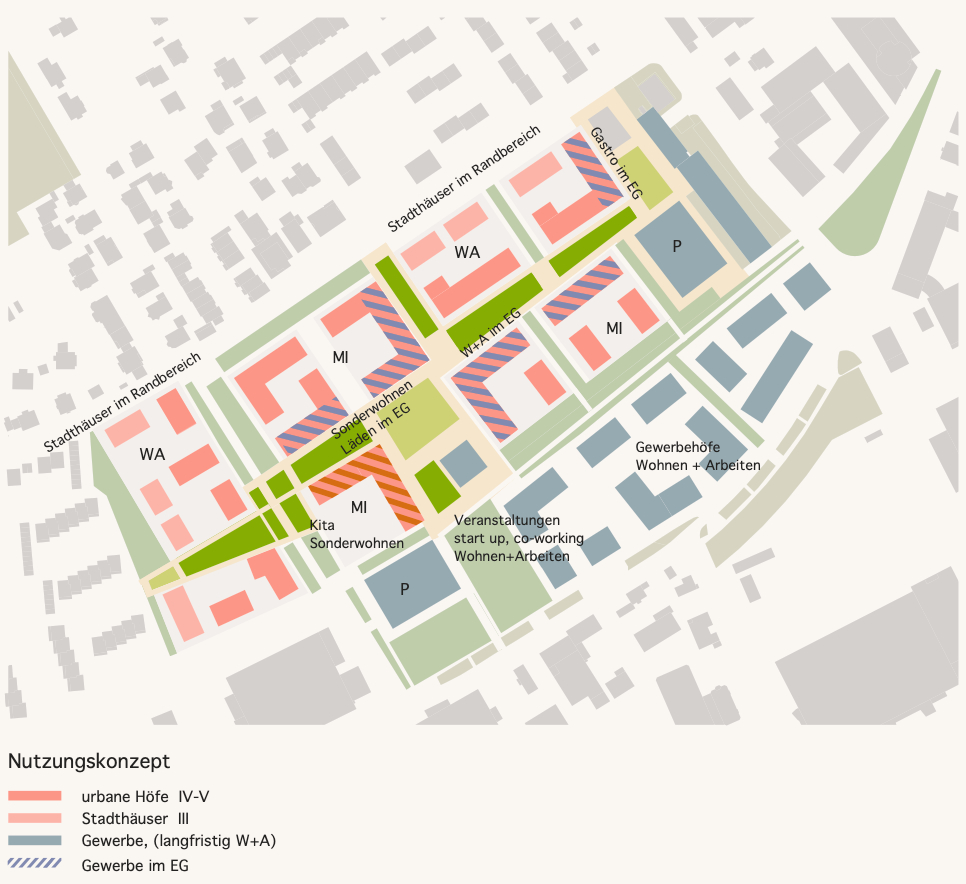
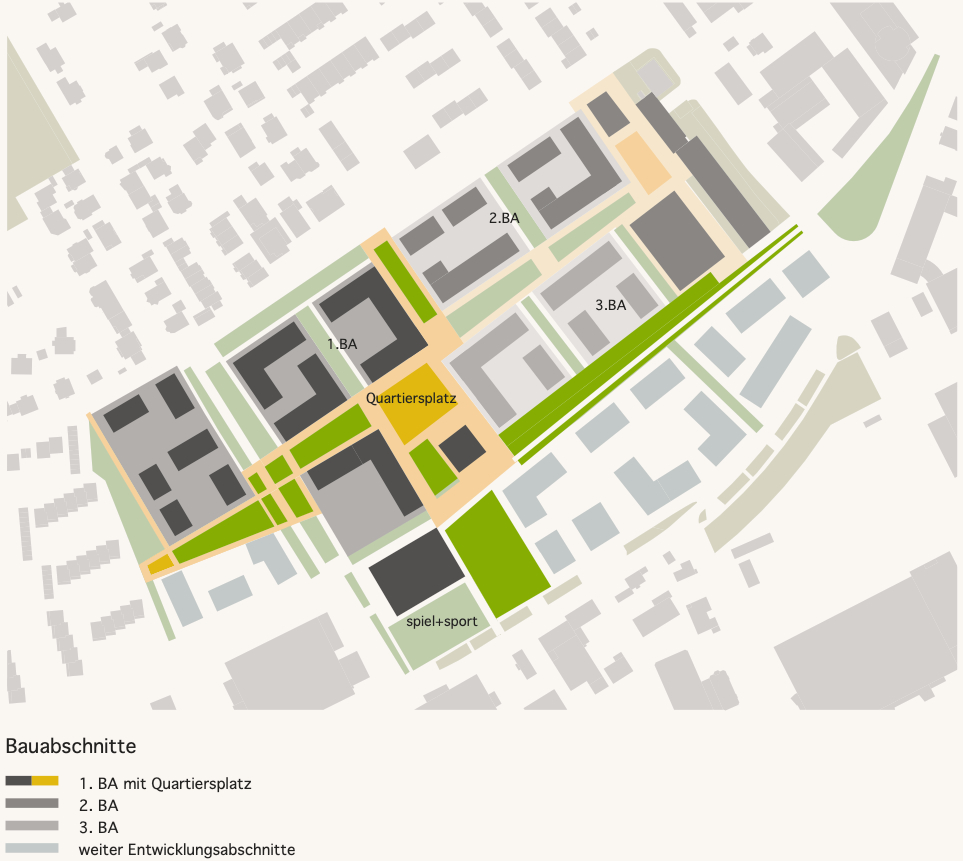
The concept envisages building plots with open courtyard structures that can be developed in sections as independent neighbourhood areas. They form a robust urban framework for a mixed-use urban neighbourhood, with a coexistence of residential, working and commercial uses. Flexible development for multi-storey residential buildings, townhouses or houses-within-houses with different living and working models will be created on various individual plots.
The building plots will be developed with individual detached houses, contributing to a lively, small-scale neighbourhood image. The result will be a flexible mix of different typologies for subsidised and privately financed housing.
Small ground-floor commercial units, communal areas and living+working spaces face the ‘urban green space’ and enliven the public space. The impetus provided by the building groups is being used here to strengthen the character of the neighbourhood with its mixed working and living models.
The residential courtyards support the idea of communal living, with play areas and places for communication. As green inner courtyards, they contribute to well-being and function as green oases with a high quality of living. Green living areas, residential gardens with large trees and self-sufficient gardens on the roofs form further communal areas within the building groups.
This clear and robust framework creates the conditions for small-scale construction development with a maximum of individual freedom. A few typological specifications will create the basic structure for a new urban quarter – integrated into the urban space and flexible for new living concepts.
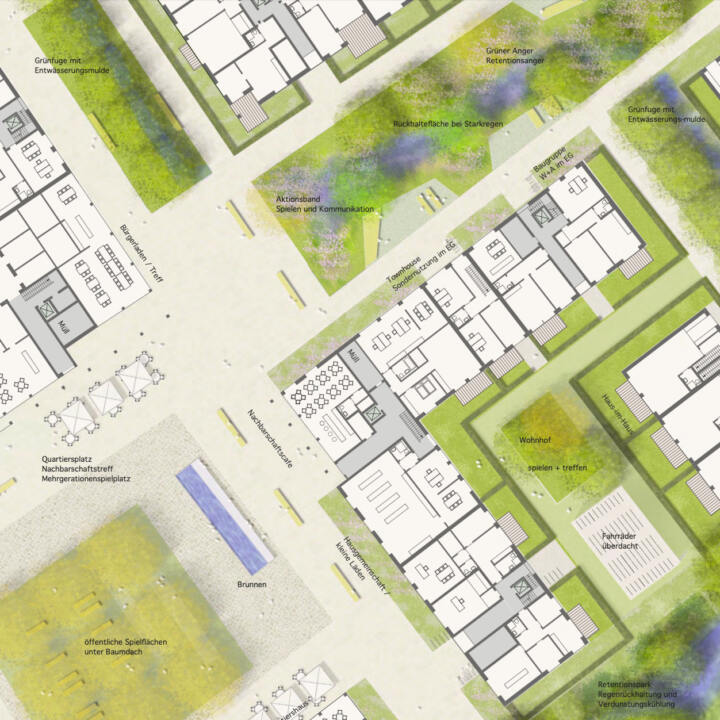
Central square as a calling card
At the intersection of the path axes, the neighbourhood square is created, which can serve as a hub for urban life. It forms the heart of the new neighbourhood and serves as a place of communication between the residents of the adjacent districts and the new neighbourhood. Here there are play and communication areas for all age groups and open-use areas for community events. A small fountain forms a central and invigorating element on the square.
The central neighbourhood house is being built directly on the square, symbolising the architectural centre as a solitary landmark. It will house cultural and commercial uses, co-working and innovative office space for start-ups. A gallery café enlivens the public space and acts as an urban magnet.
Adjacent to this is the neighbourhood centre with a daycare centre and a multi-generational house above it. The neighbourhood meeting place and community shop will enliven the striking corner of the northern construction site. Above these are special types of housing for senior citizens with various care services.
Climate protection and climate adaptation
All trees worth preserving will be retained and supplemented with new tree plantings. The current and future tree population can thus continue to serve as a source of fresh and cool air. The open construction method provides bioclimatic relief and improves ventilation conditions.
Within the neighbourhoods, too, generous tree planting in squares and residential streets will provide sufficient shade and thus contribute to improving the microclimate. The greening of inner courtyards, extensive façade greening and the greening of roof areas will ensure maximum cooling and evaporation effects.
Traffic and mobility
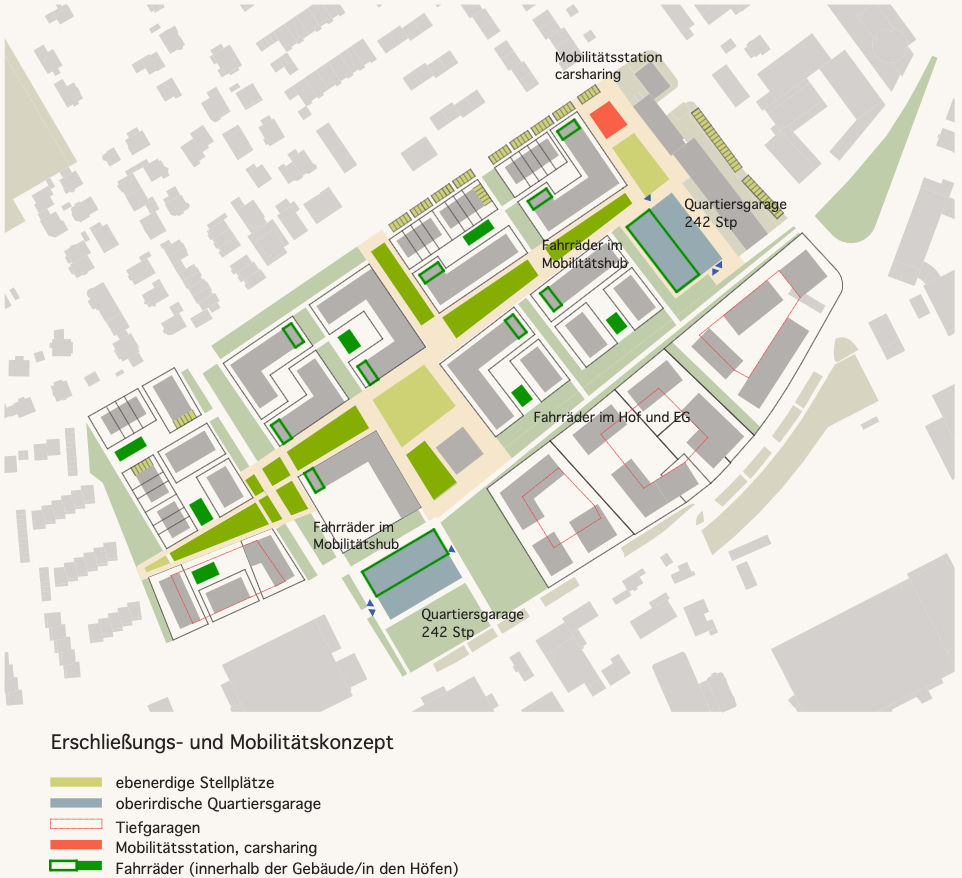
The car parking spaces are distributed across two neighbourhood garages located centrally within the individual construction phases. Access is via the adjacent road space, with traffic taking a short route to the neighbourhood garage. The entrances to the garages face the squares, creating communicative spaces. The base houses a mobility station and parking spaces for bicycles.
The central mobility hub is located at the entrance plaza, a pavilion with a bicycle repair shop and all the functions required for the concept of ‘soft mobility’, such as car-sharing spaces, rental bicycles and charging stations for electric vehicles. Intelligent mobility and sharing concepts in combination with public transport can significantly reduce moving and stationary vehicle traffic. The footpaths and cycle paths through the green spaces reinforce the permeable internal access concept and promote individual walking and cycling.
The residential environment is kept free of traffic and is only accessible to residents, refuse collection and emergency vehicles when necessary. This creates a largely traffic-free interior area with high-quality open spaces, which in turn creates a vibrant neighbourhood with a high quality of life. Understated and well-placed street furniture enhances the quality of public spaces as places for people to meet and communicate.
Rainwater concept
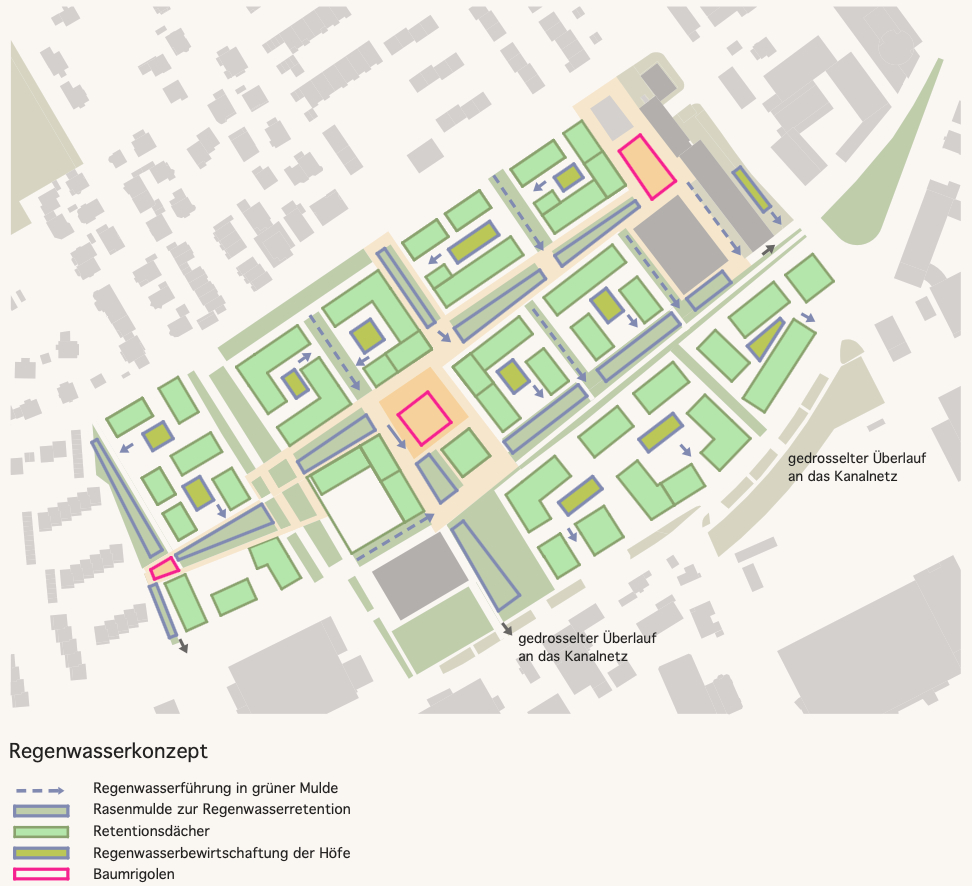
A differentiated, decentralised rainwater management system in three stages is proposed for drainage. In the first stage, the roof water is retained via retention roofs and a large proportion of it evaporates on the roof via green roofs, which has a significant cooling effect on the area.
The remaining and greatly reduced portion of the roof water, as well as the runoff from the very limited paved areas in the inner courtyards, is retained via open ditches and gutters and in the slightly lowered lawn depressions, where it partially seeps away. In addition, if proven to be economically viable, water from private areas can be collected in decentralised retention cisterns, retained on the property and used for grey water purposes.
Rainwater from public roads and squares is also collected in a network of small ditches and open gutters and, in a first step, fed into the slight depressions within the Green Anger and the green joints. In the event of heavy rainfall, these hollows flow into the retention area on the southern edge. Due to the long retention time of the water in the green hollows, some of the water can evaporate or seep away into the vegetation areas.
Tree trenches ensure that the collected surface water from the squares supplies the trees with water.
The topic of rainwater management is made visible and tangible as an ecological quality and adaptation to climate change, contributing to the positive image of the settlement.
Economic efficiency/recycling
The primary goal is to reuse demolition materials, e.g. as recycled concrete in a hybrid construction with timber. The buildings are constructed using recyclable materials and are energy self-sufficient. The waste-to-energy concept is also intended to contribute to a natural cycle of recyclable materials in which no waste is generated.
The planning is based on recurring dimensions and takes into account uniform standards in all areas. This creates the conditions for an element-based construction method with a high degree of prefabrication, which is particularly useful in the field of timber construction. The aim is to save as much energy as possible with as few technical measures as possible, to conserve resources and to make maximum use of them.



Children's Centre, educational campus Rainbrunnen | Schorndorf
Recognition | Children’s centre, educational campus Rainbrunnen
Schorndorf
In collaboration with Atelier 30
Urban integration and interlocking with the landscape
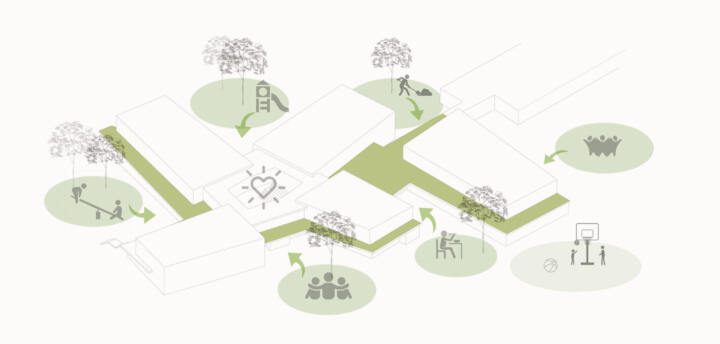
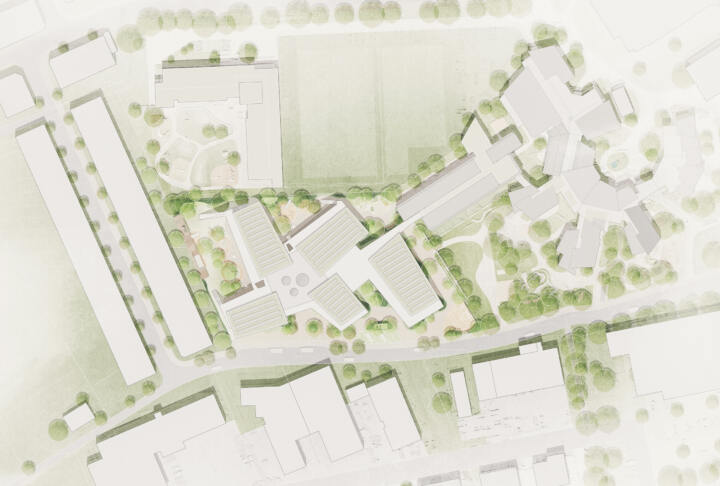
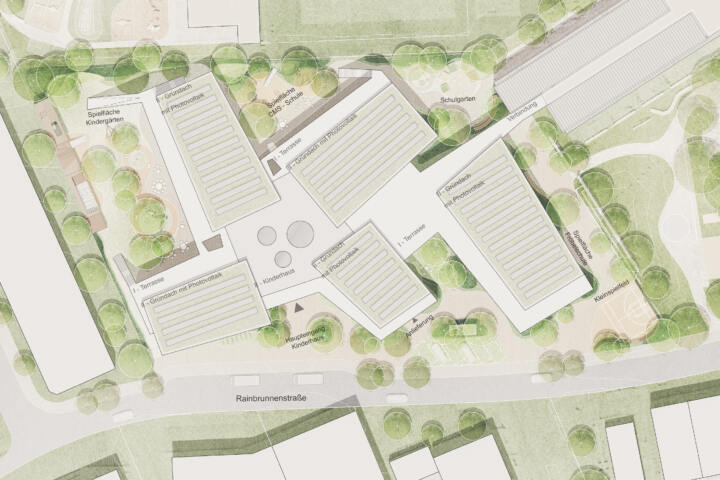
The new children’s house with the extension of the school building on the Schorndorf educational campus is a scaled ensemble of individual buildings with a common centre, the future communicative heart of the new buildings. In the context of the existing buildings, these form an arrangement in a free network that interlocks with the open spaces and offers well-proportioned open spaces.
The school extension for the Fröbelschule is connected to the new building in a natural way. The kindergarten will have its own separate entrance in the southern part of the site. The design concept of interlocking landscape and building is also reflected in the interior of the ensemble. The orderly structures of the buildings create very well-organised interior sequences and exciting spatial relationships from the inside to the outside and vice versa. These characteristics make the new building an emblematic, varied and creative building for children and teachers. Another important aspect of the concept was to locate the uses in recognisable structures, whereby the extension to the school complements and strengthens the existing campus concept and its facilities.
Outdoor facilities
Arrival
The start of the new school and kindergarten day takes place on the forecourt. Planted with a multi-stem, generously planted amber tree with a round bench hovering around the tree, the entrance plaza is both a passageway and a recreation area. The western part of the forecourt along the lay-by and in front of the main entrance offers generous space for waiting, boarding and alighting, while the eastern part extends the open space in front of the dining hall, offers space for the playing field to be relocated and extends the existing playground of the Fröbelschule to the east.
Play yards
The positioning of the buildings allocates clearly defined open spaces to the individual kindergarten and school areas. A linear play sculpture with integrated sand play, climbing and retreat options and a slide closes off a western play yard to the property boundary and arranges the play options in such a space-saving way that there is plenty of room for romping and dashing and for a bobby car track outside the fall protection area. The northern play yard in the spatial context of the Christian Morgenstern School is designed as an exercise yard with a range of play equipment adapted to the age group. The school garden with its opportunities for barrier-free gardening and outdoor lessons is located in the north-east courtyard.
Ecological aspects
We see the open space on the entire site as a heavily greened play and school landscape. It is covered by large-crowned future trees and structured by sunken areas of grasses and shrubs which, in addition to their insect-friendly abundance of flowers, also serve as retention and seepage areas. The paved recreation areas are paved with permeable concrete paving, with linear grass paving at the edges. All shrub plantings around the edges are planted with native trees and shrubs and a border of native wild herbs to protect birds. Where no playable and walkable lawn area is required, lean, double-cut meadows make their contribution to biodiversity. In addition to aesthetic considerations, all planting is carried out in such a way that it can make a valuable contribution to biodiversity. Through a targeted selection of different substrates, a mosaic of ecologically valuable sites is initiated, which develops into particularly species-rich plant communities through the sowing of native wild herb seeds. Modelling the terrain into shallow depressions for retention and infiltration further increases the diversity of the microsites.
Water management and biodiversity
In addition to the requirements of the exercise and learning landscape, the open spaces also fulfil fundamental functions of resilient and sustainable area development. These include a maximum of structurally rich vegetation areas, water-permeable surface paving and rainwater management as a circulation system. The roof surfaces of the school building are designed as retention roofs (approx. 20-40 cm of substrate and retention boxes) to optimise rainwater retention and evaporation. The substrate layer in combination with the retention boxes stores the rainwater and makes it available to the plants. In the ground-bound vegetation areas, the rainwater is channelled to the planting areas through the formation of the topography.

Daycare Centre Hegge | Waltenhofen
2nd Price | Daycare Centre Hegge
Waltenhofen
In collaboration with Benkert Schäfer
Local spatial setting and integration into the surroundings
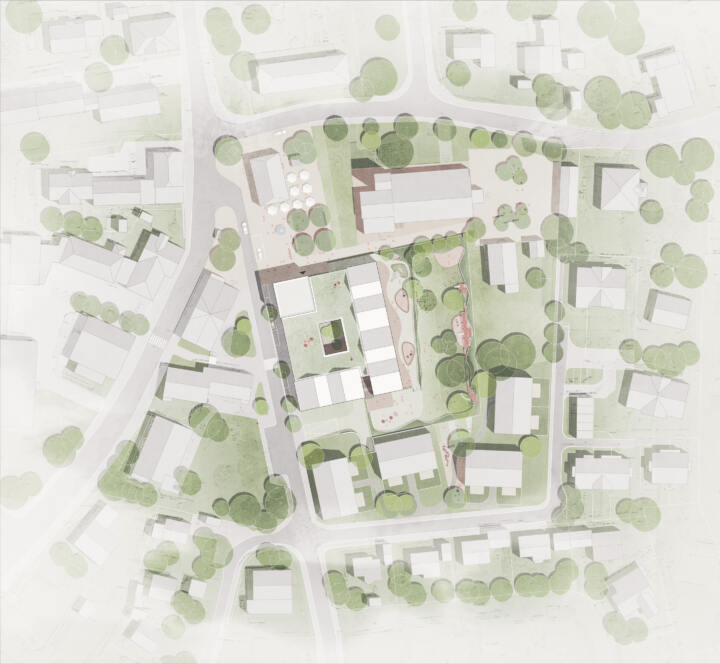
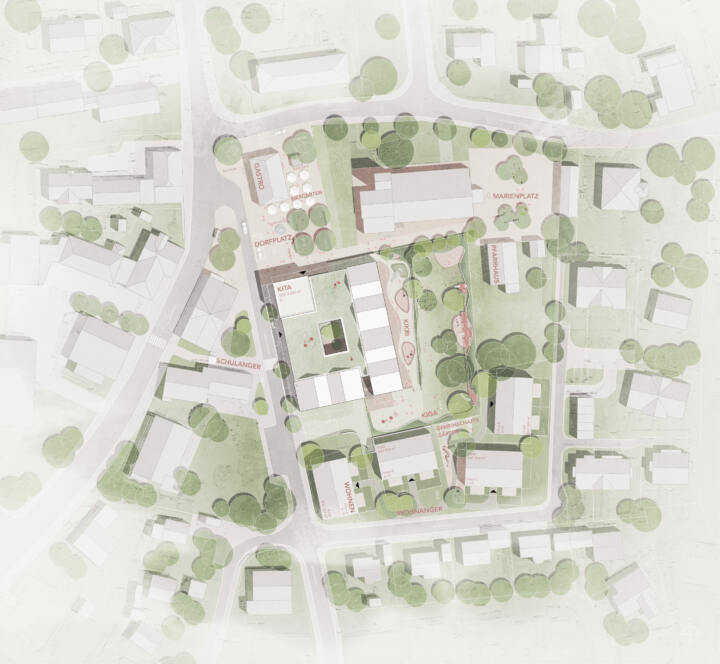
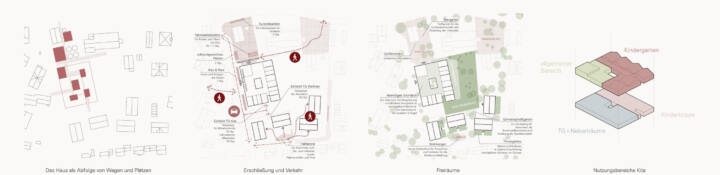
The district of Hegge is characterised by open development without spatial densification towards the centre. Peripheral zones have been densified by residential development, while the centre lacks a place for the community. The new day care centre is intended to resolve this tension and seize the opportunity to create a new centre. The proposed location of the new daycare centre in the immediate vicinity of the church and local supermarket will reorganise the village centre and create a lively village square. In order to bring the church back to life on the village square, buildings that are no longer necessary will be removed. The deliberate placement of trees divides the new village centre into different areas of use. A small pub with a beer garden and shady areas invite people to linger. A cooling fountain improves the microclimate, especially on hot summer days. The new daycare centre itself is an open house for the children on the village square. With a sequence of paths and squares, it continues the village square inside and allows the different uses of the daycare centre to be experienced. The building makes clever use of the local topography – the multi-purpose room directly at the entrance is an address and open to the whole community, while the kindergarten and other communal uses are organised around a shared inner courtyard at the centre of the building. The crèche for the youngest children is organised in the plinth below, with direct access to the garden. An open and rhythmic setting in the scale of the surrounding buildings is proposed for the residential building. Following the principle of the clustered village, small outdoor areas are created that can be used communally.
Access and traffic
The main access to the daycare centre is via the village square and Veitser Straße. Kiss & Ride car parks will be created along the road to ensure that children can be picked up and dropped off safely. Access to the garden to the south and east and an entrance from Veitserstrasse, as a link to the day-care centre opposite, round off the connection with the surrounding area. Parking for daycare centre staff and residents of the new residential development is provided in the shared underground car park, which is also accessed from Veitser Strasse. Additional parking spaces for short errands in the village centre are located to the north of the village square along Industriestrasse. The residential street ‘Am Pfarrgarten’ will therefore remain largely reserved for residents and thus offers quiet access to the individual residential buildings via the shared green. A new footpath connects the village square with Marienplatz and creates a direct pedestrian axis for the residents of the eastern ‘Illerbogen’ area. The entrance to the new daycare centre is located on the village square, where there is also covered bicycle parking – creating a meeting place for teachers, parents and children. The kitchen will be delivered via an additional entrance on Veitser Straße.
Typology and spatial organisation
The two-storey day care centre blends harmoniously into the existing hillside location. The entrance area and the foyer with multi-purpose room are located on the ground floor, facing the centre of the village square. The general area with kitchen and dining room as well as the kindergarten are accessible from there. The large exposed seating staircase in the foyer leads to the garden level below and, in addition to providing access, also serves as a reading staircase and library.
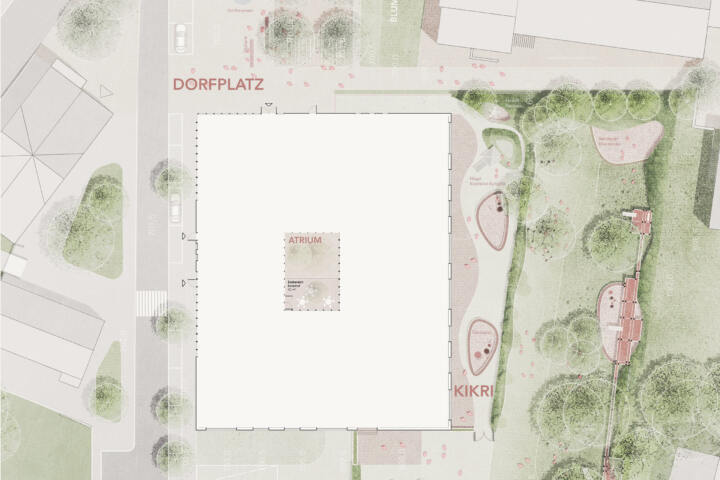
An atrium in the centre of the building provides sufficient lighting and offers further sheltered outdoor areas for the children. The crèche is located on the garden floor with direct exits to the toddler play area in the garden. The workroom and studio are centrally located and have their own outdoor area in the atrium. The staff area is also located on the garden floor, with its own exit to the outdoor seating area. The underground car park, storage area and ancillary rooms are economically located on the slope side of the garden level.
Orientation towards the open space
All of the daycare centre’s group rooms face south-east towards the garden. The children in the kindergarten can access the garden via an external staircase in the south of the building or barrier-free via the lift. Various play areas and a large play element await them there. The area of the former parish garden will be integrated into the new play area. The younger children in the crèche have direct access to the garden via their group rooms. The outdoor area of the staff area leads via an atrium to a small terrace.
Outdoor facilities
The open space of the new day care centre creates a lively, green environment,
that blends harmoniously into the existing village structure. The preservation of the existing trees creates a natural atmosphere, provides shade and makes a valuable ecological contribution. Careful modelling of the topography creates varied outdoor areas that take up the natural terrain formation. A multifunctional play element structures the space, serves as a separation between the areas and at the same time promotes the children’s motor skills. It integrates additional storage areas for outdoor play equipment. The nursery and crèche areas are clearly defined by targeted planting, while terrace-like open spaces allow flowing transitions between indoor and outdoor areas. This creates a well thought-out. This creates a well thought-out combination of nature, play and community that optimally supports the educational use of the outdoor space.
Sustainability
The new daycare centre in times of climate change – sustainable, economical and climate-neutral
In the construction sector, and therefore also for cities and municipalities, there is a growing responsibility to focus on sustainable concepts when realising new buildings. The building proposed here is therefore sustainable, economical and forward-looking.
TOPOS and open space – sustainable inner-city development is climate-resilient and can adapt to climate change through blue-green settlement strategies. Green roofs and, in some cases, green façades reduce heat loss and improve the microclimate through absorption cooling in summer. A house tree and retention areas in the inner courtyard support these measures. Rainwater can be retained on site via cisterns, utilised and excess precipitation can seep away in soakaways on the property
New Construction of the Training Academy Chamber of Crafts Karlsruhe | Karlsruhe
Recognition | New Construction of the Training Academy Chamber of Crafts Karlsruhe
Karlsruhe
In collaboration with Atelier30
Urban planning idea
The new training academy gives the Karlsruhe Chamber of Crafts the opportunity to present itself in the context of constant economic, technological and social change with a new, contemporary and modern learning and working environment.
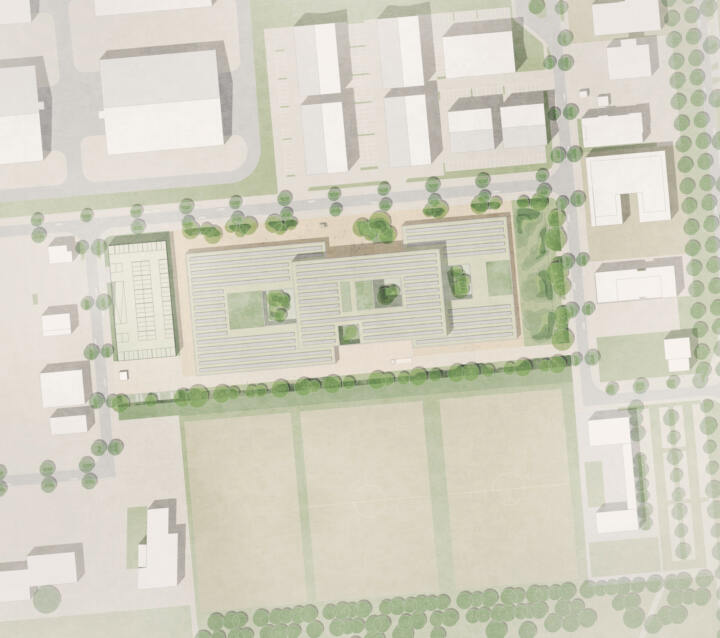
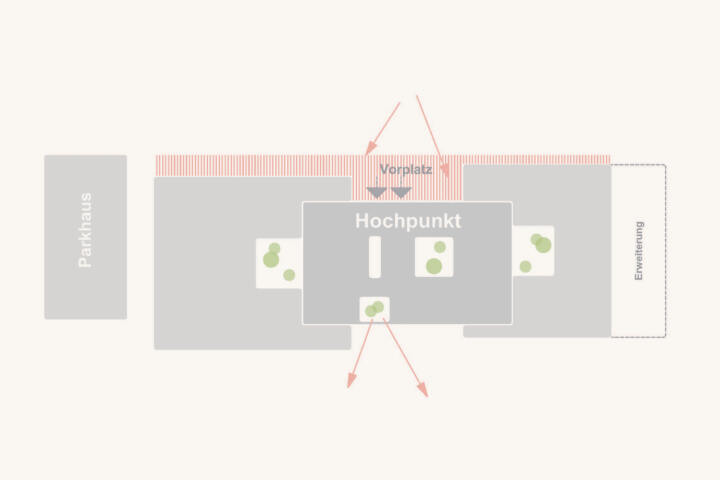
In accordance with planning and building regulations, the new building will be positioned along Johann-Georg-Schlosser-Straße. By staggering the structure, the building volume is structured and functionally organised.
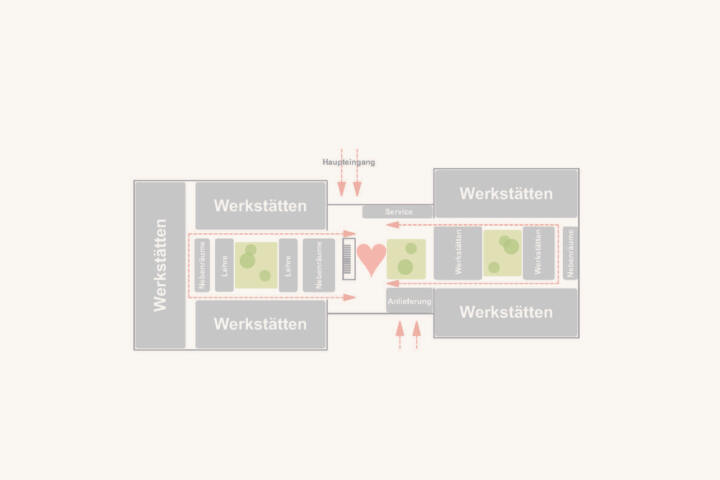
The main entrance to the building is located in the centrally positioned, striking three-storey section of the academy, giving the educational academy an easily recognisable appearance that is appropriate to the location.
An entrance square is located in front of the main entrance, providing a short link between the car park at the side and the main entrance.
Inner courtyards
The workshops are arranged around central courtyards. This creates a varied circulation area with interesting views when moving through the workshop areas. In addition, widened areas in front of the courtyards and the courtyards themselves offer space for communication and relaxation.
Open space
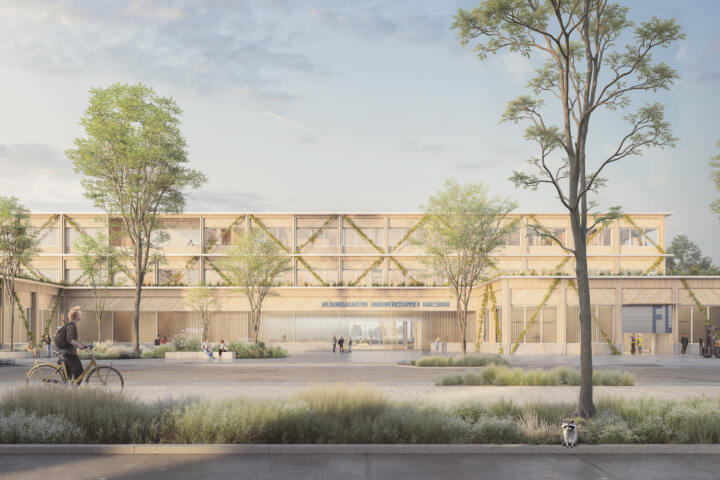
The Bildungsakademie in Karlsruhe is reached via a spacious forecourt. Past small green islands and numerous trees, the entrance is clearly recognisable. A combination of greenery and seating areas creates an attractive place to meet and offers the opportunity to spend time in the urban centre under shady trees.
The collective relocation of the car parks to the western part of the site creates a calmer area in front of the academy for pedestrians and cyclists. This is reinforced by bicycle parking spaces in front of the entrance.
Deliveries are made via the southern open space. Together with the entrance to the petrol station, deliveries can take place separately from the rest of the Academy’s use. A strip of vegetation in combination with a fence restricts accessibility and creates a clear spatial separation. To further enhance this area, however, numerous trees will be planted. Small niches with seating areas are created under this tree canopy in combination with extensions of the green belt.
A central point in the outdoor area planning is the increasingly important rainwater management in order to ensure that the educational academy remains a modern location for many years to come. Generous retention and infiltration areas were therefore planned.
To the south of the new building, the retention area is located in a combination of several troughs. This allows excess rainwater from the site and neighbouring areas to be collected, evaporated and seeped away.
A green belt around the car park deck also allows some of the rainwater in the western part of the site to be absorbed. The remaining water is channelled into the long infiltration area to the south.
The three inner courtyards with green and seating elements also support the handling of precipitation through direct infiltration areas.
Roof and façade design
The roofs of the single-storey building areas and the storey ceilings of the central building are planned as timber-concrete composite ceilings on a construction grid of 5x5m. If required, the construction grid can be extended to 7.5×7.5m or 10x10m and the construction supported by beams.
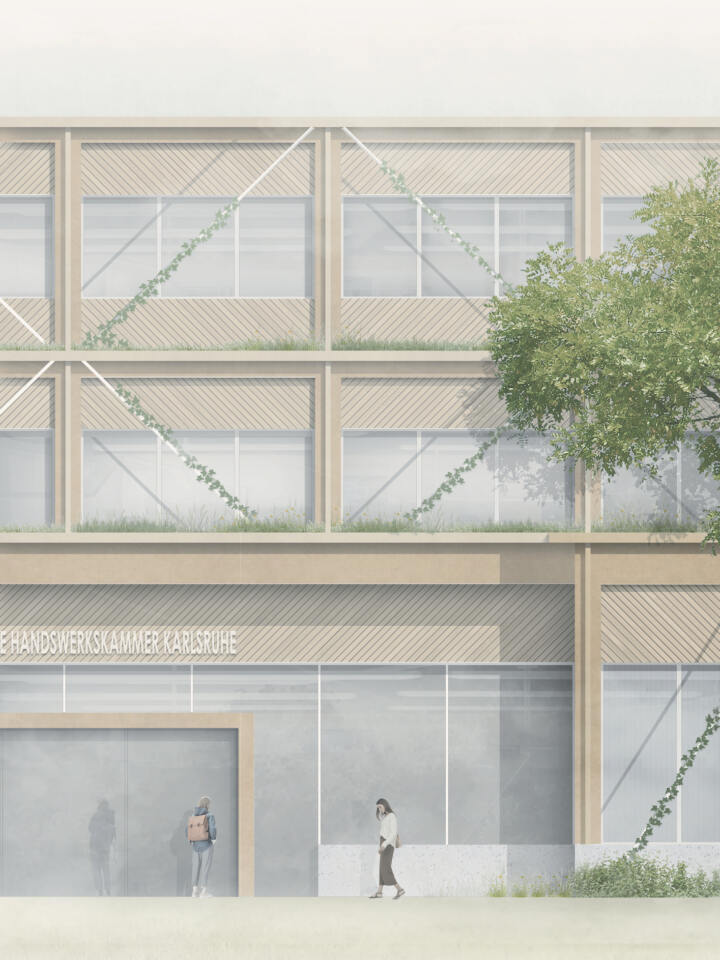
The façade elements and interior walls are planned in timber frame construction.
The materiality of the façade continues the timber construction method. The façade surfaces are clad with timber panelling. Greenery is proposed for parts of the façade.
Biodiversity and rainwater management
In addition to the functional requirements of the educational academy, the open spaces also fulfil fundamental functions of resilient and sustainable area development. Rainwater management, water-permeable surface paving,
vegetation areas rich in structure, biodiversity and cohabitation take centre stage here.
centre stage. The building roofs will be intensively greened with regional seeds. The 30 cm thick substrate layer retains rainwater almost completely through storage and evaporation. Excess rainwater from the roofs is collected in cisterns and made available as service water for the building services and the green areas.
The outdoor areas are provided with a comprehensive rainwater management system. For this purpose, the rainwater is channelled into the planting or shrub areas so that it can be collected there and seep away locally. Excess rainwater during heavy rainfall events is channelled into retention areas.
The open green spaces, with a large proportion of species-rich flowering zones, with heat-tolerant extensive shrubs and grasses, serve as food and habitat for bees and insects. Free-growing hedges of native trees and shrubs are planned along the edges; they form the boundary of the space, reduce noise and provide protection. Interspersed fruit trees increase the biodiversity of the open space. A green space for people, animals and plants.
Forstfeld-Centre | Kassel
2. Preis | Forstfeld-Centre
Kassel
Multiple commissioning in collaboration with Baufrösche
Key idea
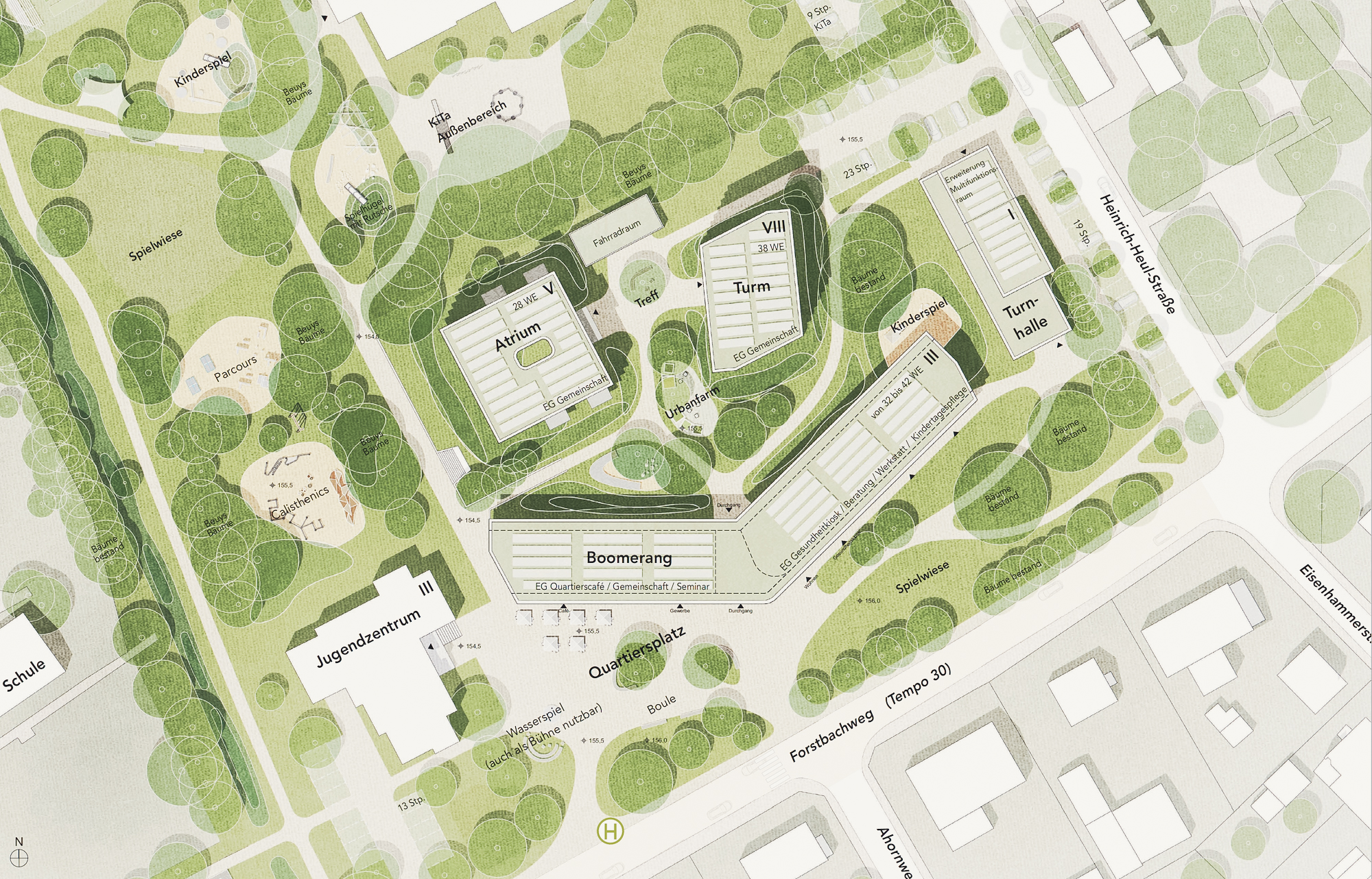
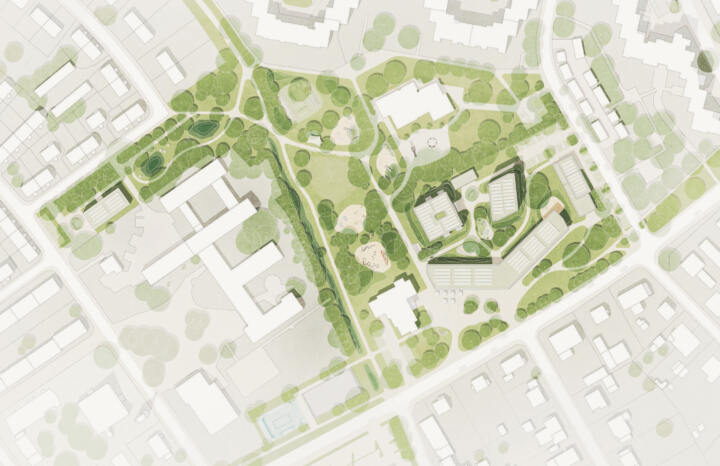
The urban design for a district centre combines a targeted building configuration with the existing buildings, striking groups of trees with an inviting green neighbourhood square along Forstbachweg.
Urban development and open space
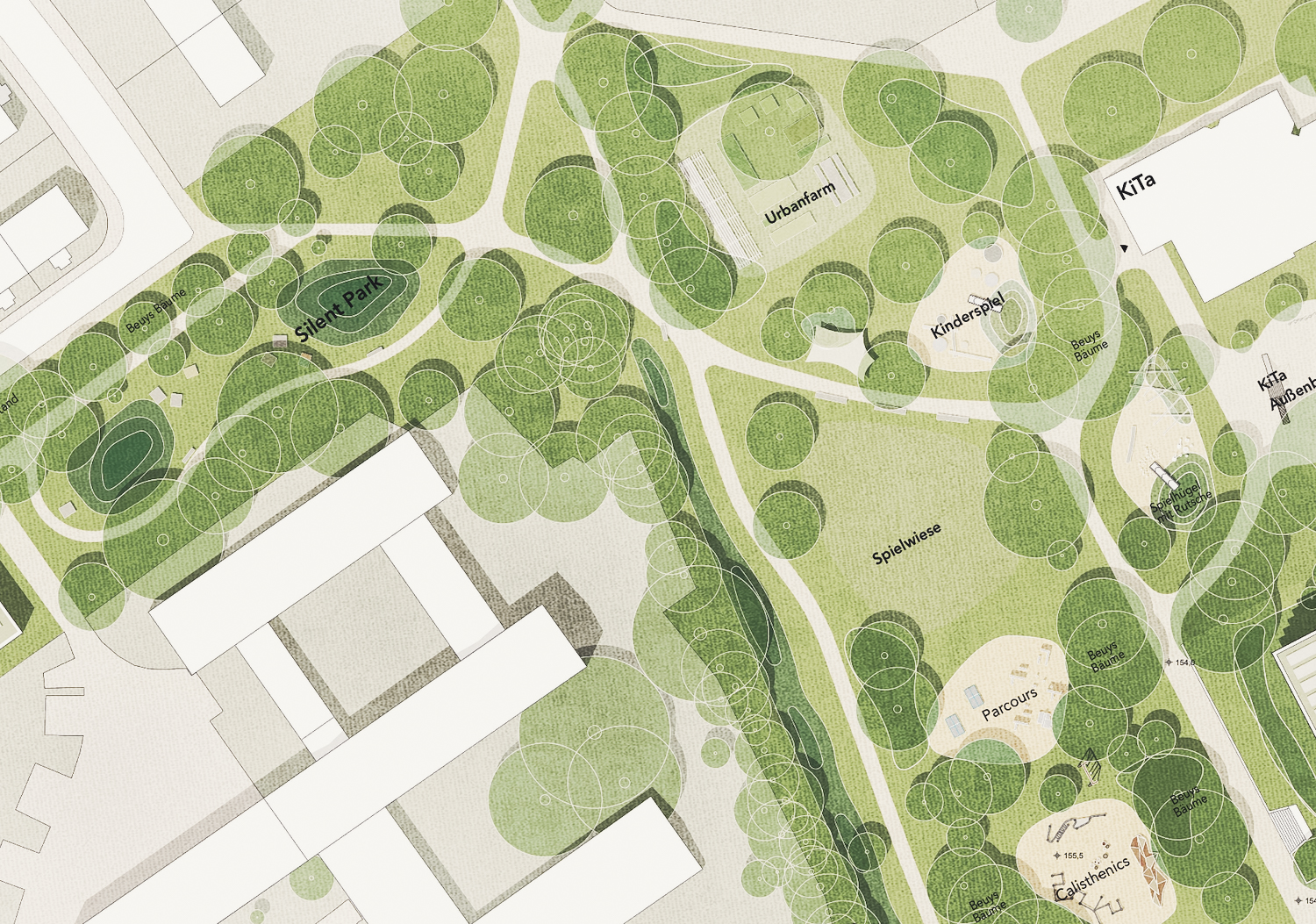
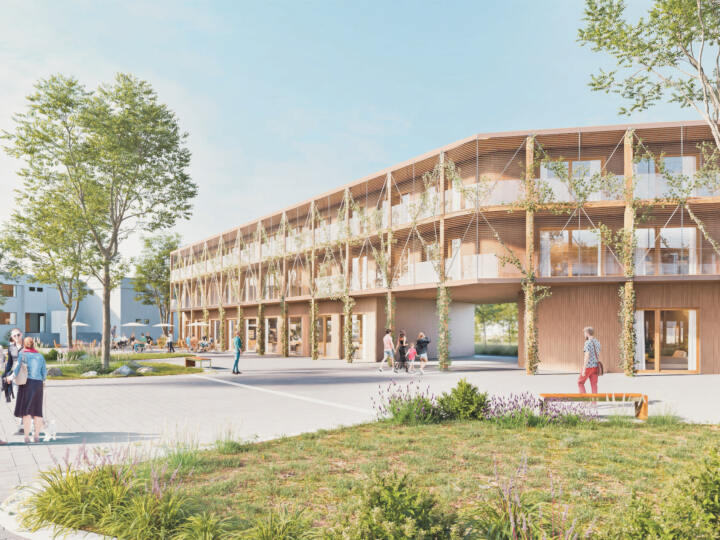
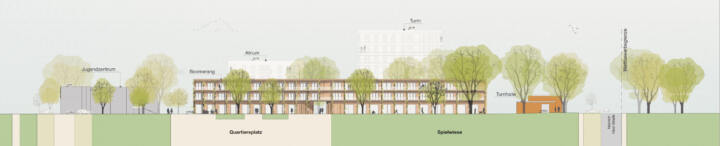
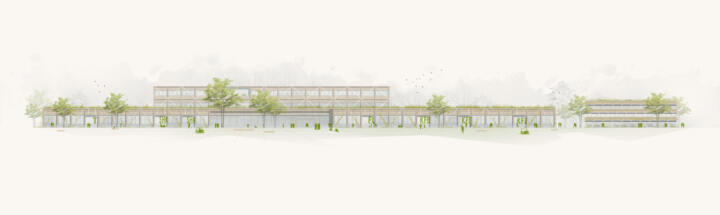
The Boomerang House for meeting, education and living forms the new district centre with a neighbourhood square and park along Forstbachweg thanks to its urban design, together with the youth centre and the gymnasium and multifunctional hall. The planned greening with old and new trees contributes to the creation of an inviting, versatile and protected open space. The ground floor of the Boomerang building is intended for communal, social and commercial uses in order to revitalise the centre of the neighbourhood and visibly promote social interaction. The tower and the atrium house complete the collage and together form a green, semi-public residential courtyard. This residential courtyard can be further enlivened by spacious communal areas on the ground floors, making it ideal for communal living models. A spacious passageway in the Boomerang House connects the open, park-like courtyard with the neighbourhood square. The TOGO House at the end of Togopark forms a striking spatial accent, provides social security and utilises the existing unused brownfield site for residential and commercial use. The noise-intensive uses for a ball sports field and a skate park are being created on the school grounds along Forstbachweg and, together with the supermarket, now complement the new Forstfeld centre along Forstbachweg. These measures will help to reduce noise pollution in the neighbouring residential areas.
Development
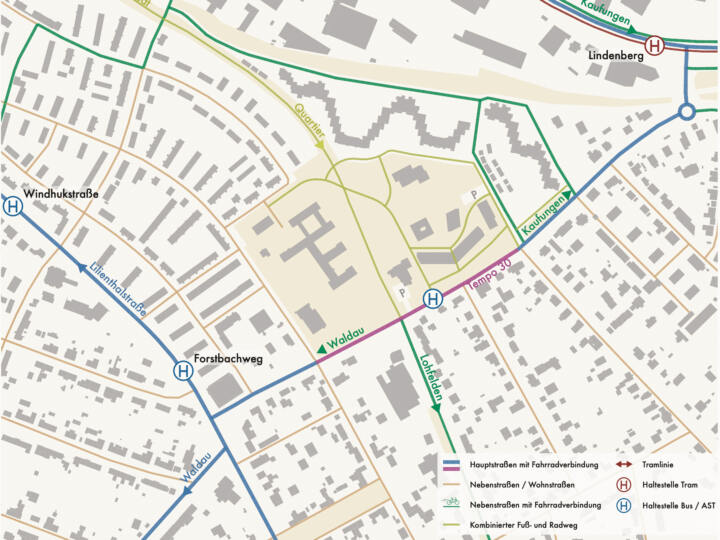
Car traffic in the entire neighbourhood will be significantly reduced in order to prioritise public open and green spaces as high-quality recreational areas for the residents of the Forstfeld district. Forstbachweg will be converted into a 30 km/h zone in some areas (e.g. Leuschnerstraße). The existing access road and the car parks for the daycare centre will be removed and relocated to Heinrich-Steul-Straße. The areas of the existing car parks will be converted into outdoor play areas for children. The resulting elimination of the break between the youth centre and the adjoining areas will make a significant contribution to moving the Forstbachweg building into the urban context and onto the neighbourhood square. The required parking spaces will be provided in a short cul-de-sac and along Heinrich-Steul-Straße. If required, an underground car park can be built under the tower house. Bicycle parking spaces are provided in the open space with hangers and a lockable bicycle shed. In addition, the lifts in the residential buildings are suitable for bicycles, so that bicycles can also be parked safely and conveniently in their own cellars. It is possible to cycle through the new centre of Forstfeld at a speed of 10 km/h. As the Boomerang House is only planned with three storeys and the tower house and the atrium house will be equipped with safety staircases, no complex fire service bypasses are necessary.
Open space and ecology
The urban development concept results in a high proportion of green spaces with characterising grove structures in the existing buildings, sophisticated new planting and attractive squares. Of particular importance for the concept of the open spaces is the neighbourhood square with a high quality of stay and the connection between the open spaces.
The generous green spaces and the preservation and planting of new trees fulfil the increased need for urban greenery due to climate change. These measures serve as a buffer against heat stress and heavy rainfall events and also act as a dust filter. Wherever possible, rainwater is channelled into open retention basins and made visible. At the same time, the run-off of rainwater from the roofs is minimised by using green roofs as buffer storage.